


PHILADELPHIA—Math’s most prestigious prizes were announced today at the International Congress of Mathematicians. Following a lively brass-band performance by the West Philadelphia Orchestra in a massive auditorium at the Pennsylvania Convention Center, the president of the International Mathematical Union bestowed the prizes to four mathematicians for work ranging from the theory of knots to the motion of fluids.
The Fields Medals went to Hong Wang of New York University and France’s Institute of Advanced Scientific Studies (IHES), Yu Deng of the University of Chicago, John Pardon of Stony Brook University and Jacob Tsimerman of the University of Toronto.
In the awards’ 90-year history, Wang is only the third woman to win one, after mathematicians Maryam Mirzakhani and Maryna Viazovska in 2014 and 2022, respectively. Wang and Deng represent the prizes’ only Chinese-born recipients besides mathematician Shing-Tung Yau, who won a Fields Medal in 1982.
On supporting science journalism
If you’re enjoying this article, consider supporting our award-winning journalism by subscribing. By purchasing a subscription you are helping to ensure the future of impactful stories about the discoveries and ideas shaping our world today.
The awards, often referred to as math’s Nobel Prizes, are named for John Charles Fields, a Canadian mathematician who led the push for their creation in the 1920s as a way to bring the international math community together. But unlike the Nobels, they are only bestowed every four years and, starting in 1966, only go to researchers who are less than 40 years old.
Hong Wang
When Wang rose to speak during a symposium at the Institute for Advanced Study in Princeton, N.J., this past February, she opened with a characteristic note of humility. “Thank you for having me; it’s a great honor,” she said. “Especially when I saw the speaker list, I thought, ‘Maybe I shouldn’t speak.’”
But no one in the rapt audience shared Wang’s opinion. At age 34, her work at the interface of two mathematical fields—taking collections of wavelike equations and using them to explore how shapes fill space—had already transformed both subjects. In particular, a 2025 proof of the three-dimensional Kakeya conjecture that she co-authored with mathematician Joshua Zahl marked a triumphant end to what had been a fervent, field-defining 50-year search.
Hong Wang is a mathematician at New York University and the Institute of Advanced Scientific Studies (IHES) in France. She and a collaborator solved the three-dimensional Kakeya conjecture, a major problem.
Now Wang possesses the ultimate qualification for any list of mathematical greats: a Fields Medal.
The Kakeya conjecture is the answer to a mathematical game: swirl your pencil around in the air so that it points in every direction exactly once while also swiveling it through as little space as possible. Wang and Zahl proved a fundamental limit to how small that space can possibly be.
“She solved the ‘holy grail’ problem,” says Nets Katz, a mathematician at Rice University, adding that this is only one of the accomplishments that “has made her a central figure” in the area. Wang’s Fields Medal, he says, “is well deserved.”
Wang remembers being excited when Mirzakhani became the first woman to win a Fields medal in 2014. But like it was for the late Mirzakhani, who was a reticent public figure, this aspect of the achievement is somewhat secondary to Wang. “I didn’t think too much about it,” she says.
Yu Deng
Informed quietly in January that he’d won a Fields medal, Deng fled his University of Chicago office, spending the next few days walking the shores of Lake Michigan to calm his nerves. But then he went back to work. “You just act as if nothing happened,” he says.
In 2024 and 2025 he and his co-authors released a series of gargantuan papers that amounted to an unprecedented achievement in math and physics. The motion of fluids has always seemed contradictory. Microscopically, a fluid is a chaotic jumble of molecules bouncing off one another like billiard balls. But macroscopically, it follows laws of motion as if it was one continuous whole.
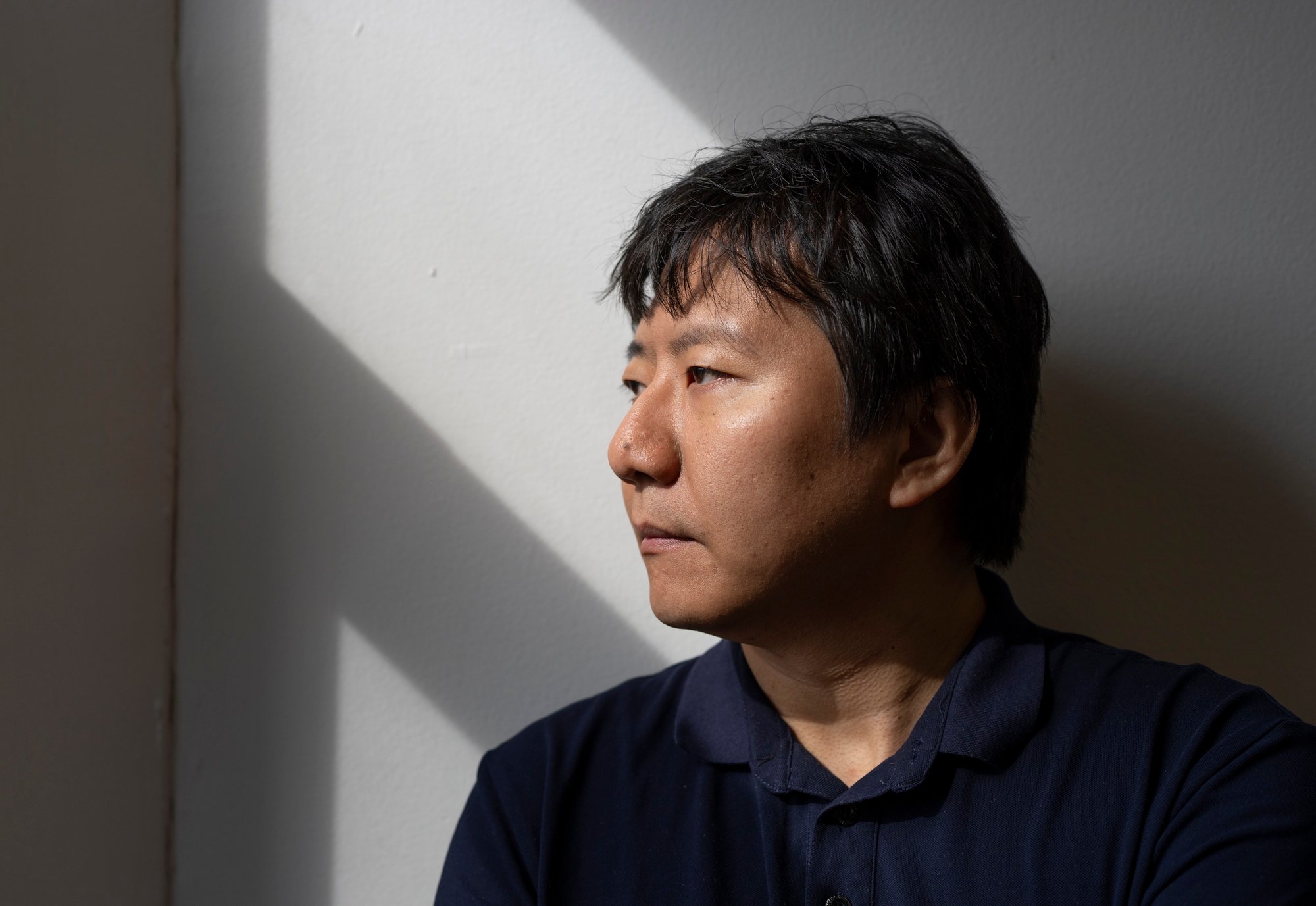
Yu Deng is a mathematician at the University of Chicago. He and collaborators explained why the math of how fluids move looks so different at the microscopic scale.
Mathematicians had tried—and largely failed—for more than a century to formally reconcile how fluids could behave in these two distinct ways. Deng’s award is for changing that. He and his collaborators proved that the equations that describe fluids on different scales are actually one and the same.
“It’s a truly spectacular, singular result,” says Scott Armstrong, a mathematician at N.Y.U. It’s hard to imagine a more deserving recipient, Armstrong adds, and he expects Deng’s mathematical run to continue. “It would have been a disaster had he not won.”
With today’s awards, Deng and Wang have now tripled the total number of Chinese-born Fields Medalists. This reflects China’s decades of investment in math education, which has led to a fresh crop of talented young mathematicians populating the top universities. “I’m working mostly just as myself,” Deng says, “but I’m also happy that I’m one of the first of this new generation to get this recognition.”
John Pardon
If a Fields Medal is an award for the mathematically precocious, it’s hard to imagine a better fit than Pardon. In 2010 he was just a 21-year-old undergraduate at Princeton University when his work in knot theory ensured the entire math world learned his name.
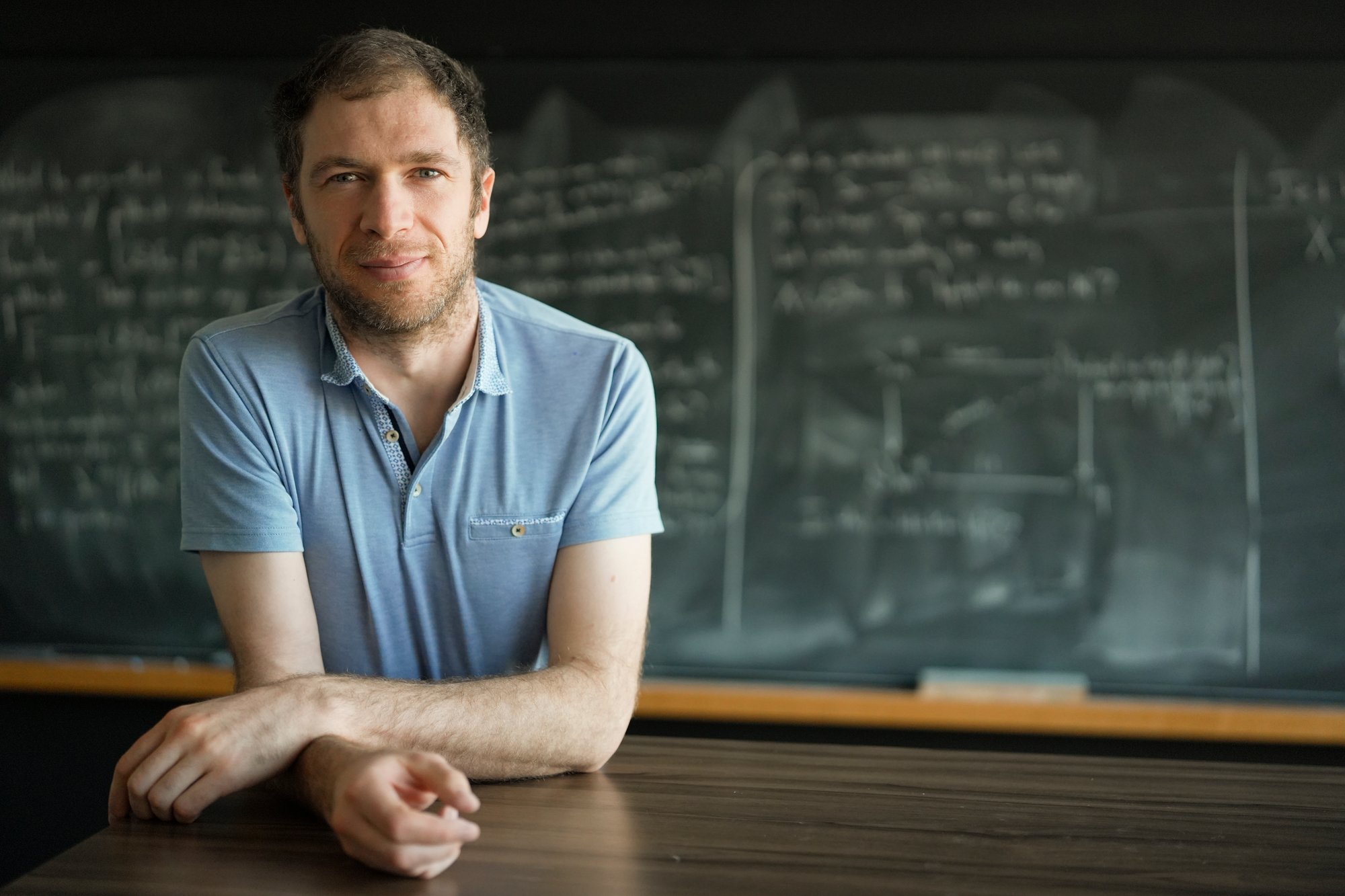
John Pardon is a mathematician specializing in geometry and topology at Stony Brook University. He solved a major conjecture about knots as a Princeton University undergraduate at age 21.
Knot theory is about all the different ways a piece of string can be tied up, with its two loose strands glued together after the tying. These myriad forms are famously difficult to sort—two knotted-up strings might look totally different yet, through elaborate manipulations, be made to match. So mathematicians try to come up with foolproof methods for differentiating them.
One of these is “distortion”: a way of measuring how difficult a knot is to traverse. It gauges how long it would take an ant, for instance, to crawl from one point along the string to another—compared with a grasshopper that could simply leap between them.
“John showed that, for a certain sequence of knots, the distortion became arbitrarily large,” says David Gabai, a mathematician at Princeton. “This simply stated problem attracted much interest among mathematicians during the previous 25 years.”
“I was happy about it,” Pardon recalls of toppling this mathematical Goliath as a mere equation-slinging undergraduate. But in hindsight, he says, he should’ve been even happier. “It’s hard to know at the time how much significance a given solution will have.” This is a sentiment Pardon has experienced many times since: in graduate school and beyond, he went on to conquer other major conjectures covering other areas of geometry.
Jacob Tsimerman
Tsimerman loved math from an age at which most children seem scarcely aware it even exists. “My parents recognized, by the time I was three, that I was super into it,” he says. “I never really considered not being a mathematician.”
His grandfather would give him simple mathematical puzzles to work with, and when his mother noticed his early fascination with negative numbers, she offered him her high school math textbook to thumb through. “It just became like recreation for me, long before it was a career,” Tsimerman says.

Jacob Tsimerman is a mathematician at the University of Toronto. He and collaborators proved the famous André-Oort conjecture, and he made strides in the field of Hodge theory.
In 2021 he and two collaborators proved the André-Oort conjecture, which concerns the field of math that seeks solutions to equations for which all the variables are whole numbers. But this conjecture leaves simple equations and whole numbers behind; it seeks special points on rarified objects called “Shimura varieties,” which are sometimes (but not always) solutions to equations. This is esoteric stuff, but Shimura varieties are hugely important in math today, and the conjecture gives mathematicians an unprecedented handle on their elaborate structure.
“Jacob is a brilliant mathematician,” says his longtime collaborator Jonathan Pila of the University of Oxford. “I have seen his brilliance and resourcefulness at first hand—he is also a very easygoing character.”
The André-Oort conjecture is just one of Tsimerman’s mathematical feats. He’s also made important contributions in “Hodge theory,” an area that relates to one of the seven Millennium Prize Problems—meaning its solution has a $1-million reward.
Although a Fields Medal’s monetary value is modest—just the 14-karat-gold medal itself plus 15,000 Canadian dollars—the prestige it bestows is invaluable. Tsimerman wants to use his share to direct more attention to a new area: artificial intelligence. “I think that there are big changes coming to our world, and I want people to focus on that,” he says. “One of the many scary things about AI is that we don’t really understand the system very well.” Tsimerman hopes pure mathematics can change that.