

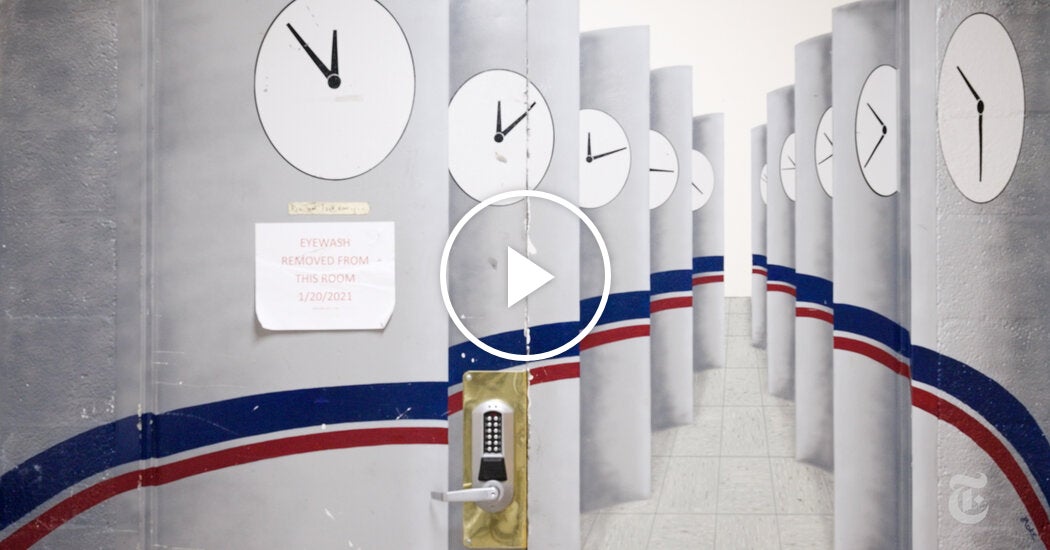
“Three, two, one, go!” When I became a father, my entire relationship to time changed. It’s probably obvious. But back then, it felt profound. While my partner and I tried to make space for bedtimes, naps and pediatrician appointments in our already hectic schedules for our son, it didn’t seem like time had any shape at all. When he learned to talk, it was fascinating to listen to him puzzle out the differences between tomorrow, next week, morning and afternoon. He took each moment as it came. But as he got older, I began to notice that I was always rushing him. One night when he was 5, I was trying to get him to put away his toys and go to bed. He got really upset. When he calmed down, he said that he couldn’t stop playing because the machine inside his body that controls time wouldn’t let him. “The system, like … controls your minute.” “And what is your minute” “Your minute is, like … a bunch of little moments. And then, you … and then the machine puts them all together to make your minute.” “What are those little moments?” “They are little pieces of time.” To accurately measure time, you need to count it. But how do you count something you can’t see or feel or hear? You count something else. In the days and weeks that followed, I couldn’t stop thinking about the machine that controlled my son’s minute. “How much time does it take to ride once around the house? It takes two and a half glasses full.” The more I thought about time, the less I understood what it actually was. And that led me to Colorado. “And little pieces of time.” That’s him trying to make sense of it. “That is an incredibly sophisticated comment. I think what he’s telling me is you can’t blame me. It’s not my fault that the machine counts these seconds and it’s not done yet.” This is the National Institute of Standards and Technology in Boulder, Colo. It’s home to some of the atomic clocks that help set the time standards for the United States and around the world. In other words, they set the time, and we live by it. Tell me what you see, honey. “A rocket lifting off. Bells to tell you what’s happening next. Satellite circling Earth. Delivering. Probably a drone camera.” What do you think this is? “A giant time machine.” Yeah. Remember when I went to the clock place? I learned about this there. It’s a machine for counting time. It’s filled with tiny atoms of something called cesium. Inside an atomic fountain clock, atoms of the element cesium are set into vibration by lasers. These vibrations are so consistent that a clock set by them falls out of sync by less than one second every 100 million years. “Once you agree on how many cycles of something make a second, the rest of it is just counting. That’s what atomic clocks are, a counting process.” For cesium, the vibrations occur 9,192,631,770 times per second, or rather, counting that number of oscillations is how we define a second. There are hundreds of these clocks in labs across the globe. Together, they coordinate standardized time so billions of people hear their clocks strike all at once. “Having everybody do the same thing is liberating. When you go to Safeway, you don’t have to ask them whether they sell apples in Safeway pounds. Making things uniform means you don’t have to think about it.” For nearly all of human history, time was calibrated astronomically. It was regional and fluid. There were thousands of different local times around the world. But then in 1884, representatives from 26 countries gathered to discuss standardizing time on Earth. There was a proposal to carve up the globe into 24 time zones, like slices of a melon. Britain, the world’s most powerful nation at the time, would be at the temporal center. And everyone else would have to set their clocks accordingly. The proposed system would help coordinate shipping routes, unify train timetables and allow colonies to be overseen with the efficiency of a factory floor. By the middle of the 20th century, increasing economic and technological developments demanded more precise timekeeping. And in 1967, another international conference established atomic time, using cesium as the new standard. Today, there are two federal agencies that maintain the atomic clocks in the United States, N.I.S.T. at the Department of Commerce and the U.S. Naval Observatory at the Department of Defense. N.I.S.T. is more concerned with research, safety, business and trade. The military uses clocks for things like satellites and G.P.S. Why do you think we need clocks? “Clocks tell you the time. But there’s different types of time: first, seconds. What comes after? Minutes. What comes after minutes — comes hours.” Why does it matter if they’re all the same, or why would it matter that they all be connected or accurate? “So there’s no argument like, no, I’m right, it’s this time. No, I’m right, it’s this time.” It took decades for some of the ideas proposed in 1884 to become global standards. It happened slowly, incrementally, and not without resistance, including from anti-colonial movements. In Ireland, newspapers published letters calling the adoption of Britain’s Greenwich Mean Time a badge of slavery and an act that stripped Ireland of its national identity. In India, mill workers went on strike to demand the return of Bombay time. By now, the majority of the world’s clocks are set relative to Greenwich Mean Time. But our experience of time remains unruly and impossible to pin down. “There’s a difference between clocks and everyday life. Everyday life is not the same thing as clocks.” Time can bring order to chaos —— “The council will now begin the public comment period. Each speaker is limited to three minutes.” Or contain threats to the status quo. “A hundred and fourteen days later, and we are still debating whether a cease-fire, the bare minimum, the bare minimum, again, should be called. We are at 114 days. And we have been — thousands in the streets of Chicago.” “Thank you very much for your comments. However, your time has expired.” We can lose track of time entirely when in transit and feel every second drag on while we wait. Time can bring great comfort in its structure — or isolate us in our anxiety. “I’m able to get more done in a day than you probably do in a week because of these three stupid, simple time-management hacks.” “Here’s how you can master time management in two minutes.” “Do you want to know a surprisingly simple strategy used by the world’s most successful people to get more done in fewer hours?” “Inhale. We’re going down for five, four, three, two. Hold — up. Five, four, three ——” “And one, two, and three and four and 10. And one and two and three ——” My own relationship to time is often one of scarcity. I’m always chasing it, wishing I had more. For my son, though, time is still elastic, expansive, full of possibility. But as he gets older, I watch his relationship to time change. He counts to 60 when I tell him I’ll be off the phone in a minute. Keep going. You got it. He knows what it means to be late and early. Because he has to be at school at 8:25 every morning, we’re often rushing him out the door. Yet there’s something wonderfully untamed about him. He’s still guided by his internal machine, his own understanding of time. He gets the system enough to play along, but hasn’t surrendered to it. I hope he never does. Do you think that Mom and I rush you a lot? “Yeah, sometimes.” What does that feel like? “It feels like rushing, tired because you keep rushing me.” Yeah. Do you not like rushing? “Yeah.” Yeah. “I would say just take your time. But if you’re late, you should just go fast. But still take your time.” OK, that’s good to know. Thanks, honey. You want some ice cream? “Yeah.”