

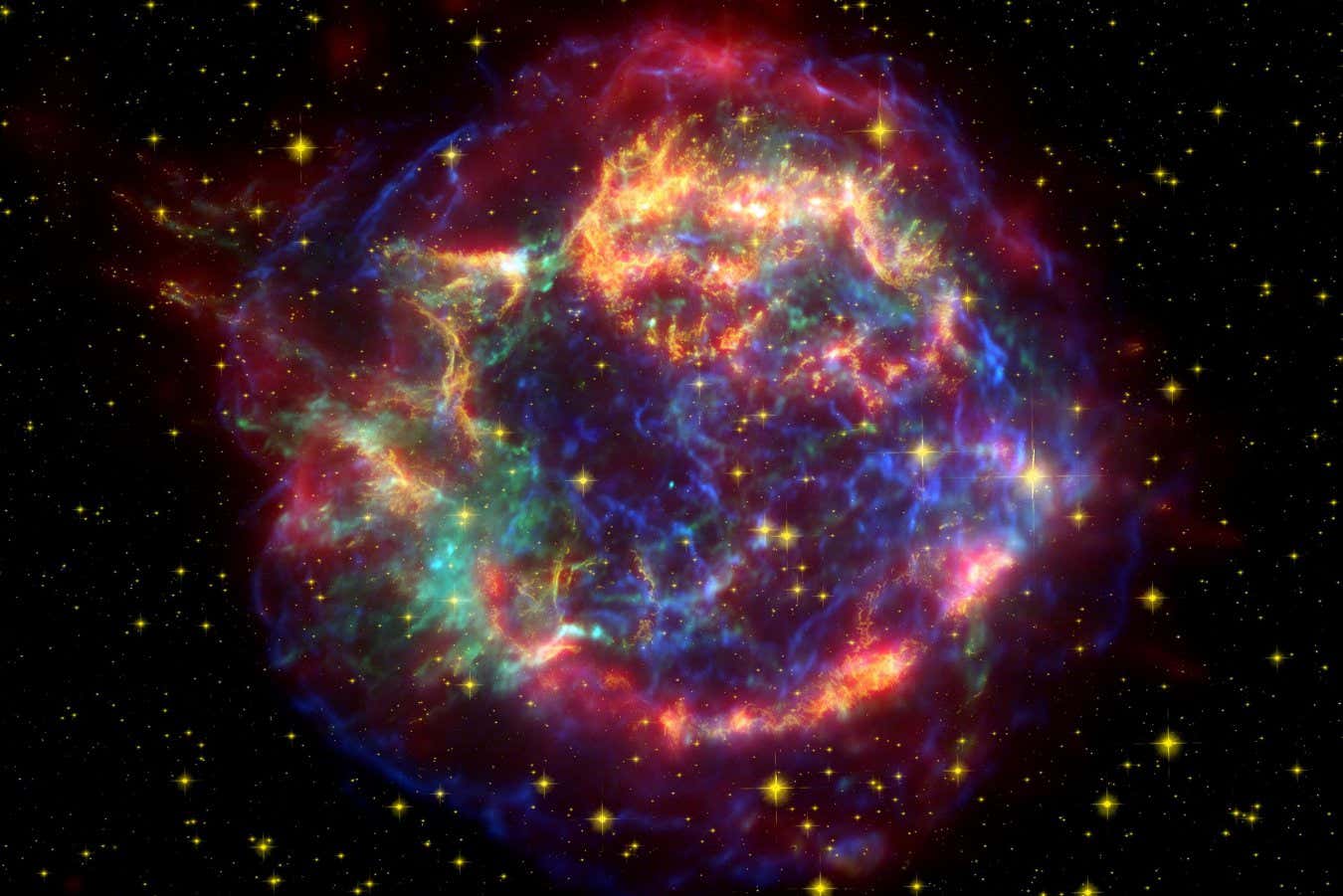
The supernova remnant Cassiopeia A
NASA/JPL-Caltech/O. Krause (Steward Observatory)
Hidden within Cassiopeia A, the youngest known exploded star in our galaxy, astronomers have found surprisingly high levels of chlorine and potassium. These elements carry an odd number of protons in their atomic nuclei, and though they are thought to be less abundant in the universe, they are essential for planet formation and for living systems. This means the Cassiopeia A finding could have implications for where alien life might be found in the Milky Way.
Exploded stars – supernova remnants – contain plenty of elements, like oxygen and magnesium, with an even number of protons in their nuclei. The nuclei with odd numbers of protons – those belonging to “odd-Z” elements – are inherently less stable and so are less likely to be produced during stellar fusion. This is reflected in models of our galaxy’s chemical evolution, which generally predict very low levels of odd-Z elements.
“[As a result] the origins of these odd-Z elements have long been uncertain,” says Kai Matsunaga at Kyoto University, Japan.
Matsunaga and his colleagues realised that high-resolution X-ray spectroscopy could be a step towards solving the puzzle. In the intense heat of a supernova remnant, atoms lose electrons and emit distinct X-ray fingerprints that a sensitive detector can pick up. The X-Ray Imaging and Spectroscopy Mission (XRISM), launched in September 2023, is a suitably sensitive detector, and it observed Cassiopeia A twice in December 2023.
To estimate how much of each element was present, the researchers compared the faint signals from odd-Z elements with stronger signals from even-Z elements like sulphur and argon, using them as steady reference points to get a more accurate reading on the odd-Z elements.
The results show that the Cassiopeia A supernova produced far more chlorine and potassium than standard models predict. This suggests that theorists may need to rethink how massive stars forge these rare elements, as some widely used models don’t match the specific conditions in Cassiopeia A.
“Although the authors highlight that their observations conflict with previous models, the picture is more nuanced,” says Stan Woosley at the University of California Santa Cruz, who wasn’t involved in the study. “It’s not that all our models are wrong. Some work better than others, and a few agree reasonably well. The main thing is that these observations give astronomers new, concrete information to improve models and better understand what happens when a massive star explodes.”
The new measurements also allowed Matsunaga and his colleagues to begin testing some of the long-standing theories about how odd-Z elements might form in massive stars – through stellar rotation, the interaction between pairs of binary stars, or the merging of different burning layers deep inside the star. Until now, there was no way to check these theories against real data.
“We still do not have a full understanding of which type of stars contributed to [this] galactic inventory,” says Katharina Lodders at Washington University in St. Louis, Missouri, who wasn’t involved in the study. “Especially the origins of chlorine – an element abundant in our oceans.”
If these findings hold true in other supernova remnants, they could also reshape how we think about the distribution of life-essential elements across the Milky Way. Some regions may be better supplied with the ingredients for life than others, depending on which stars seeded their planets – which might suggest that any alien life is spread unevenly through our galaxy.
“It’s certainly possible,” adds Matsunaga, “but we cannot say for sure based on the current results.” It’s unclear whether Cassiopeia A is an oddity in producing such high quantities of odd-Z elements, he says, or whether it is representative of supernovae remnants generally. “Future observations of other supernova remnants with XRISM or upcoming instruments will be crucial for addressing this question.”

The world capital of astronomy: Chile
Experience the astronomical highlights of Chile. Visit some of the world’s most technologically advanced observatories and stargaze beneath some of the clearest skies on earth.
Topics: