
Close Menu
    Trending
    • Opinion | Is This the End of Close Elections?
    • Your Appearance Speaks Before You Do. What Is Yours Saying?
    • We may finally know why dinosaurs like T. rex evolved tiny arms
    • Ciara Miller Unloads In ‘Summer House’ Reunion Trailer
    • Trump purges another Republican critic with Massie defeat in Kentucky
    • US Senate advances resolution to curb Trump’s power to wage war on Iran | US-Israel war on Iran News
    • WR Rashee Rice’s jail stint, surgery create more concerns for Chiefs offense 
    • AI Startup Chronicle Has a New Way to Find the Next Big Thing
    Benjamin Franklin Institute
    Wednesday, May 20
    • Home
    • Politics
    • Business
    • Science
    • Technology
    • Arts & Entertainment
    • International
    Benjamin Franklin Institute
    Home»Science»Odd “butterfly” molecule could lead to new parts of the quantum realm
    Science

    Odd “butterfly” molecule could lead to new parts of the quantum realm

    Team_Benjamin Franklin InstituteBy Team_Benjamin Franklin InstituteMay 20, 2026No Comments3 Mins Read
    Share Facebook Twitter Pinterest Copy Link LinkedIn Tumblr Email VKontakte Telegram
    Share
    Facebook Twitter Pinterest Email Copy Link


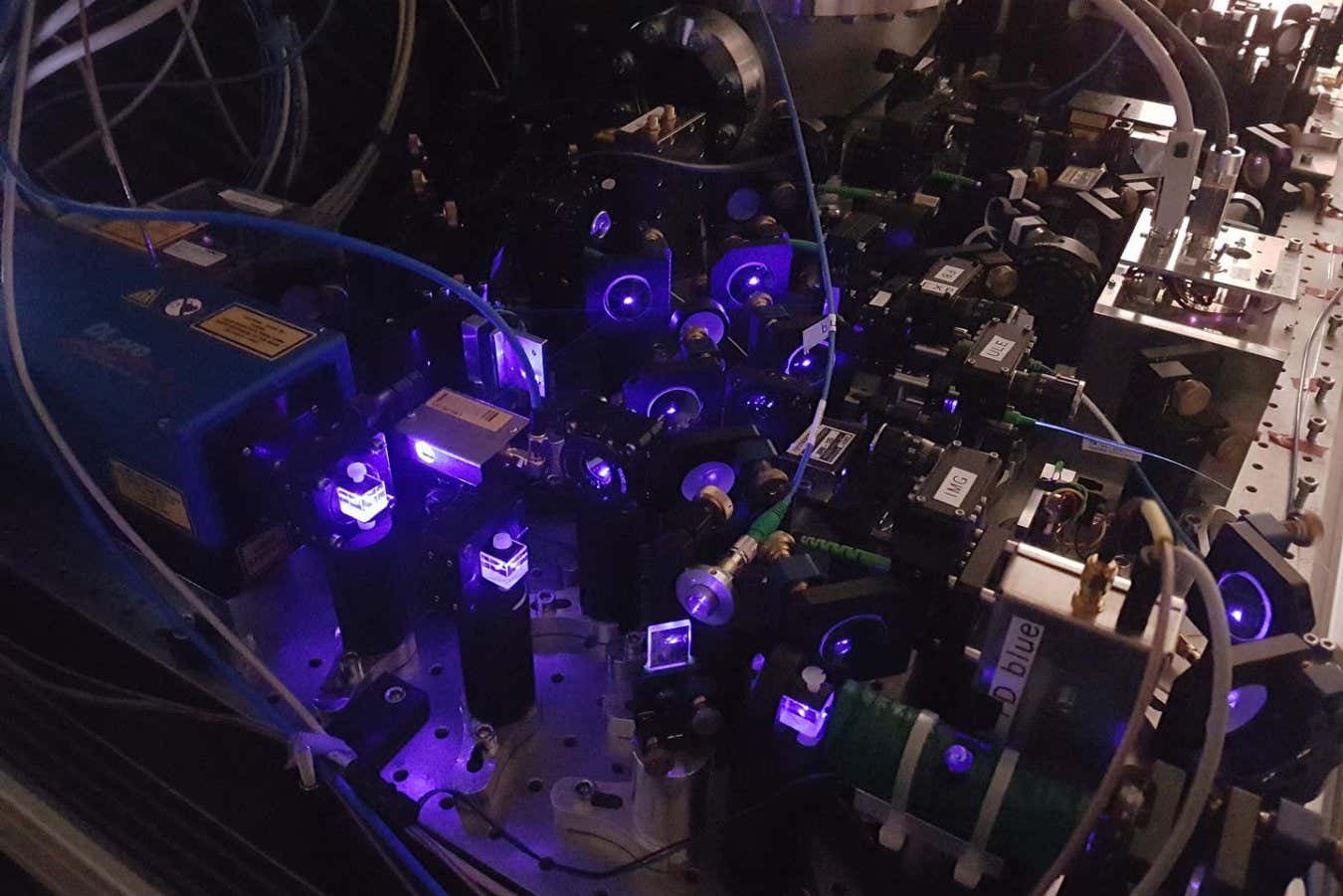
    A laser system used to create butterfly molecules

    Prof. Herwig Ott

    A large, cold molecule that resembles a butterfly, with “wings” made from electrons, has been made for the first time, completing the search for a “zoo” of similar molecules. The result could provide a gateway to completely new parts of the quantum realm.

    Herwig Ott at RPTU University Kaiserslautern-Landau in Germany and his colleagues made the molecule by cooling rubidium atoms to a few millionths of a degree above absolute zero by using lasers and electromagnetic forces. The researchers then used lasers again to make some atoms very large by pushing their outermost electron very far from their nuclei. The quantum properties of atoms that have been cooled and enlarged in this way can be precisely manipulated with lasers, which the team leveraged to move a giant atom’s electron towards a normal-sized rubidium atom, binding them together to create a new type of molecule with extreme properties.

    Each molecule was about 25 nanometres in size – bigger than the diameter of a DNA strand that contains billions of atoms – and thousands of times more responsive to electric fields than most molecules. The shape of the new molecule was determined by its electrons, with the outermost being spread out in space in a shape that resembles the wings of a butterfly.

    Ott says that tuning the lasers just right to get molecules with this exact configuration was tricky – it took weeks of tweaking before the team successfully created them in the lab. Ott compares the process to searching for an object on a road by inspecting 1 millimetre at a time while standing a kilometre away.

    Team member Matthew Eiles at Purdue University in Indiana says the work is a culmination of several past mathematical and experimental studies that helped narrow down this search. Based on mathematical models, researchers have spent 20 years searching for a “zoo” of giant ultracold molecules ought to exist, and the new butterfly is the last one to be discovered, he says.

    At the same time, this experiment opens a path towards creating more exotic and elusive ultracold molecules, including those that could be very heavy in addition to being very large and charged, says Michał Tomza at the University of Warsaw in Poland. Weibin Li at the University of Nottingham in the UK says the butterfly molecule was difficult to create but could now be used as precursor for making something even more difficult – ultracold atoms with negative charge, or anions. If made ultracold, anions could be used in tests of fundamental laws of particle physics or antimatter studies, but standard cooling methods have failed to chill them so far.

    Eiles and Ott have already mathematically investigated exactly how to use the butterfly molecule to create ultracold anions and hope to see the first signs of them within just a few years. “The theory is already written,” says Eiles.

    Topics:

    • quantum physics/
    • ultracold


    Source link

    Share. Facebook Twitter Pinterest LinkedIn Tumblr Email Telegram Copy Link

    Related Posts

    Science

    We may finally know why dinosaurs like T. rex evolved tiny arms

    May 20, 2026
    Science

    Solar farm on the ocean outperforms land-based solar in Taiwan

    May 19, 2026
    Science

    Wind-assisted cargo ships could more than halve shipping emissions

    May 19, 2026
    Science

    Colossal claims an artificial eggshell will help it bring back the moa

    May 19, 2026
    Science

    How I used psychology to come back from the worst year of my life

    May 19, 2026
    Science

    What is love? Even a meeting on the subject can’t find the answer

    May 19, 2026
    Editors Picks

    Opinion | Why Texas Is Winning the Housing War

    April 29, 2026

    Iran foreign minister met IAEA chief ahead of nuclear talks

    February 16, 2026

    Test your brain on these mind-bending scientific riddles

    December 13, 2025

    Australian soldier charged with war crimes vows to clear his name

    April 19, 2026

    Dodgers’ Roberts defends Ohtani’s special treatment after backlash

    April 10, 2026
    About Us
    About Us

    Welcome to Benjamin Franklin Institute, your premier destination for insightful, engaging, and diverse Political News and Opinions.

    The Benjamin Franklin Institute supports free speech, the U.S. Constitution and political candidates and organizations that promote and protect both of these important features of the American Experiment.

    We are passionate about delivering high-quality, accurate, and engaging content that resonates with our readers. Sign up for our text alerts and email newsletter to stay informed.

    Latest Posts

    Opinion | Is This the End of Close Elections?

    May 20, 2026

    Your Appearance Speaks Before You Do. What Is Yours Saying?

    May 20, 2026

    We may finally know why dinosaurs like T. rex evolved tiny arms

    May 20, 2026

    Subscribe for Updates

    Stay informed by signing up for our free news alerts.

    Paid for by the Benjamin Franklin Institute. Not authorized by any candidate or candidate’s committee.
    • Privacy Policy
    • About us
    • Contact us

    Type above and press Enter to search. Press Esc to cancel.