

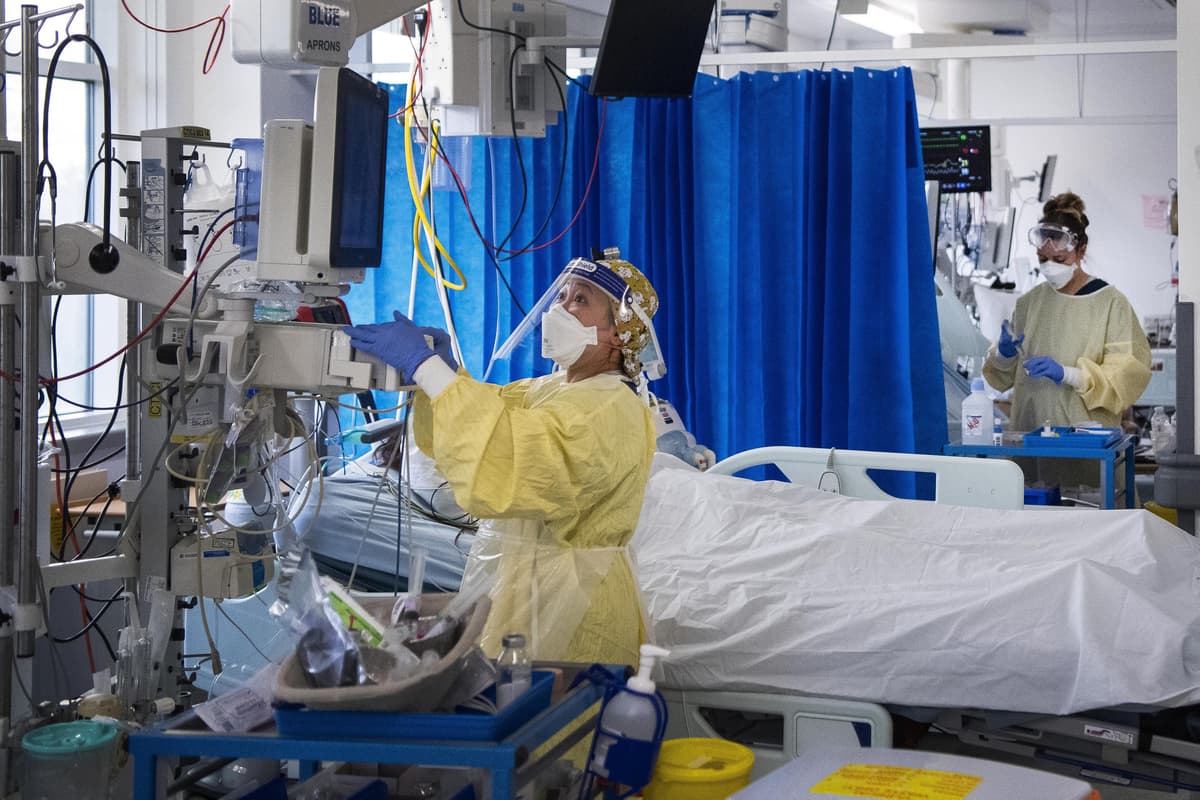
Released today, the latest segment of the Covid-19 inquiry report investigated the impact of the pandemic on UK health systems.
Its findings suggest the NHS was not only tested but also ill-prepared, plunging it into a precarious state amid the demands of the pandemic.
In the years leading up to the pandemic, NHS budgets had been tightly squeezed, leaving systems struggling to cope with a surge of patients desperately seeking help.
Here are the key takeaways of today’s report.
Nurses caring for Covid-19 patients in the Intensive Care Unit (ICU) in St George’s Hospital in Tooting, south-west London in July 2021
PA
1. The NHS came close to collapse
According to the inquiry, “healthcare systems were overwhelmed and came close to collapse” as health care facilities almost buckled under the pandemic strain.
The NHS only got through the pandemic thanks to the “extraordinary efforts of all those working in healthcare across the UK”.
Baroness Hallett DBE, who shared an opening statement for the inquiry, described the UK response as “we coped, but only just”.
2. Paused cancer screenings led to deaths
With hospitals overwhelmed, other healthcare services suffered during the pandemic.
Among them were cancer screening services, which were paused in parts of the UK, leading to a “steep drop in diagnosis in 2020”.
The report says: “Missed and late diagnoses and longer waits for treatment for colorectal cancer during the pandemic resulted in loss of life and increased mortality rates.”
The backlog for screenings and cancer diagnoses varied significantly across the UK, adding to “lengthy waiting lists”.
3. Politicians were ‘reluctant to accept’ the NHS was ‘overwhelmed’
In an opening statement by Baroness Hallett, one observation was the reluctance among politicians to accept the reality unfolding in UK healthcare settings.
She also named Matt Hancock, the Health Secretary at the time.
“Politicians, including the Secretary of State for Health and Social Care, Matt Hancock, were reluctant to accept that healthcare systems were ‘overwhelmed’, as they chose this to mean total collapse,” she said.
Baroness Hallett continued: “In my view, it is a question of semantics. Whatever word one chooses, healthcare systems were placed under intolerable strain.”
4. London reported ‘CRITCON 4’ four times in early pandemic
Hospitals were required to report their CRITCON level during the pandemic to monitor the strain under which hospitals are placed.
CRITCON 4 is the highest level, “emergency”, which describes situations higher than “unprecedented” and “full stretch”.
According to the report: “CRITCON 4 means essentially the whole [intensive care] system can’t offload …
nowhere is full until everywhere is full – nowhere is overwhelmed, rather, until everywhere is overwhelmed.”
However, it’s unclear whether there may have been discrepancies in initial reporting, with some people stating overwhelmed facilities may not have reported CRITCON 4, while others did so by mistake.
The report says: “The Inquiry was told that NHS England believed several of the CRITCON 4 declarations in Figure 17 had been made in error.”
5. Women and ethnic minorities in the NHS less likely to have access to fitting masks
Women and ethnic minority staff were less protected against contracting Covid-19, according to the report. This is reportedly because they had “less opportunity” to get appropriate FFP3 masks while working compared to their “white, male colleagues”.
According to the report, “given the large percentage of female and ethnic minority healthcare workers working in
the NHS and the lack of access to FFP3 masks that were designed to fit their facial shapes, women and ethnic minority healthcare workers were more likely to be left inadequately protected.”
About 45 per cent of the NHS workforce in London comes from ethnic minority backgrounds.
More broadly, there were also higher mortality rates among ethnic minority groups, with Sir Christopher Whitty adding this was “largely to do with where the waves were at their worst. So in the first wave, London, which has a large proportion of the British black population, and the second wave, the Midlands, where a higher proportion of the British Asian population live.”
6. London hospital capacities prompted the launch of Nightingale hospitals
Shortly before the first lockdown, there was already concern that London would be the first UK city to exceed hospital capacity.
London had 800 intensive care beds at the time, but modelling projected around 4,000 would be needed.
“While it was anticipated that the other surge measures examined in this chapter would help to increase intensive care capacity, it was obvious that this capacity needed to be increased yet further,” the report reads, prompting early discussions about the establishment of the Nightingale hospitals.
7. Stay at home advice deterred people from seeking medical attention
The report also claims people were “deterred from accessing healthcare”, in part due to public messaging.
Although the “stay at home” advice shared with the public during the pandemic was “intended to keep them safe,” the report says a lot of people “did not want to ‘overburden’ the NHS”.
This may indicate that messaging was confusing to some and “inadvertently sent the message that healthcare was closed”.
8. London nursing ratios stretched during pandemic
Highlighting not only the incredible resilience of nursing staff but also the sheer pressure under which they were placed, the inquiry shows that nursing ratios were stretched dramatically during the pandemic.
A number of London hospitals had to stretch their nursing ratios during the pandemic, with the Queen Elizabeth Hospital operating with one nurse to every four patients.
Meanwhile, in the Royal London Hospital (Barts Health NHS Trust), the radio stretched to one nurse for every five patients, while some intensive care units “reached one specialist care nurse to six mechanically ventilated patients”.
9. ‘Terrible trade-offs were required’
The report also highlights that, given the amount of Covid-19 cases, “terrible trade-offs were required,” such as stopping people from visiting loved ones at the end of their lives.
This has had a “devastating impact on bereaved family members”.
The report added: “This was a particular issue in the early stages of the pandemic, where restrictions meant that many patients died without the comfort of being surrounded by their loved ones and were deprived of the opportunity
to say goodbye.”