

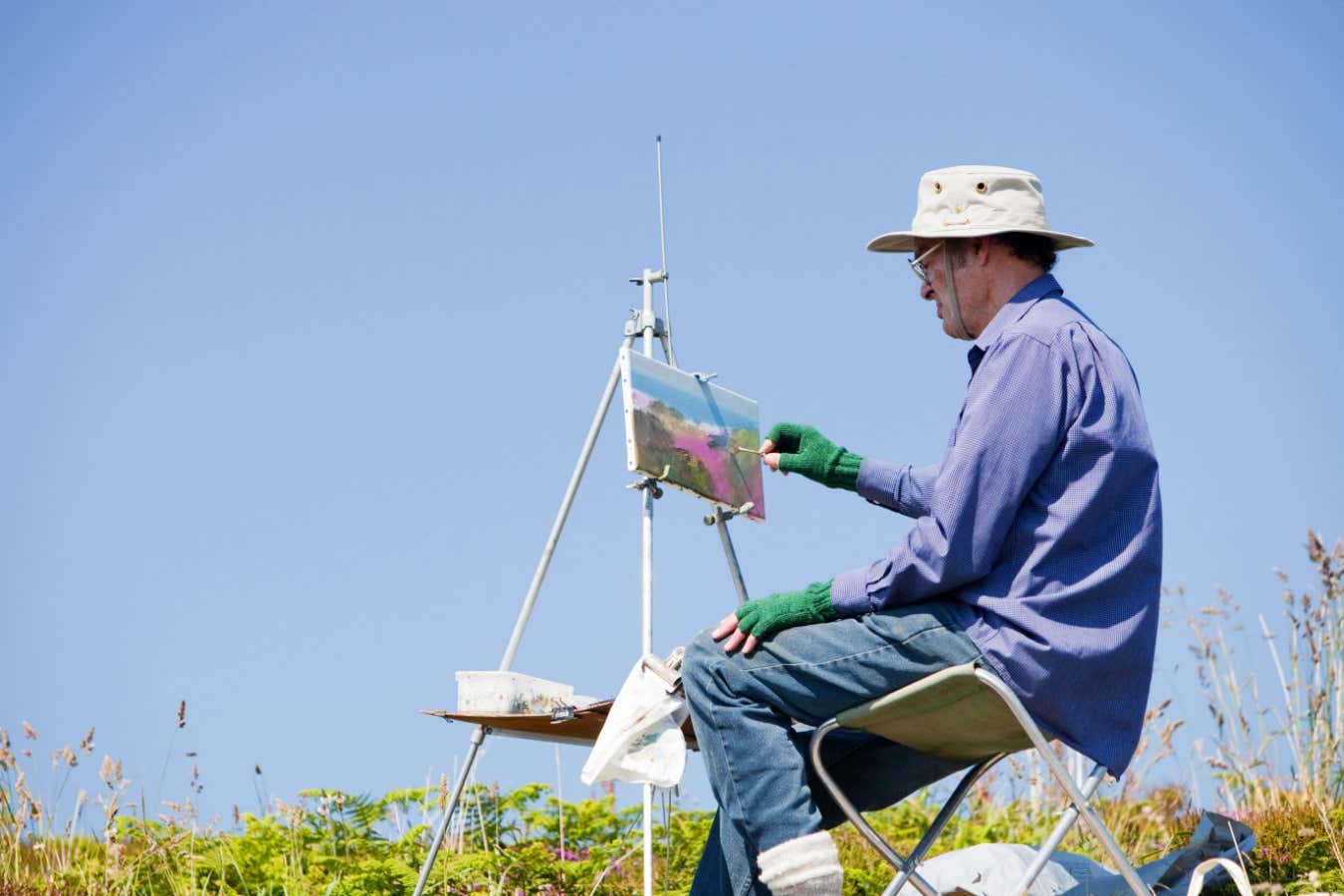
Taking time to paint in Cornwall, UK
Ashley Cooper/Alamy
Russell stood with his hand on the door, wondering whether to go in. It just wasn’t his scene. He was only here because his doctor had told him to come.
It had started with a stroke. He’d been walking home from work when the blood supply to the base of his brain became blocked and the world careened sideways. He’d had to relearn to walk, to talk. There had been months lying in bed staring at the ceiling and panicking about his future. He’d developed back pain so bad he couldn’t sit up. He’d lost his job, his relationship with his partner fell apart, he couldn’t play with his son any more, he put on weight, he couldn’t sleep. When he did sleep, his breathing kept stopping, so he had to wear a mask over his head at night, blowing air into his lungs to keep his airways open. His doctors prescribed dozens of pills, but new problems kept accumulating. He felt himself spiralling down into depression.
When his doctor first wrote the prescription for eight weeks of art classes, Russell thought for a moment it was some sort of joke. How was art supposed to help? But he didn’t feel he had anything to lose any more, so he opened the door.
The first class wasn’t as bad as he’d expected. He didn’t paint, just watched the others in the class. But somehow just being around the paints, the colours, and the calming atmosphere had an impact, and on his way home he noticed his breathing was slower and deeper and he felt a bit calmer than he had walking in. The next week wasn’t as daunting. He recognised a few of the other people. Again, he didn’t do any art. But that night he couldn’t sleep, so he snuck outside and sat in the shed in the garden, doodling little caricatures of the people in the art group. In the third class, he picked up a paintbrush. Russell’s still not sure how things escalated so rapidly after that, but a few weeks later, he found himself standing in front of the art group to announce an idea he’d had: to paint portraits of them all.
I first met Russell at 6 a.m. in the basement cafeteria of a Premier Inn in Manchester. We were both waiting to go on television for the BBC Breakfast news show to talk about a new proposal to roll “arts on prescription” across the National Health Service. Over cups of instant coffee, I tried to grasp the magnitude of the experience he was telling me about.
At the next check-up, Russell explained, his doctor was pleased with his progress. His mood had improved and his pain levels were lower. Even his blood pressure was better. The art class gave structure to his week, and he found himself looking forward to it. At the following check-up they started to review his medications the doctor didn’t feel he needed as many. His sleep was better too.
As his portraits neared completion, Russell approached the Museum of Gloucester to ask if they would allow him to host an exhibition of the paintings in their café. He called the exhibition “We’re All Mad Here”. His classmates and his doctor were amongst those who attended. He received his first commission shortly afterwards – a nurse who had come to the exhibition wanted him to paint her children. That was just the beginning.
In the decade since, Russell Haines has exhibited his artwork all around the UK, from Gloucester Cathedral to the Tower of London. His pieces sell for thousands of pounds (if you can get your hands on one fast enough). He’s been leading his own classes back in the community too, and his doctor has been referring more patients to him. He doesn’t take any pills nowadays. He hasn’t even had to visit his doctor in over a year.
I asked him, “How great a change do you think those art classes actually made for you? How big of an impact are we talking?”
He didn’t miss a beat.
“They saved my life.”
This is an extract from Daisy Fancourt’s Art Cure: The science of how the arts transform our health (Cornerstone Press), the March read for the New Scientist Book Club. Sign up to read along with us here
Topics: