
Close Menu
    Trending
    • When is London Marathon 2026? Start time and how to watch race for FREE
    • Pentagon Requests $54 Billion For AI War
    • Clavicular Hit With New YouTube Crackdown
    • Beijing’s new supply chain rules deepen concerns for US firms in China
    • India denounces ‘hellhole’ remark shared by Trump | Donald Trump News
    • New photos of Mike Vrabel and Dianna Russini emerge
    • AI search demands a new audience playbook
    • How do earthquakes end? A seismic ‘stop sign’ could help predict earthquake risk
    Benjamin Franklin Institute
    Friday, April 24
    • Home
    • Politics
    • Business
    • Science
    • Technology
    • Arts & Entertainment
    • International
    Benjamin Franklin Institute
    Home»Science»New fibre optic record allows 50,000,000 movies to be streamed at once
    Science

    New fibre optic record allows 50,000,000 movies to be streamed at once

    Team_Benjamin Franklin InstituteBy Team_Benjamin Franklin InstituteApril 1, 2026No Comments3 Mins Read
    Share Facebook Twitter Pinterest Copy Link LinkedIn Tumblr Email VKontakte Telegram
    Share
    Facebook Twitter Pinterest Email Copy Link


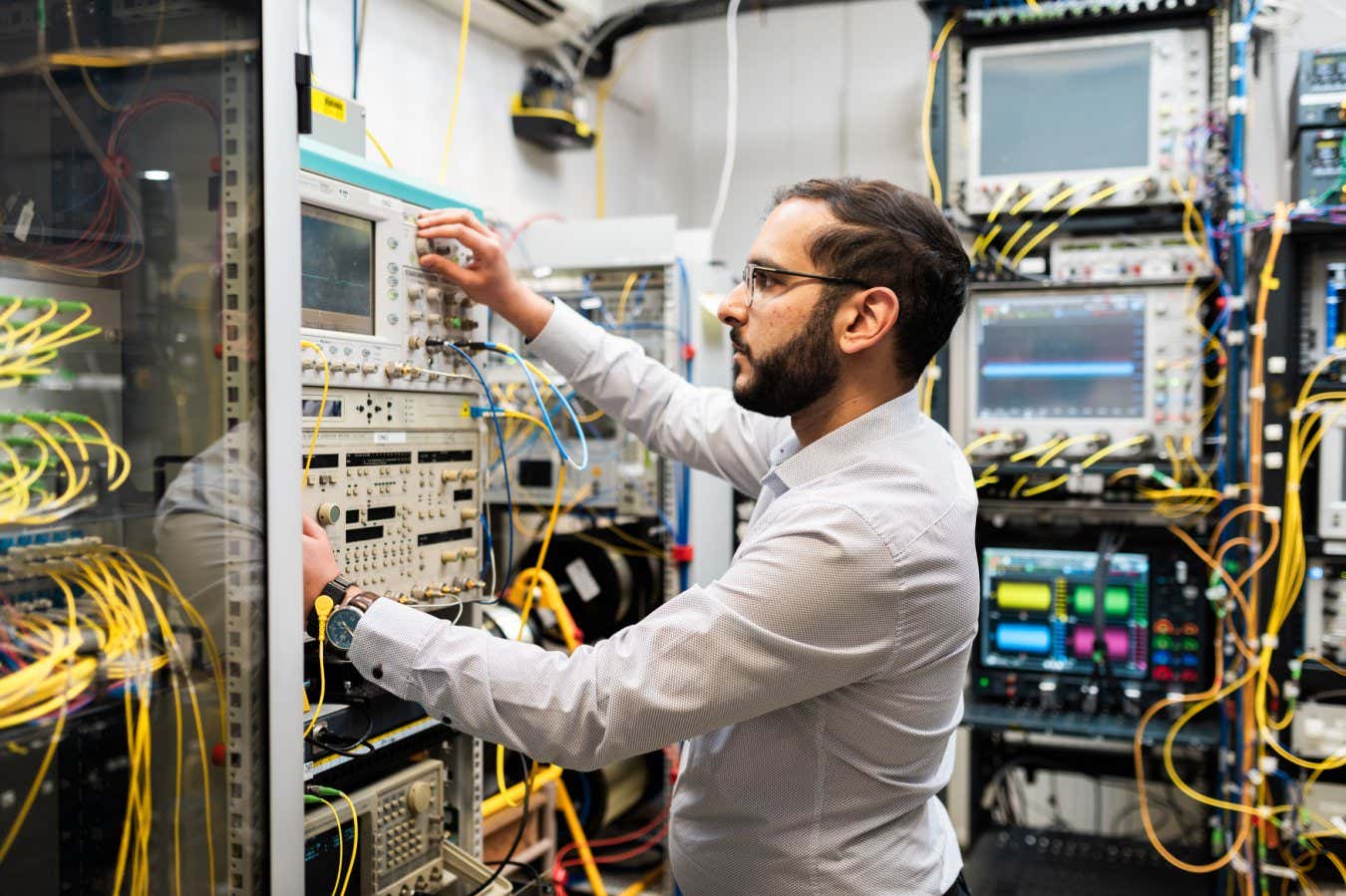
    Team member Ronit Sohanpal works on the high-speed data transmission set up

    UCL

    A new speed record has been set for data transmission through an existing, commercially-installed fibre optic cable, with 450 terabits per second – or 450,000,000,000,000 bits per second – being beamed through a pair of cables underneath London’s busy streets.

    Polina Bayvel at University College London and colleagues achieved the record using existing fibre optic cables running from their laboratory in Bloomsbury to a data centre in Canary Wharf, then back again. That rate of data transmission would be enough for around 50 million movies to be streamed simultaneously.

    Bayvel says that the record achieved a data rate around ten times faster than is seen in current commercial networks, meaning that if it was rolled-out widely we could see an increase in internet bandwidth equivalent to adding nine new cables alongside each existing one, but without having to go through the cost or inconvenience of installing a single metre more cable.

    Such a leap in data transfer rates might be so large that human users of the internet can’t make use of it all, but that the AI boom could certainly take advantage of it. “There’s only a certain amount of data that anyone could process – you can only watch so many movies,” she says. “But AI infrastructure is generating a lot of data, and that data is is spewing into the network.”

    The record was set thanks to custom-designed hardware developed which allowed data to be sent in a wide spectrum of frequencies – from 1264 nanometres to 1617.8 nanometres – that far exceeds what is used in commercial networks today. These different frequencies required various new approaches to correct differing amounts and types of distortion, as laser pulses encounter different refractive indexes inside fibre optic cables at different intensities.

    Faster speeds have been achieved before in highly regulated experiments, but this work crucially used existing cables which have been heavily used, have dirty connectors, sit underneath a bustling city full of traffic and noise, and represent a real-world test that shows it could be rolled-out on existing infrastructure. The researchers say that commercial roll-out could happen within five years.

    Kerrianne Harrington at the University of Bath says that there are two streams of research in fibre optics: squeezing more bandwidth out of the cables that have already been deployed at great cost, and developing new types of cable that will remove some of the bottlenecks of that technology.

    “The interesting thing about this work is it’s using what’s already in the ground, which is the expensive thing to change,” says Harrington. “I do think it’s a very practical approach to the problem. I would say that the work that’s shown in this paper has a more immediate benefit to increasing capacity than new fibres.”

    Topics:


    Source link

    Share. Facebook Twitter Pinterest LinkedIn Tumblr Email Telegram Copy Link

    Related Posts

    Science

    How do earthquakes end? A seismic ‘stop sign’ could help predict earthquake risk

    April 24, 2026
    Science

    ‘Kraken’ fossils show enormous, intelligent octopuses were top predators in Cretaceous seas

    April 24, 2026
    Science

    Largest ever octopus was great white shark of invertebrate predators

    April 24, 2026
    Science

    Do you need to worry about Mythos, Anthropic’s computer-hacking AI?

    April 23, 2026
    Science

    How many dachshunds would it take to get to the moon?

    April 23, 2026
    Science

    The Age Code review: Can you slow ageing with your diet? A new book gives it a go

    April 23, 2026
    Editors Picks

    Cowboys pulled petty move on Trevon Diggs days before releasing him

    January 2, 2026

    Global treaty is failing to curb ultra-potent HFC-23 greenhouse gas emissions

    January 5, 2025

    Storylines for the Valero Texas Open: Rickie Fowler’s Masters Hail Mary

    April 1, 2026

    Opinion | The Growing Scandal of $TRUMP

    May 28, 2025

    John Harbaugh has massive demands for accepting next HC job

    January 10, 2026
    About Us
    About Us

    Welcome to Benjamin Franklin Institute, your premier destination for insightful, engaging, and diverse Political News and Opinions.

    The Benjamin Franklin Institute supports free speech, the U.S. Constitution and political candidates and organizations that promote and protect both of these important features of the American Experiment.

    We are passionate about delivering high-quality, accurate, and engaging content that resonates with our readers. Sign up for our text alerts and email newsletter to stay informed.

    Latest Posts

    When is London Marathon 2026? Start time and how to watch race for FREE

    April 24, 2026

    Pentagon Requests $54 Billion For AI War

    April 24, 2026

    Clavicular Hit With New YouTube Crackdown

    April 24, 2026

    Subscribe for Updates

    Stay informed by signing up for our free news alerts.

    Paid for by the Benjamin Franklin Institute. Not authorized by any candidate or candidate’s committee.
    • Privacy Policy
    • About us
    • Contact us

    Type above and press Enter to search. Press Esc to cancel.