
Close Menu
    Trending
    • India denounces ‘hellhole’ remark shared by Trump | Donald Trump News
    • New photos of Mike Vrabel and Dianna Russini emerge
    • AI search demands a new audience playbook
    • How do earthquakes end? A seismic ‘stop sign’ could help predict earthquake risk
    • Trump Announces Cease-Fire Between Israel and Lebanon
    • Google Is Tracking Your Life – Photo Cloud Feeding AI System
    • Rachel Zoe Confronts Amanda Frances In ‘RHOBH’ Reunion Clip
    • China’s DeepSeek says it released long-awaited new AI model
    Benjamin Franklin Institute
    Friday, April 24
    • Home
    • Politics
    • Business
    • Science
    • Technology
    • Arts & Entertainment
    • International
    Benjamin Franklin Institute
    Home»Science»Neanderthal infants were enormous compared with modern humans
    Science

    Neanderthal infants were enormous compared with modern humans

    Team_Benjamin Franklin InstituteBy Team_Benjamin Franklin InstituteApril 16, 2026No Comments4 Mins Read
    Share Facebook Twitter Pinterest Copy Link LinkedIn Tumblr Email VKontakte Telegram
    Share
    Facebook Twitter Pinterest Email Copy Link


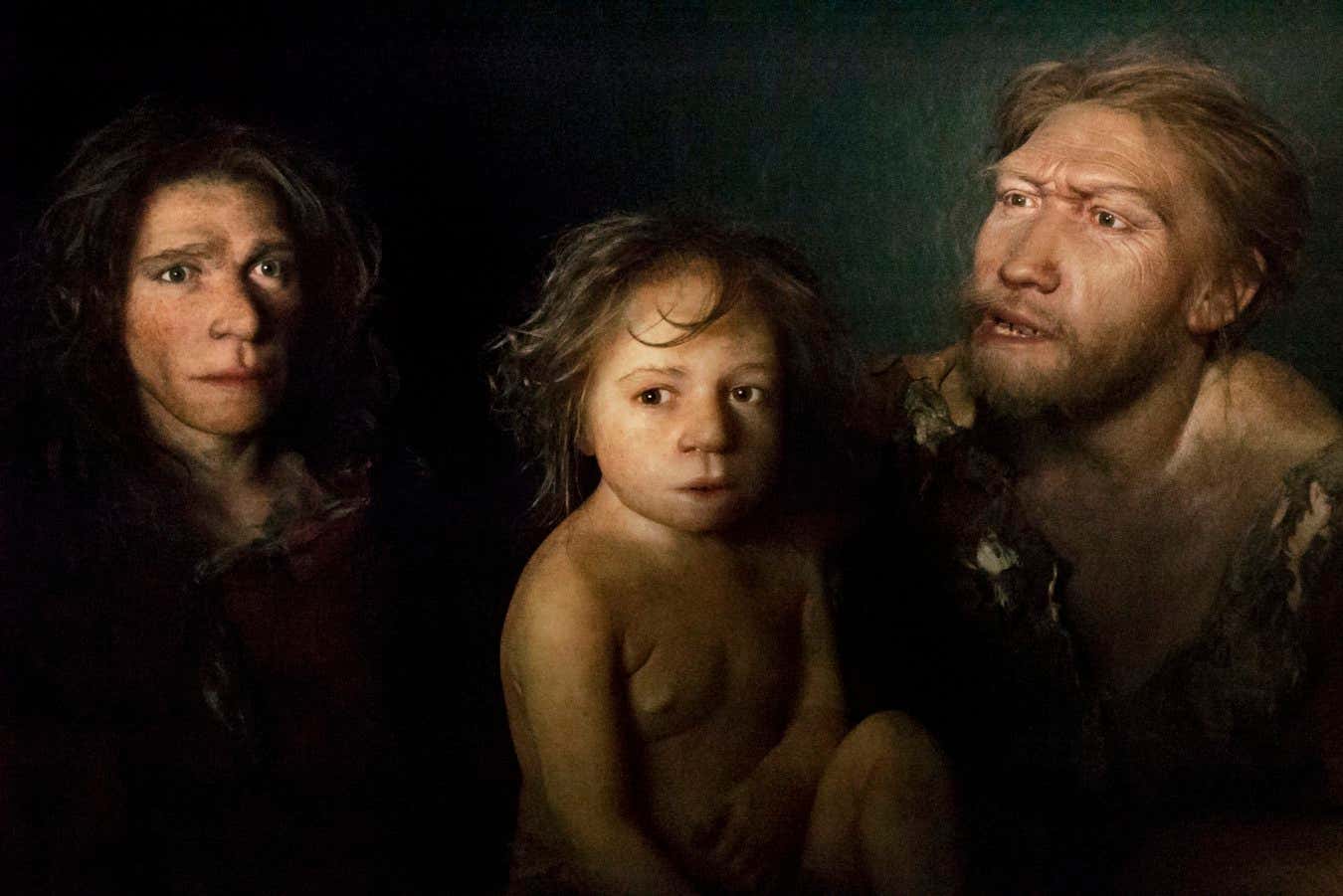
    Reconstruction of a family of Neanderthals

    P.PLAILLY/E.DAYNES/SCIENCE PHOTO LIBRARY

    Neanderthal babies may have physically dwarfed their Homo sapiens counterparts, according to a new study that examined an infant skeleton of one of our ancient hominin relatives.

    “We cannot say how advanced Neanderthal babies were in their behaviour,” says Ella Been at Ono Academic College in Israel. “We do not know whether they started walking at a different time than modern human babies do.” But, she says, they were big and “not necessarily chubby”.

    Been and her colleagues conducted a detailed anatomical analysis of the almost-complete skeleton of a Neanderthal baby who lived in what is now Israel sometime between 51,000 and 56,000 years ago.

    The infant, known as Amud 7, was discovered in a cave 4 kilometres from the western shore of the Sea of Galilee in Israel in 1992. Their sex cannot be determined. Amud 7 is one of only a handful of young Neanderthals that have ever been recorded.

    Neanderthals were the dominant species of hominin throughout Eurasia for several hundred thousand years until climate change and competition with modern humans saw them become extinct around 40,000 years ago.

    Based on the stage of the eruption of the baby’s teeth and microscopic scans of the teeth’s internal structure, Amud 7 was probably about 6 months old when they died, says Been.

    But in terms of bone length and brain development, Amud 7 is more comparable to a modern human aged between 12 and 14 months old. In other words, the infant seems to have a young dental age and a much older skeletal age.

    Been says when the researchers compared these findings from Amud 7 with those from two other Neanderthal infants, a 2-year-old named Dederiyeh 1 from Syria and a 3-year-old found at Roc de Marsal in France, they saw the same trend.

    “Seeing the same pattern in three different Neanderthal infants shows that this is not accidental,” says Been.

    Trying to fit Amud 7 and the other Neanderthal youngsters’ developmental markers onto the growth timeline expected of H. sapiens is problematic, she says.

    Instead, it is likely that Neanderthal infants and H. sapiens babies had significantly different growth rates, implying higher energetic demands in young Neanderthals, she says. However, by about 7 years of age, the growth differences seem to disappear and the children of both species follow a similar trajectory, says Been.

    If she had to choose the most likely age of Amud 7, Been says it would be that suggested by the teeth, not the skeleton.

    Amud Cave Archaeological excavation

    The excavation at Amud cave in Israel that led to the discovery of Amud 7

    Professor Erella Hovers

    “I think Amud 7 is closer to 6 months old,” she says. “In the first few years of life, from birth through early childhood, Neanderthals grew faster than modern humans.”

    This was probably an adaptation to the harsh environments they lived in, says Been, because smaller bodies tend to lose heat more quickly than larger ones.

    Chris Stringer at the Natural History Museum in London says Amud 7 fills an important gap in the story of how Neanderthals developed.

    “Putting all the evidence together, the researchers identify three different growth stages in young Neanderthals,” he says. Newborn Neanderthals’ teeth generally developed in sync with the rest of their body. Then, in infants and toddlers like Amud 7, there was then a surge in body and brain growth compared with slower dental development. “However, in older children, the dental and body development came back into synchrony, while brain growth continued at a fast rate,” he says.

    As adults, Neanderthals were a similar size to H. sapiens, says Been – “though they were on the short side”.

    Topics:

    • Neanderthals/
    • ancient humans


    Source link

    Share. Facebook Twitter Pinterest LinkedIn Tumblr Email Telegram Copy Link

    Related Posts

    Science

    How do earthquakes end? A seismic ‘stop sign’ could help predict earthquake risk

    April 24, 2026
    Science

    ‘Kraken’ fossils show enormous, intelligent octopuses were top predators in Cretaceous seas

    April 24, 2026
    Science

    Largest ever octopus was great white shark of invertebrate predators

    April 24, 2026
    Science

    Do you need to worry about Mythos, Anthropic’s computer-hacking AI?

    April 23, 2026
    Science

    How many dachshunds would it take to get to the moon?

    April 23, 2026
    Science

    The Age Code review: Can you slow ageing with your diet? A new book gives it a go

    April 23, 2026
    Editors Picks

    Electromagnetic Compatibility Expert Was a TV Repairman

    March 5, 2026

    Curt Cignetti discusses NFL interest ahead of CFP national title game

    January 18, 2026

    US Homeland Security sends more officers to Minneapolis after protests swell

    January 11, 2026

    No school, no scrolling: Australia’s teens face holidays under social media ban

    December 24, 2025

    Amazon has a gas discount most Prime members don’t even know exists

    April 10, 2026
    About Us
    About Us

    Welcome to Benjamin Franklin Institute, your premier destination for insightful, engaging, and diverse Political News and Opinions.

    The Benjamin Franklin Institute supports free speech, the U.S. Constitution and political candidates and organizations that promote and protect both of these important features of the American Experiment.

    We are passionate about delivering high-quality, accurate, and engaging content that resonates with our readers. Sign up for our text alerts and email newsletter to stay informed.

    Latest Posts

    India denounces ‘hellhole’ remark shared by Trump | Donald Trump News

    April 24, 2026

    New photos of Mike Vrabel and Dianna Russini emerge

    April 24, 2026

    AI search demands a new audience playbook

    April 24, 2026

    Subscribe for Updates

    Stay informed by signing up for our free news alerts.

    Paid for by the Benjamin Franklin Institute. Not authorized by any candidate or candidate’s committee.
    • Privacy Policy
    • About us
    • Contact us

    Type above and press Enter to search. Press Esc to cancel.