

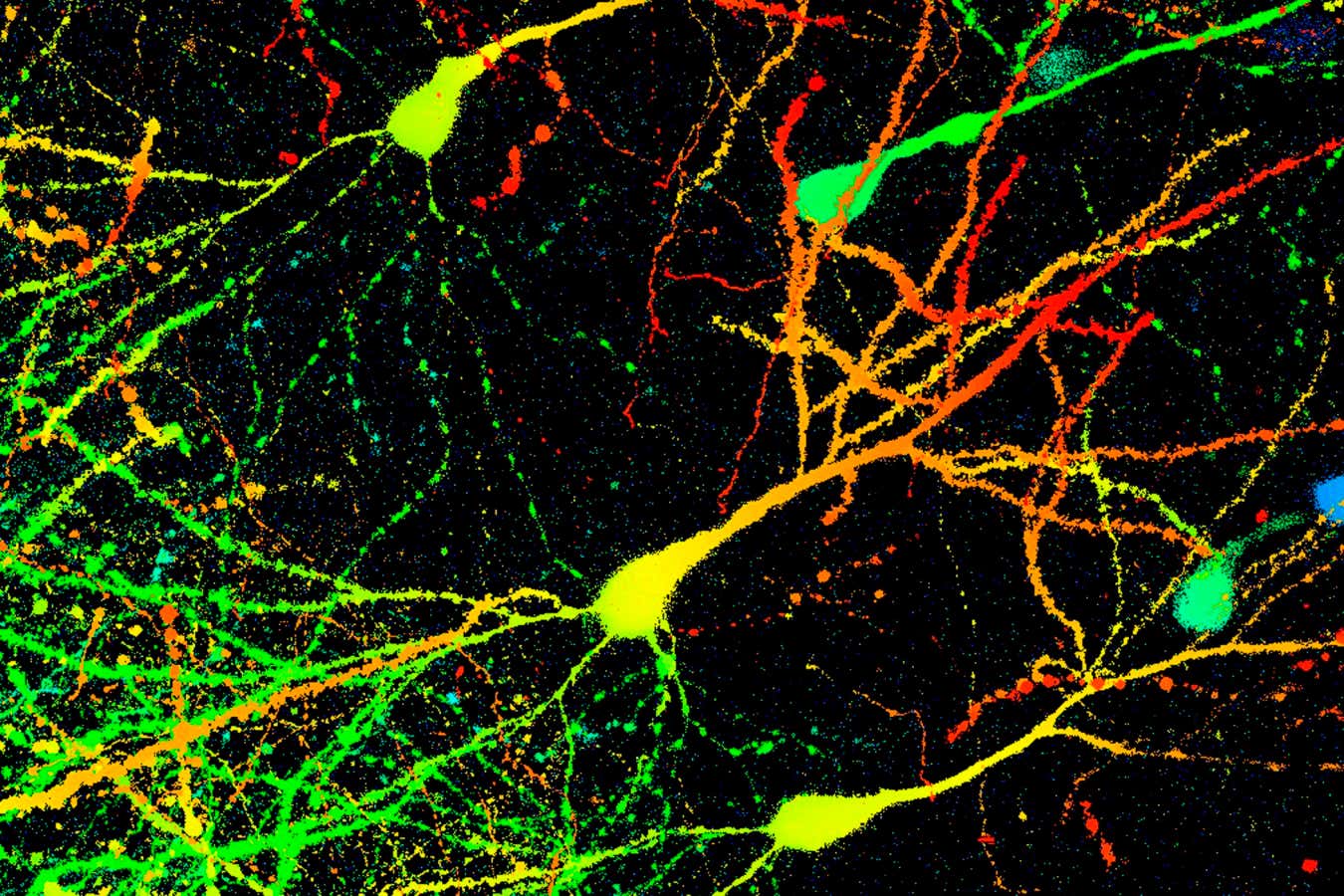
Parkinson’s occurs when nerve cells in the brain become depleted. This light micrograph shows mouse neurons labelled with a fluorescent protein to distinguish between cells at different depths
DR GOPAL MURTI/SCIENCE PHOTO LIBRARY
A mystery drug has shown promise for Parkinson’s disease, improving the mobility and balance of mice with Parkinson’s-like symptoms. The drug works by boosting the brain’s waste disposal system to remove toxic protein clumps, but the researchers behind the work aren’t yet revealing what the treatment is, referring to it only as compound X.
“We aim to put some [intellectual property] protection around the repurposing of compound X as it has shown significant findings so far, and could become the first disease-modifying treatment for Parkinson’s disease,” says Zhao Yan at the Swinburne University of Technology in Melbourne, Australia.
Parkinson’s disease, which affects more than 10 million people worldwide, is associated with a loss of nerve cells in parts of the brain that help control movement. This is thought to be due to a build-up of a misfolded form of a protein called alpha-synuclein. Studies suggest that this accumulates due to impairments in the brain’s waste disposal system, known as the glymphatic system. But it was unclear whether boosting this system eased symptoms.
To explore this, Yan and her colleagues turned to a novel mouse model of Parkinson’s. The approach, which they previously developed, involves repeatedly putting a couple of drops containing misfolded alpha-synuclein up the noses of mice. From there, the protein spreads into and around the brain, causing increasingly severe mobility issues. This replicates Parkinson’s much more accurately than other models where symptoms are induced via brain damage, such as toxin exposure, without replicating the alpha-synuclein clumps we see in people, says Yan. She presented the study findings at the Oxford Glymphatic and Brain Clearance Symposium in the UK on 1 April.
The team exposed 20 mice to weekly doses of alpha-synuclein for four months. Two months in, half the mice were given compound X, a drug that has been approved by the US Food and Drug Administration, four times a week. This group also received a chemical called methylcellulose that helps the drug dissolve. Compound X has been shown to boost slow brainwaves, a key driver of glymphatic function, but no study has directly explored its effect on brain waste clearance before, says Yan.
The remaining mice received methylcellulose alone, acting as the controls. The degree of Parkinson’s progression in the mice was roughly equivalent to when people with Parkinson’s disease are at an early stage of the condition, where they may be experiencing changes in smell or sleep, says Yan.
All the mice then completed a mobility test in which they were placed at the top of a thin pole and had to carefully turn their body to make their way down. In the compound X group, 80 per cent of the mice completed the task successfully, compared with just 10 per cent of the control group.
Another movement task required the mice to balance on a rotating rod for 5 minutes. Nearly all of those that received compound X stayed on the whole time, whereas mice in the control group fell off after about 3 minutes, on average.
Further analysis revealed that compound X boosted slow brainwaves during deep sleep, enhancing the flow of fluid through the glymphatic system. This also reduced the number of alpha-synuclein clumps in the mice’s motor cortex – a brain region that controls movement – by 40 per cent more, on average, compared with methylcellulose alone.
“I think this is very important,” says Wenzhen Duan at Johns Hopkins University in Maryland. “We need compounds or therapies that can delay or slow down the disease. Available treatments in the clinic temporarily relieve symptoms, [but] none of them really slow down or change the disease.”
The team hopes to get regulatory approval to trial the drug in people with early-stage Parkinson’s within the next year. “The long-term aim would be to treat people at the earliest phase of the disease as this would have the biggest benefit,” says Yan.
Topics: