
Close Menu
    Trending
    • Singapore Airlines, Southwest Airlines partner to expand access to nearly 120 US destinations
    • Trump warns Netanyahu: ‘You’ll be on your own’ if attacks on Iran continue | US-Israel war on Iran News
    • Cristiano Ronaldo, ‘The Bosnian Diamond’ headline the World Cup 40-and-over club
    • How housing market inventory is shifting across every state
    • What is a ‘normal’ memory slowdown, and when should I worry?
    • Ariana Grande And Ethan Slater Are ‘Still Friends’ Following Split
    • US says BYD, Baidu, Alibaba and other tech giants are aiding China’s military
    • Maine’s Platner faces test as four US states hold midterm primary votes | US Midterm Elections 2026 News
    Benjamin Franklin Institute
    Tuesday, June 9
    • Home
    • Politics
    • Business
    • Science
    • Technology
    • Arts & Entertainment
    • International
    Benjamin Franklin Institute
    Home»Science»More than 100 moons were discovered in our own solar system in 2025
    Science

    More than 100 moons were discovered in our own solar system in 2025

    Team_Benjamin Franklin InstituteBy Team_Benjamin Franklin InstituteDecember 24, 2025No Comments3 Mins Read
    Share Facebook Twitter Pinterest Copy Link LinkedIn Tumblr Email VKontakte Telegram
    Share
    Facebook Twitter Pinterest Email Copy Link


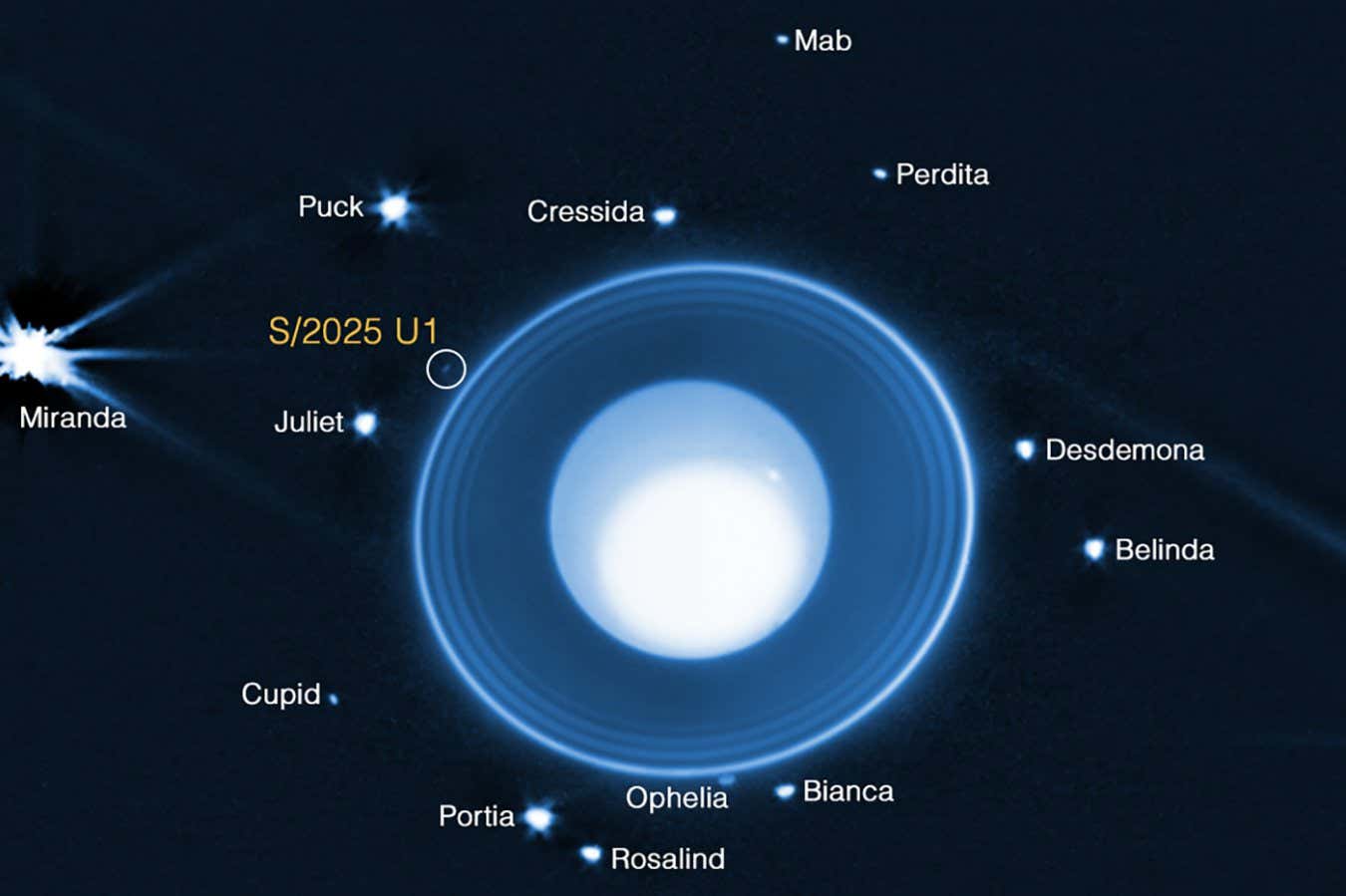
    Uranus’s new moon, S/2025 U1, was spotted using the James Webb Space Telescope

    NASA/ESA/CSA/STScI/M. El Moutamid (SwRI)/M. Hedman (University of Idaho)

    This year, astronomers discovered more than 100 previously unknown moons in our own solar system. There may be many more yet to be discovered, and cataloguing them could help us better understand how planets form.

    In March, Edward Ashton at Academia Sinica in Taiwan and his colleagues discovered 128 moons around Saturn, bringing the planet’s total to 274. The team gathered hours’ worth of images from the Canada-France-Hawaii Telescope in Hawaii and stacked them on top of each other to spot objects that are otherwise too dim to see.

    Ashton’s team now has the right to name the new moons, although Saturn’s moons are so numerous that many are no longer given informal names.

    In August, a small and dim new moon was found in orbit around Uranus, bringing the planet’s total to 29. Maryame El Moutamid at Southwest Research Institute in Colorado and her colleagues made the discovery using 10 long-exposure infrared images taken by NASA’s James Webb Space Telescope.

    The team remains tight-lipped on potential names for the moon, so it still has the provisional name S/2025 U1. In time, it will probably be named along the same lines as 27 of Uranus’s moons, which take a character’s name from one of Shakespeare’s plays. This convention dates back to the discovery of the planet’s first two moons, Titania and Oberon, in 1787.

    Nigel Mason at the University of Kent, UK, says there are likely to be many more moons to be discovered in our solar system, particularly around Neptune and Uranus, although the largest ones have probably already been mapped.

    “Everybody always likes to find new moons and everybody always likes to think about what they’re going to call them,” he says. “It’s an exciting moment. It’s a bit of a legacy.”

    The more we catalogue and measure our local moons, the more we can find out about how they are created and use that information to update our models of planet formation, says Mason.

    “Why are there so many? What is it that triggered [planets] to make 40, 50, 60 of such varying shapes and sizes? 
That’s why they’re exciting,” he says. “It’s not just stamp collecting. It really is ‘wow’. Really surprisingly, the whole planet-formation process is not as well as understood as we think.”

    Topics:


    Source link

    Share. Facebook Twitter Pinterest LinkedIn Tumblr Email Telegram Copy Link

    Related Posts

    Science

    What is a ‘normal’ memory slowdown, and when should I worry?

    June 9, 2026
    Science

    Wildlife thrives in solar farm built on restored peatland

    June 8, 2026
    Science

    You don’t need to worry about recursive-self-improving AI – yet

    June 8, 2026
    Science

    Understanding anorexia’s grip on the brain could unlock new therapies

    June 8, 2026
    Science

    Why GLP-1 drugs might reduce cancer risk

    June 8, 2026
    Science

    Landmark pancreatic cancer treatment paves way for targeting other tricky tumors

    June 8, 2026
    Editors Picks

    China says raised ‘stern protest’ with Australia after mid-air incident

    October 22, 2025

    ‘Riverdale’ Star Allegedly Cuts Off Dad After Marrying Her Ex-BFF

    May 23, 2026

    US tightens visa interview rules: What Singaporeans need to know

    July 30, 2025

    How I Built a Multi-Unit Franchise Operation Without Leaving My Day Job

    July 2, 2025

    Pope Leo XIV appeals for ‘no more war’ in first Sunday message

    May 11, 2025
    About Us
    About Us

    Welcome to Benjamin Franklin Institute, your premier destination for insightful, engaging, and diverse Political News and Opinions.

    The Benjamin Franklin Institute supports free speech, the U.S. Constitution and political candidates and organizations that promote and protect both of these important features of the American Experiment.

    We are passionate about delivering high-quality, accurate, and engaging content that resonates with our readers. Sign up for our text alerts and email newsletter to stay informed.

    Latest Posts

    Singapore Airlines, Southwest Airlines partner to expand access to nearly 120 US destinations

    June 9, 2026

    Trump warns Netanyahu: ‘You’ll be on your own’ if attacks on Iran continue | US-Israel war on Iran News

    June 9, 2026

    Cristiano Ronaldo, ‘The Bosnian Diamond’ headline the World Cup 40-and-over club

    June 9, 2026

    Subscribe for Updates

    Stay informed by signing up for our free news alerts.

    Paid for by the Benjamin Franklin Institute. Not authorized by any candidate or candidate’s committee.
    • Privacy Policy
    • About us
    • Contact us

    Type above and press Enter to search. Press Esc to cancel.