

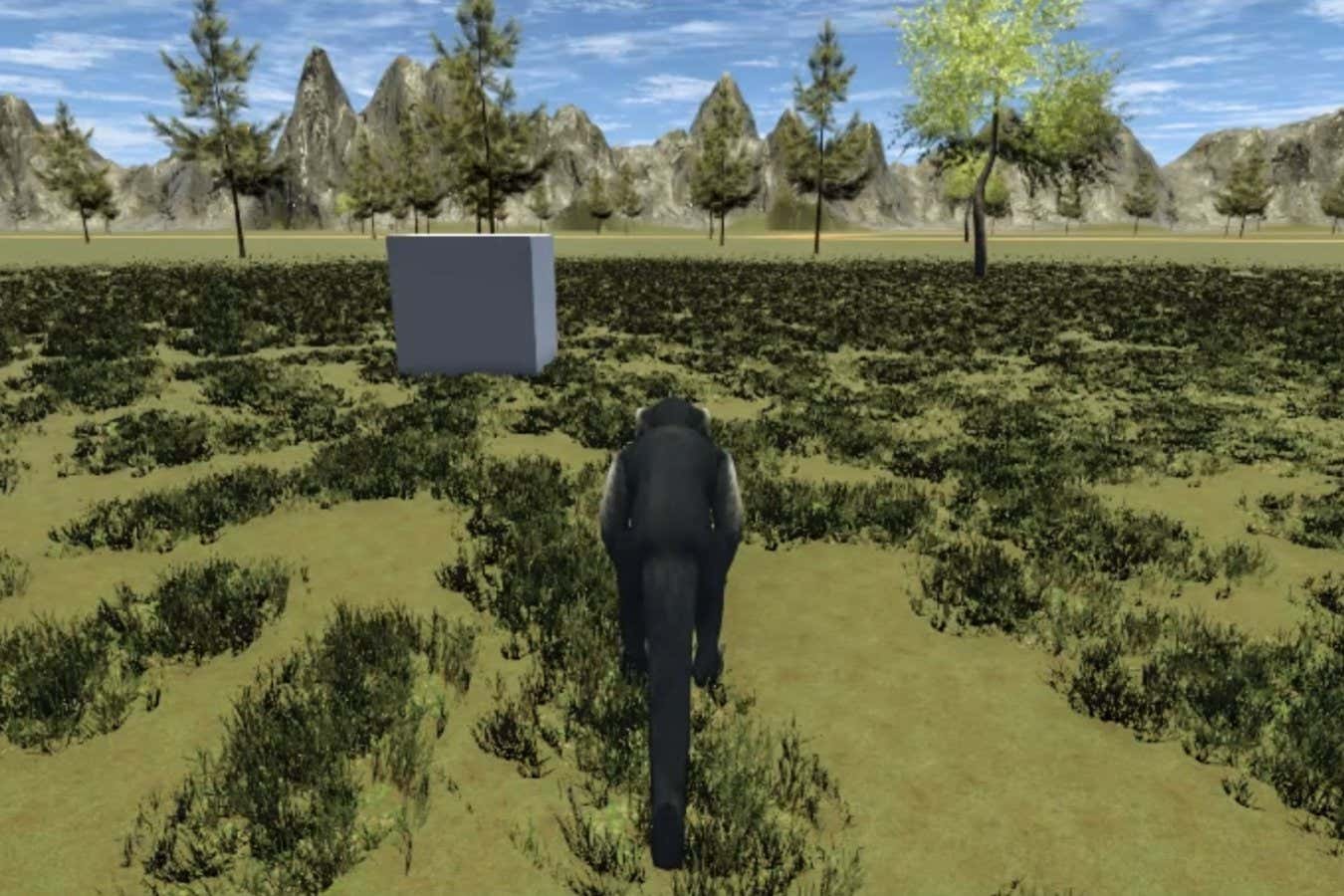
Monkeys can walk around a virtual world using a brain-computer interface
Peter Janssen et al. 2026
Monkeys fitted with a brain-computer interface (BCI) successfully navigated a variety of virtual worlds using only their thoughts. Researchers hope the experiments will pave the way for people with paralysis to explore virtual worlds or more intuitively control electric wheelchairs in this one.
Peter Janssen at KU Leuven in Belgium band colleagues implanted three rhesus macaque (Macaca mulatta) monkeys with BCIs. Crucially, each animal got three implants, each consisting of 96 electrodes, positioned in the primary motor, dorsal and ventral premotor cortex. The first area is commonly used in BCI research and relates to physical movement, but the latter two are thought to be involved in planning movement in a higher, more abstract way. Electrical signals from the implants were then interpreted by an AI model and used to control VR avatars as the monkeys watched a 3D monitor.
In experiments, the monkeys were able to control a sphere moving across a virtual-reality landscape from a fixed point of view, but also control animated monkeys from a third-person viewpoint as you would see in a computer game. The researchers say that in subsequent tests, the monkeys have navigated through virtual buildings by opening doors and moving from room to room.
In many previous human trials of BCI, people have had to think of a physical movement such as raising or lowering a finger to move a cursor on a screen, but Janssen believes that the placement of the sensors in the monkeys has accessed a higher-level and intuitive connection to movement.
“We cannot ask these monkeys, of course, but we just think that it’s a more intuitive way of controlling an a computer, basically,” says Janssen, who adds that people sometimes describe using current BCIs as “trying to move your ears” – a foreign and sometimes frustrating experience that can take weeks or months to master.
Janssen believes that the approach would work in humans and would allow people with paralysis to intuitively navigate virtual worlds or control electric wheelchairs, but trials are some time off. “There’s a bit of work necessary to know exactly where to implant a human because a lot of these areas are not very well known in humans, where they are exactly,” says Janssen. “But once we figure that out, it should be possible. It should actually be easier because you can explain to the human what they are supposed to do.”
Andrew Jackson at Newcastle University, UK, says that one impressive thing about the work is that the monkeys are able to control movement from different viewpoints and in different contexts in the same way. It could be that the BCI has tapped in to parts of the brain that think about movement in abstract ways, and that makes it flexible enough to adapt from context to context – like people playing various computer games with the same familiar controller.
“I’ve got a bunch of different buttons I can press, and in different games I have to work out the specific mapping between those different buttons and and the particular game. But it’s a pretty easy thing to do because there’s only so many combinations I need to try,” explains Jackson. “If the new game actually involved me putting down the controller, going over and opening my fridge or something, then it would be much harder.”
Several trials of simpler BCIs in humans have already been carried out. In one, a man with paralysis was able to fly a virtual drone through a complex obstacle course simply by thinking about moving his fingers, with signals being interpreted by an AI model. In another, a person could imagine that they were writing with a pen, and a computer converter converted brain signals into text.
And in 2024 the company Neuralink, co-founded by controversial billionaire Elon Musk, announced that it had installed its BCI in a human for the first time, allowing them to control a cursor on a computer. However, it was later revealed that after just a month, some 85 per cent of those electrode threads had shifted, dramatically reducing the person’s ability to control a computer. Neuralink has been criticised in the past for alleged animal cruelty in its experiments, which Musk denied, and had faced US government investigations, before it seemingly stalled under President Donald Trump.
Science Advances
DOI: 10.1126/sciadv.adw3876