
Close Menu
    Trending
    • How housing market inventory is shifting across every state
    • What is a ‘normal’ memory slowdown, and when should I worry?
    • Ariana Grande And Ethan Slater Are ‘Still Friends’ Following Split
    • US says BYD, Baidu, Alibaba and other tech giants are aiding China’s military
    • Maine’s Platner faces test as four US states hold midterm primary votes | US Midterm Elections 2026 News
    • John Harbaugh, Giants urged to cut ties with former first-rounder
    • Why Repair Cafés are becoming more popular amid the anti-consumerism movement
    • Wildlife thrives in solar farm built on restored peatland
    Benjamin Franklin Institute
    Tuesday, June 9
    • Home
    • Politics
    • Business
    • Science
    • Technology
    • Arts & Entertainment
    • International
    Benjamin Franklin Institute
    Home»Science»Millions of planets might form around supermassive black holes
    Science

    Millions of planets might form around supermassive black holes

    Team_Benjamin Franklin InstituteBy Team_Benjamin Franklin InstituteMay 28, 2026No Comments3 Mins Read
    Share Facebook Twitter Pinterest Copy Link LinkedIn Tumblr Email VKontakte Telegram
    Share
    Facebook Twitter Pinterest Email Copy Link


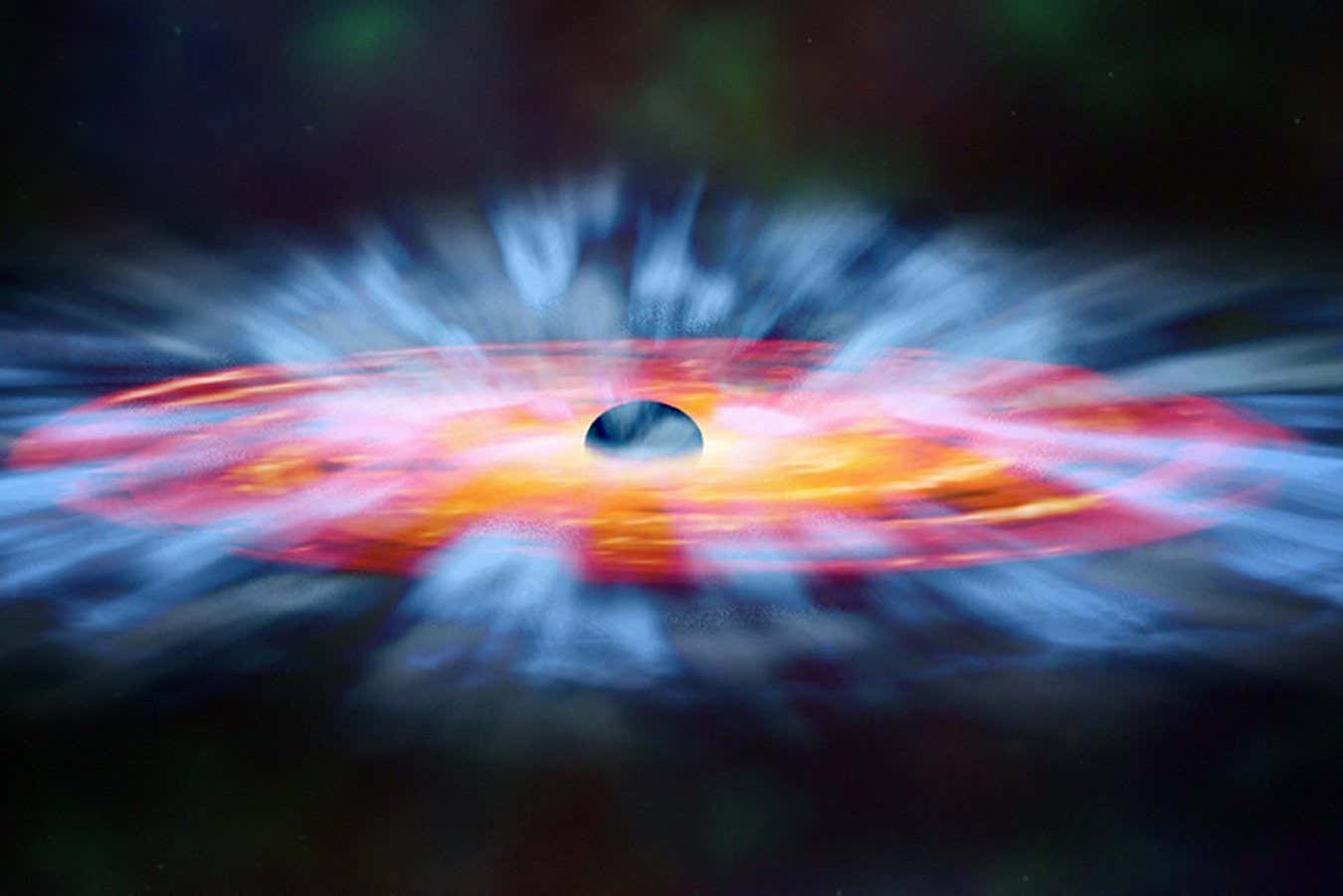
    The disc of material swirling around a supermassive black hole may give birth to many planets

    NASA and M. Weiss/Chandra X-ray Center

    The active centres of galaxies might be regions of extraordinary planet formation, where millions of worlds are born.

    Most galaxies in the universe, such as our own Milky Way, host a supermassive black hole at their centre. Most of the time, these black holes are quiescent, as there is no matter falling into them. But occasionally they become active and consume huge amounts of dust and gas, perhaps from a merger with another galaxy, becoming an active galactic nucleus for millions of years.

    Barry McKernan at the City University of New York and his colleagues modelled the disc of dust and gas around a typical active galactic nucleus. They found it would be a prime location for planet formation, with the dust easily clumping together into bigger and bigger objects. Eventually planets would begin to grow in huge numbers, and with strange properties.

    “This is a really amazing new pathway to form very alien planets,” says McKernan. “If these things exist, they’re quite unlike planets that we know and love.”

    The planets would grow to enormous sizes because active galactic nuclei contain massive amounts of dust, much more than the protoplanetary discs around young stars that formed solar systems like our own. That could lead to giant rocky planets the size of Jupiter or even bigger forming, something not known to happen anywhere else in the universe, many with surfaces covered in lava because of frequent collisions with other worlds.

    Some of the planets would become so large that they could ignite nuclear fusion at their cores, says McKernan, becoming “very weird alien stars” made of rock, or swallow up large amounts of nearby gas and collapse into objects known as intermediate-mass black holes.

    The disc of dust around an active galactic nucleus can extend for dozens of light years, meaning this process would take place at huge scales. “You could get millions of planets around the central supermassive black hole,” says McKernan.

    We knew that planets and stars can form around black holes, but planet formation of this scale has not been investigated before, says Sean Raymond at the University of Bordeaux, France. It could make active supermassive black holes one of the best places in the universe to form new worlds.

    “With that much stuff around a supermassive black hole, what else is going to happen?” says Raymond. “It seems pretty much unavoidable.”

    Many of the planets would be scattered into the black hole or ejected out into the galaxy because of their repeated interactions with each other. Any that remain might be detectable, perhaps by noticing their gravity warp the light of more distant stars, a technique called microlensing.

    Telescopes such as NASA’s Nancy Grace Roman Space Telescope, which is expected to launch in September, could make this possible. “We are going into the age when microlensing is very much a thing,” says Benne Holwerda at the University of Louisville, Kentucky.

    McKernan also notes that many active galactic nuclei have been observed to flicker, which could be due to a “swarm of little things that are passing in front”, such as planets. “These things should exist,” says McKernan. “So can we see them?”

    Topics:


    Source link

    Share. Facebook Twitter Pinterest LinkedIn Tumblr Email Telegram Copy Link

    Related Posts

    Science

    What is a ‘normal’ memory slowdown, and when should I worry?

    June 9, 2026
    Science

    Wildlife thrives in solar farm built on restored peatland

    June 8, 2026
    Science

    You don’t need to worry about recursive-self-improving AI – yet

    June 8, 2026
    Science

    Understanding anorexia’s grip on the brain could unlock new therapies

    June 8, 2026
    Science

    Why GLP-1 drugs might reduce cancer risk

    June 8, 2026
    Science

    Landmark pancreatic cancer treatment paves way for targeting other tricky tumors

    June 8, 2026
    Editors Picks

    Another Forbes 30 Under 30 honoree could be headed to prison

    February 6, 2026

    ‘Bachelor’ Alum Madi Prewett Recalls Emotional Weight Of Living ‘Double Life’

    February 11, 2026

    Federal authorities announce an end to the immigration crackdown in Minnesota

    February 12, 2026

    In a season of giving, smart leaders are giving forward

    December 12, 2025

    Don’t Risk Your $2,000 Laptop—Travel With This $324 MacBook Pro Instead

    July 3, 2025
    About Us
    About Us

    Welcome to Benjamin Franklin Institute, your premier destination for insightful, engaging, and diverse Political News and Opinions.

    The Benjamin Franklin Institute supports free speech, the U.S. Constitution and political candidates and organizations that promote and protect both of these important features of the American Experiment.

    We are passionate about delivering high-quality, accurate, and engaging content that resonates with our readers. Sign up for our text alerts and email newsletter to stay informed.

    Latest Posts

    How housing market inventory is shifting across every state

    June 9, 2026

    What is a ‘normal’ memory slowdown, and when should I worry?

    June 9, 2026

    Ariana Grande And Ethan Slater Are ‘Still Friends’ Following Split

    June 9, 2026

    Subscribe for Updates

    Stay informed by signing up for our free news alerts.

    Paid for by the Benjamin Franklin Institute. Not authorized by any candidate or candidate’s committee.
    • Privacy Policy
    • About us
    • Contact us

    Type above and press Enter to search. Press Esc to cancel.