
Close Menu
    Trending
    • Scheffler gets morbid ahead of Open Championship: ‘We’re all going to die’
    • “I’m Not a Big Company CEO.” A Billion-Dollar Founder’s Confession — and What It Reveals About Startup Success
    • See the first x-rays of humans taken in space
    • The Fed Still Doesn’t Understand Where Inflation Comes From
    • ‘Jurassic Park’ Star Sam Neill’s Cause of Death Revealed
    • US unveils new 25% tariff on certain imports from Brazil
    • UK proposes voluntary overnight social media curfew for older teens | Social Media News
    • The ‘MLB All-Star Game MVPs’ quiz
    Benjamin Franklin Institute
    Thursday, July 16
    • Home
    • Politics
    • Business
    • Science
    • Technology
    • Arts & Entertainment
    • International
    Benjamin Franklin Institute
    Home»Science»Mercury may have gained all of its unexpected water in a single day
    Science

    Mercury may have gained all of its unexpected water in a single day

    Team_Benjamin Franklin InstituteBy Team_Benjamin Franklin InstituteMay 22, 2026No Comments3 Mins Read
    Share Facebook Twitter Pinterest Copy Link LinkedIn Tumblr Email VKontakte Telegram
    Share
    Facebook Twitter Pinterest Email Copy Link


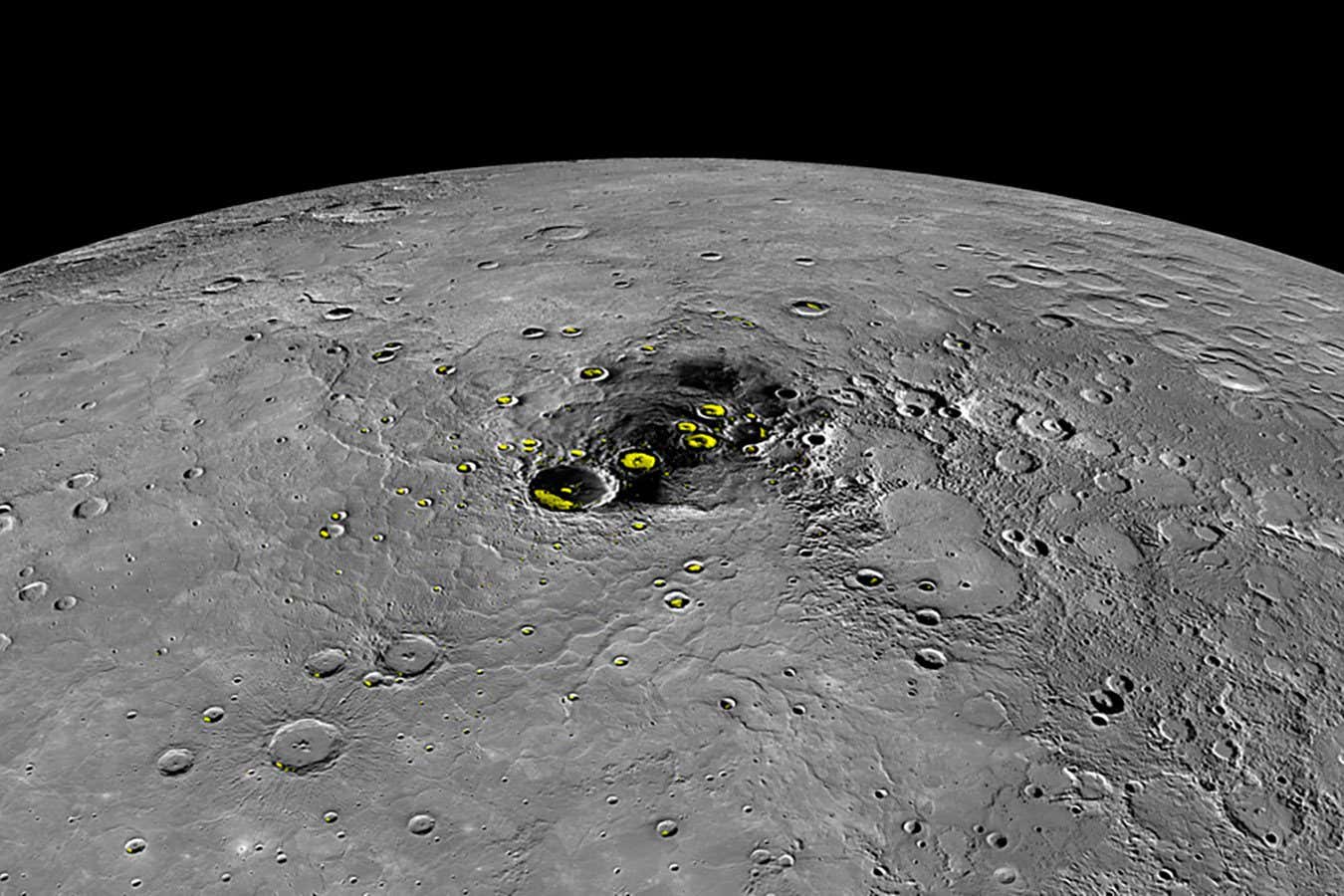
    We may now know how Mercury gained its ice deposits

    NASA’s Scientific Visualization Studio

    Around 100 million years ago, the surface of Mercury suddenly underwent a dramatic change. Before then, its surface was relatively dry and ice-free – not surprising, as daytime temperatures there can reach upwards of 430°C (806°F) – but over the course of a single Mercurian day, all that changed.

    The poles of Mercury are home to craters whose bottoms never see sunlight, known as permanently shadowed regions. Thanks to NASA’s Messenger spacecraft, which orbited Mercury between 2011 and 2015, we know that those craters contain deposits of ice several metres deep. But how that ice got there is puzzling.

    Previous research has suggested that it may have been brought there by a comet-like body around 17 kilometres across that smashed into Mercury at a speed of about 30 kilometres per second. Now, new simulations from Parvathy Prem at the Johns Hopkins Applied Physics Laboratory in Maryland and her colleagues suggest that it may have been a larger, slower collision.

    “We’ve known for a while that Mercury’s poles have ice. The idea that those ice deposits might have been laid down by an impactor is also not new, but this is the first time we’ve really modelled that process and visualised what might have gone on from the start to the end,” says Prem. “It’s the first time we’ve looked in detail [at] how exactly the movie plays out.”

    That movie starts with a huge chunk of ice and rock slamming into Mercury, creating the enormous Hokusai crater that we see on the planet’s surface today. As the impactor hit the ground, it would have vapourised almost completely, leaving Mercury with an extremely tenuous, but water-rich, atmosphere.

    “If we just looked at Mercury with our own eyes, this would have been probably too thin to see. But look at it in the right wavelengths and, briefly, the planet might have been glowing,” says Prem.

    While most of the atmosphere would have been quickly destroyed by powerful radiation from the sun, the researchers found that just over one-fifth of the water vapour from the impactor could have migrated to the poles and found shelter in permanently shadowed regions. This is more than many earlier calculations found, which better matches Messenger’s measurements, says Prem. A larger impactor coming in at a slower speed than has previously been suggested would be an even better match, trapping more water on the surface.

    If the researchers are correct, all of this would have happened over the course of one Mercurian day, which is 176 Earth days. “This would certainly have been the most eventful day in the last billion years of Mercury’s history,” says Emily Costello at the University of Hawaiʻi.

    This could answer the long-standing question of why Mercury has so much ice in its polar craters and Earth’s moon doesn’t, despite the two being remarkably similar in nearly every way. In short: “Mercury recently experienced a large-scale water delivery. The moon didn’t,” says Costello.

    It could also help us figure out how and when the rest of the inner solar system, including Earth, got its water. “Mercury’s polar ice deposits are this interesting geological record of how and when water came to be in the inner solar system, and now we’re reading that record and trying to understand what it’s telling us,” says Prem. That mission will be helped along by the BepiColombo spacecraft, which launched in 2018 and will enter orbit around Mercury later this year.

    Topics:


    Source link

    Share. Facebook Twitter Pinterest LinkedIn Tumblr Email Telegram Copy Link

    Related Posts

    Science

    See the first x-rays of humans taken in space

    July 16, 2026
    Science

    Mathematicians are closing in on the hidden order inside chaos

    July 16, 2026
    Science

    How to avoid getting cyclosporiasis—and why washing lettuce may not be enough

    July 16, 2026
    Science

    Scientists discover a ‘remarkable’ new monkey species with orange lips and a froglike roar

    July 15, 2026
    Science

    Trump’s latest CDC chief pick Erica Schwartz faces Senate confirmation hearing

    July 15, 2026
    Science

    Indonesia’s New Capital Is Changing the Borneo Rainforest Forever. Science is Listening to the Change

    July 15, 2026
    Editors Picks

    Cervical cancer deaths have plummeted thanks to HPV vaccine

    June 18, 2026

    Ukraine’s officials to boycott Paralympics over Russian flag decision

    February 19, 2026

    Best science books of all time: Why The Selfish Gene is still one of the most thrilling evolution books ever

    March 29, 2026

    The Invisible Barriers That Are Sabotaging Your Scalability

    May 24, 2026

    What a new law and an investigation could mean for Grok AI deepfakes

    January 12, 2026
    About Us
    About Us

    Welcome to Benjamin Franklin Institute, your premier destination for insightful, engaging, and diverse Political News and Opinions.

    The Benjamin Franklin Institute supports free speech, the U.S. Constitution and political candidates and organizations that promote and protect both of these important features of the American Experiment.

    We are passionate about delivering high-quality, accurate, and engaging content that resonates with our readers. Sign up for our text alerts and email newsletter to stay informed.

    Latest Posts

    Scheffler gets morbid ahead of Open Championship: ‘We’re all going to die’

    July 16, 2026

    “I’m Not a Big Company CEO.” A Billion-Dollar Founder’s Confession — and What It Reveals About Startup Success

    July 16, 2026

    See the first x-rays of humans taken in space

    July 16, 2026

    Subscribe for Updates

    Stay informed by signing up for our free news alerts.

    Paid for by the Benjamin Franklin Institute. Not authorized by any candidate or candidate’s committee.
    • Privacy Policy
    • About us
    • Contact us

    Type above and press Enter to search. Press Esc to cancel.