

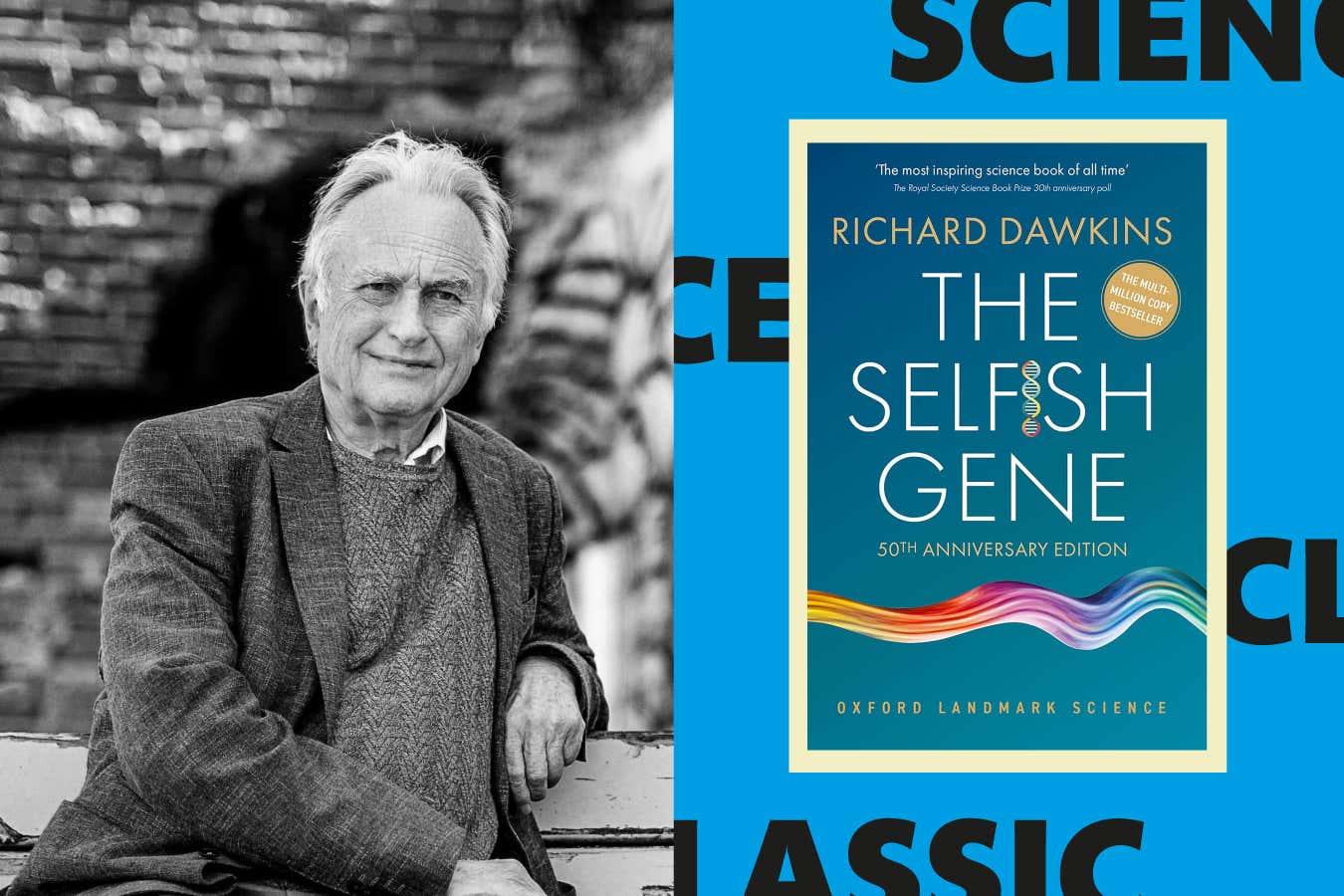
‘Richard Dawkins brilliantly made us think from the gene’s-eye view’: rereading The Selfish Gene
In 1976, Richard Dawkins published a book titled after an idea he’d come up with while teaching a lecture on animal behaviour for his PhD supervisor. It just so happened that the idea of The Selfish Gene was an irresistible scientific metaphor, and the book became a global bestseller. It remains one of the most thrilling popular books on evolution ever written.
After fifty years The Selfish Gene feels its age, but the core message remains relevant not just because genes being selfish is a brilliant meme (a term Dawkins coins at the end of the book), but because it is such a powerful way to understand how evolution operates: the metaphor makes us think as if genes behave selfishly. It makes us think from a gene’s-eye view. In doing so, Dawkins modernised evolutionary biology and also democratised it – he made it a thing of the people. Now anyone could grasp why vampire bats share blood with each other, why orchids mimic bees and why a cold virus makes us cough: why living things looked and behaved the way they did.
When Charles Darwin set out his theory of natural selection, he did so by understanding that individuals compete for resources and that they differ in how they survive and in how many offspring they add to the next generation. Individual members of a species should behave for the good of themselves, said Darwin, not for the benefit of others, and traits that help individuals do better are passed on. Fine on the surface, but that didn’t always work– for example in insect societies where sterile workers labour to help a queen reproduce or even kill themselves to protect their nest. Darwin’s solution was to argue that in social insects, such as ants, wasps and bees, the family was effectively the individual, so sterile workers apparently helping the family were essentially helping themselves. It was a fudge, but he was on the right lines.
Over the middle part of the 20th century, as part of the revamping of evolutionary biology and its marriage with genetics that became known as the modern synthesis, a number of biologists mathematically described how evolution operates by changes in the frequency of genetic variants. Then two biologists in particular, George Williams and WD Hamilton, showed how understanding adaptations (structures, traits and behaviours that help organisms survive) as working for the benefit of the gene could explain apparent altruism. From the point of view of the gene, it makes sense for a worker ant to forgo reproduction and help her mother raise offspring, as she is helping her own genes into the next generation.
Darwin, without knowing about DNA or genes, had guessed what was happening. Dawkins brought the mathematics and theory beautifully to life. Out were the Lamarckian “just-so” stories about evolution (for example, that elephants got their long trunks from generations of stretching them), and out was the idea that organisms behaved for the good of the species; in was a graspable description of biology that aligned with the genetics.
One of the criticisms levelled at Dawkins, in building on the work of Williams and Hamilton, is that he merely popularised what others had devised. But The Selfish Gene acted as midwife to academic theory; it birthed a concept that influenced generations of biologists, and, importantly, the public.
Another criticism is that the book’s idea of what a gene is, and how DNA works, is wrong or over-simplified. DNA does not work alone; a cell’s components act in symphony to produce a phenotype. The key quality of a gene is not its executive power, but its stability over time, the persistence of its genetic sequence. Dawkins knew this, but decided not to call the book The Immortal Gene.
Perhaps the biggest problem people now have with the book is that it popularised genetic animism– the belief that DNA commands the cell and the organism. In Dawkins’s telling we are “gigantic lumbering robots”, survival machines “blindly programmed to preserve the selfish molecules known as genes”. At best this is literary oversimplification. At worst, it supports an erroneous view of genetic determinism, the idea that aspects of our behaviour are inescapably programmed by our genes. We would see this again in the over-reach of the Human Genome Project, and the idea that there are genes “for” everything from heart disease to intelligence. That’s not how genes work.
Reading it today, I am struck too how the metaphor of selfishness underplays the role of cooperation and symbiosis in life. Dawkins addresses this in the text, but the power of his metaphor is such that this aspect is inevitably neglected.
These criticisms aside, the way Dawkins so brilliantly and evocatively described animal behaviour from the perspective of the gene is why it had such a huge influence. People forget that Dawkins was not a geneticist but an ethologist, he studied the evolutionary basis of animal behaviour. As an undergraduate, it’s what got me hooked and made me become a behavioural ecologist. And that, for me, absolves most of the other stuff. It is why, despite its datedness in parts, the metaphor still works.
Rowan Hooper’s book Togetherness: Symbiosis and the Hidden Story of Life’s Greatest Collaborations, is published in June.
Topics: