

May is here, bringing with it more school holidays and bank holidays to look forward to.
But before the second of the long weekends at the end of the month, we get May Day — which always falls on the 1st of May and comes with a colourful, and at times surprising, history.
From a celebration that’s thousands of years old to a workers’ day of protest, here’s everything to know about May Day.
What is the history of May Day?
The history of May Day is long and layered, blending ancient pagan customs, seasonal celebrations, and workers’ rights movements across centuries. The UK officially recognised the early May bank holiday in 1978, introduced by Labour’s Michael Foot.
- May Day traces back to pre-Christian festivals that welcomed the arrival of spring and new life.
- In Celtic Britain and Ireland, it was celebrated as Beltane — a fire festival marking the halfway point between the spring equinox and summer solstice. It involved bonfires, dancing, and rituals to encourage fertility and a good harvest.
- In ancient Rome, a similar springtime festival called Floralia honoured Flora, the goddess of flowers and fertility.
The Wessex Morris Men process into the village to dance in Cerne Abbas
Getty
Medieval and folk traditions:
- Over time, May Day became a village celebration in medieval Europe, with customs such as maypole dancing, crownings of May Queens, and decorating homes with flowers — all symbols of fertility, youth, and nature.
- It remained a day of merrymaking and community gathering, often seen as a cheerful escape from daily life.

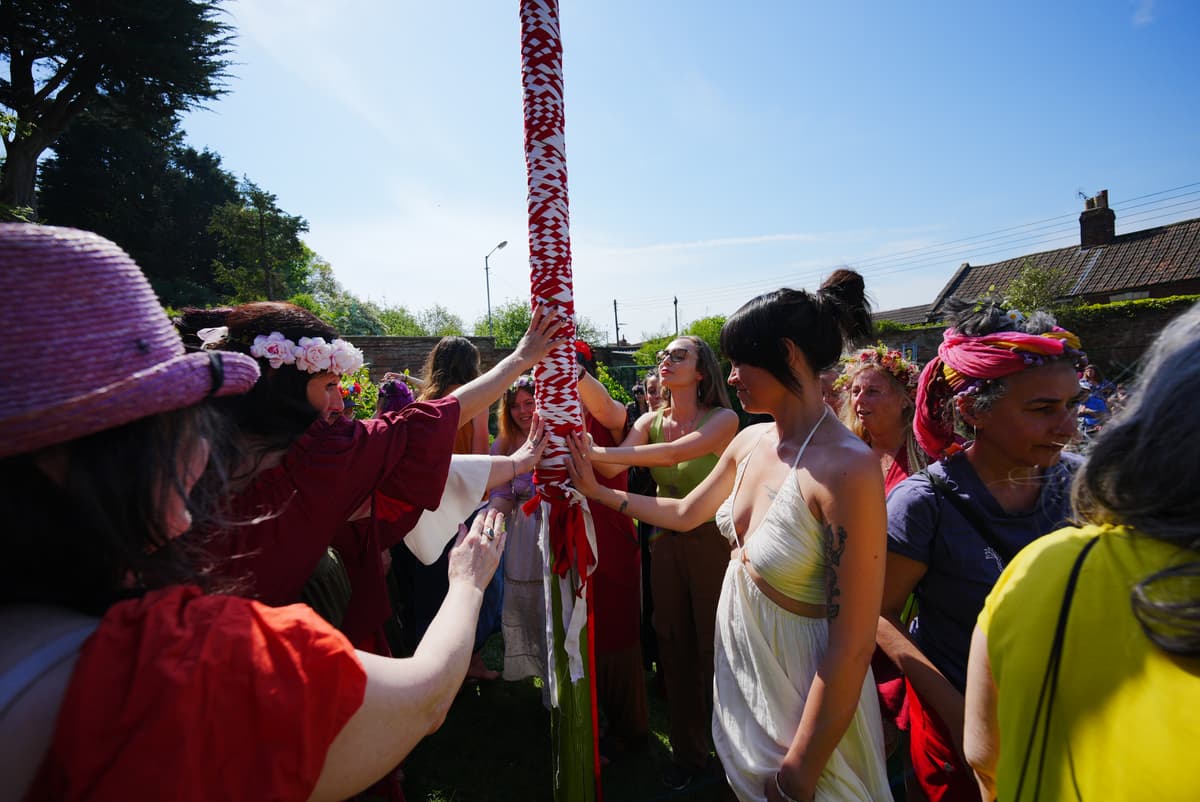
Members of the public reach to touch the maypole, during the Beltane celebrations at Glastonbury Chalice Well, where they observe a modern interpretation of the ancient Celtic pagan fertility rite of Spring
PA
Workers’ rights and political meaning:
- May 1 gained political significance in the late 19th century. It became International Workers’ Day after the Haymarket Affair in 1886 in Chicago, where a peaceful protest for an eight-hour workday turned deadly.
- In 1889, the International Socialist Congress declared May 1 a day to honour workers’ struggles. It was later adopted in socialist and communist countries, especially in the Soviet Union, where massive May Day parades became the norm.
What’s the meaning behind the maypole?
The maypole is a traditional symbol of May Day celebrations, especially in Britain and parts of Europe. It’s typically a tall wooden pole decorated with colourful ribbons, flowers, and sometimes greenery.
People — often children — dance around the maypole, each holding a ribbon, weaving in and out to create a pattern around the pole.

Children dance around a Maypole following the annual Garland Day parade in Castleton
Getty
In the Middle Ages, maypole dancing became a staple of May Day festivities.
The pole itself symbolised male fertility, while the surrounding baskets and garlands were linked to female fertility.
Villages would often compete to erect the tallest maypole, with dancing around it representing the coming together of the community and the renewal of life.
How is May Day celebrated in the UK?
May Day is celebrated in the UK as a springtime festival and, in some places, a nod to labour history. Yellow flowers, symbolising the fruitfulness of spring, remain a common sight. Maypole dancing and May Day fairs still occur in towns and villages across the UK — some more elaborate than others.
An old tradition you might like to revive is the anonymous May basket drop-off: in the 19th and early 20th centuries, people would leave small baskets of flowers or sweets on neighbours’ doorsteps, knock, and run away before being spotted.
In some towns, more unique events are still going strong. Cornwall’s Padstow ‘Obby Oss’ Festival is one of the most famous, while places like Oxford and Hastings also host traditional parades and performances.
Is May Day a UK bank holiday in 2026?
The early May bank holiday is set for Monday, May 4 — as it always lands on the first Monday of the month.
There’s also a second bank holiday in May — the spring bank holiday — which falls on Monday, May 25 in 2026.