

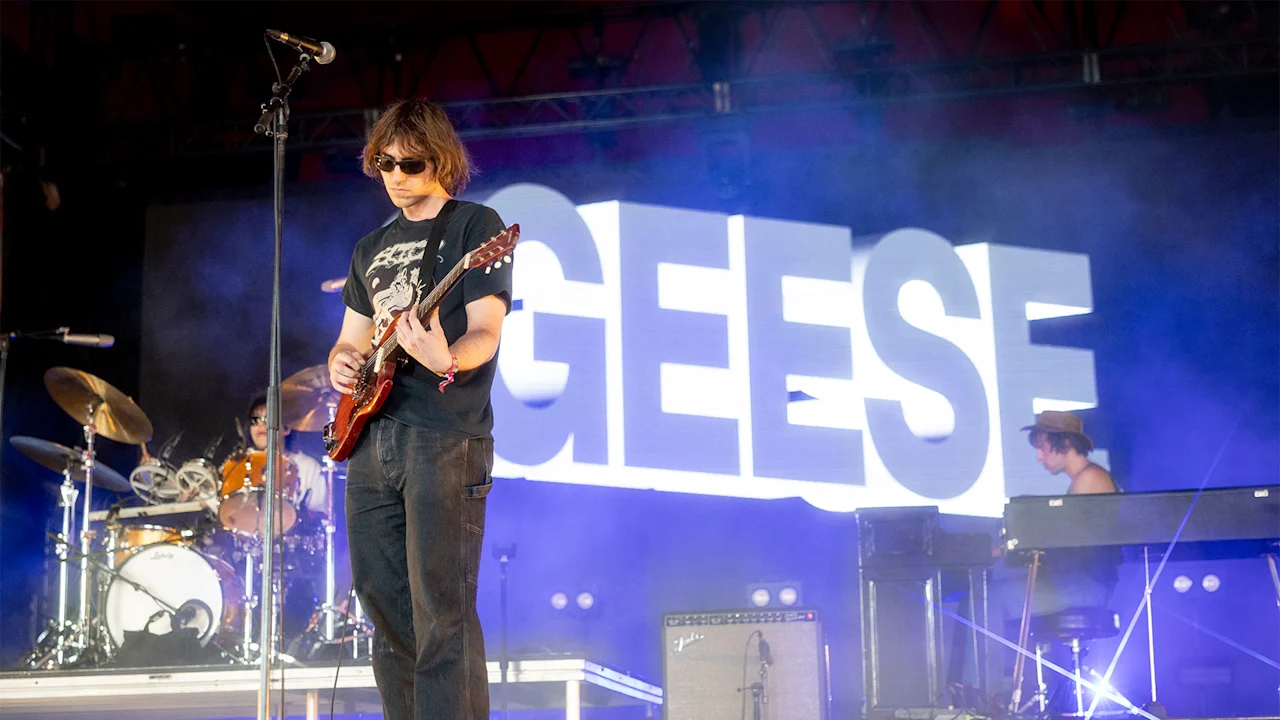
The world can’t seem to escape the Brooklyn-based Gen Z band Geese. Some call them “America’s Most Thrilling Young Rock Band,” while the band and their front man, Cameron Winter, are drawing endless comparisons to their predecessors, the Strokes and Julian Casablancas. Just last week, the band took the stage at Coachella as they gear up for an already sold-out tour.
But as Geese finds their footing in the limelight, suspicion is mounting over their relatively quick rise to fame—and now, some are saying the seemingly indie artists might have fallen into our laps on purpose all along.
In a now viral story by Wired, the publication reveals that Geese hired digital marketing company Chaotic Good Projects to engineer campaigns for the band and its lead singer. The campaigns can take the form of various social media profiles operating as a network, creating content using an artist’s music to boost them on the algorithm.
“Whole ecosystems of interactions can be fabricated out of digital cloth, stoking—and in some cases, completely manufacturing—discourse around an artist,” Wired explained.
“We can drive impressions on anything at this point,” Chaotic Good cofounder Andrew Spelman told Billboard‘s On the Record podcast. “We know how to go viral. We have thousands of pages.”
The story then ignited discourse online, validating users who were skeptical of the band’s meteoric rise, despite the fact that Geese had projects out before getting involved with the agency.
And still, the marketing firm’s work has been undoubtedly successful, including with artist clients such as Alex Warren and Sombr.
Plant politics
Commentators are now taking the moment as a chance to discuss whether turning to robust digital-first marketing in the age of algorithms and social platforms counts as a psyop—or warrants the label “industry plant.”
“Blaming Geese for hiring a TikTok marketing firm is like blaming a cereal brand for paying for shelf space at eye level,” entertainment publication Consequence Sound argued. “Every supermarket charges for placement, and it means the brand with less money ends up on the bottom shelf. That’s a legitimate problem, but the answer is to fix how shelves work, not to accuse Cheerios of fraud.”
A user on X echoed the sentiment, pointing that the practice is now standard in the industry, as have been others in the past.
“It’s understandable why this is all touching a nerve in the current day and age, but this is basically the equivalent of someone in the ’90s writing an exposé about how labels are paying groups called street teams to cover downtowns with posters promoting a band’s new album,” the user wrote.
Resorting to engineered campaigns might feel disingenuous to fans, but according to Chaotic Good, it is not the same as artificially inflating social media pages or streaming numbers—often done through bot farms—which streaming services are said to be actively combating.
Chaotic Good cofounder Adam Tarsia denied to Wired the use of bots or any other forms of artificially inflating social media pages or streaming numbers when working with Geese.
“[Geese] worked hard building a real grassroots community to achieve all their recent success,” Tarsia told Wired. “We’re protective and aware of the relationship between fan community and artist and want to aid that connection, not force it.”
Tarsia went on to say that the marketing company is “vehemently opposed to the use of bot farms.”
What is bot farming?
The practice that is garnering much attention and criticism in the wake of this controversy is not only the coordination of accounts to drive the algorithm, but also the use of bots to drive listens and views. Platforms like Fingerprint use software to track such activity to prevent fraud.
“Bot farming is essentially a multi-accounting fraud scheme,” Dan Pinto, CEO and cofounder at Fingerprint, told Fast Company. “A single fraudster uses automated scripts and bots or AI agents to create and manage thousands of fake listener accounts. These accounts then ‘listen’ to specific tracks or playlists on a loop, tricking the platform.”
Pinto explained that, while bot farming is a widespread issue, it is difficult to detect, making users mostly unaware of whether or not their favorite artists are artificially inflating their metrics.
“For the average listener, there is no surefire way to know whether an artist has used bots to grow their following or listeners,” he said. “Most platforms only share high-level streaming numbers, making it difficult to distinguish between a viral moment and a coordinated bot attack.”
Bot farm or no, the story is sure to leave many musicians even more frustrated by an industry in which success is seemingly built on insurmountable marketing investments.
“I just think it sucks that you have to hire a firm that creates 200 TikTok accounts to boost your stuff as an indie musician to get anywhere. It requires having money,” one user said on X. “I’m giving up on the notion that I’ll ever get to quit my day job, I think.”