
Close Menu
    Trending
    • When is London Marathon 2026? Start time and how to watch race for FREE
    • Pentagon Requests $54 Billion For AI War
    • Clavicular Hit With New YouTube Crackdown
    • Beijing’s new supply chain rules deepen concerns for US firms in China
    • India denounces ‘hellhole’ remark shared by Trump | Donald Trump News
    • New photos of Mike Vrabel and Dianna Russini emerge
    • AI search demands a new audience playbook
    • How do earthquakes end? A seismic ‘stop sign’ could help predict earthquake risk
    Benjamin Franklin Institute
    Friday, April 24
    • Home
    • Politics
    • Business
    • Science
    • Technology
    • Arts & Entertainment
    • International
    Benjamin Franklin Institute
    Home»Science»Male octopuses have a favourite arm that they mostly use for sex
    Science

    Male octopuses have a favourite arm that they mostly use for sex

    Team_Benjamin Franklin InstituteBy Team_Benjamin Franklin InstituteApril 1, 2026No Comments3 Mins Read
    Share Facebook Twitter Pinterest Copy Link LinkedIn Tumblr Email VKontakte Telegram
    Share
    Facebook Twitter Pinterest Email Copy Link


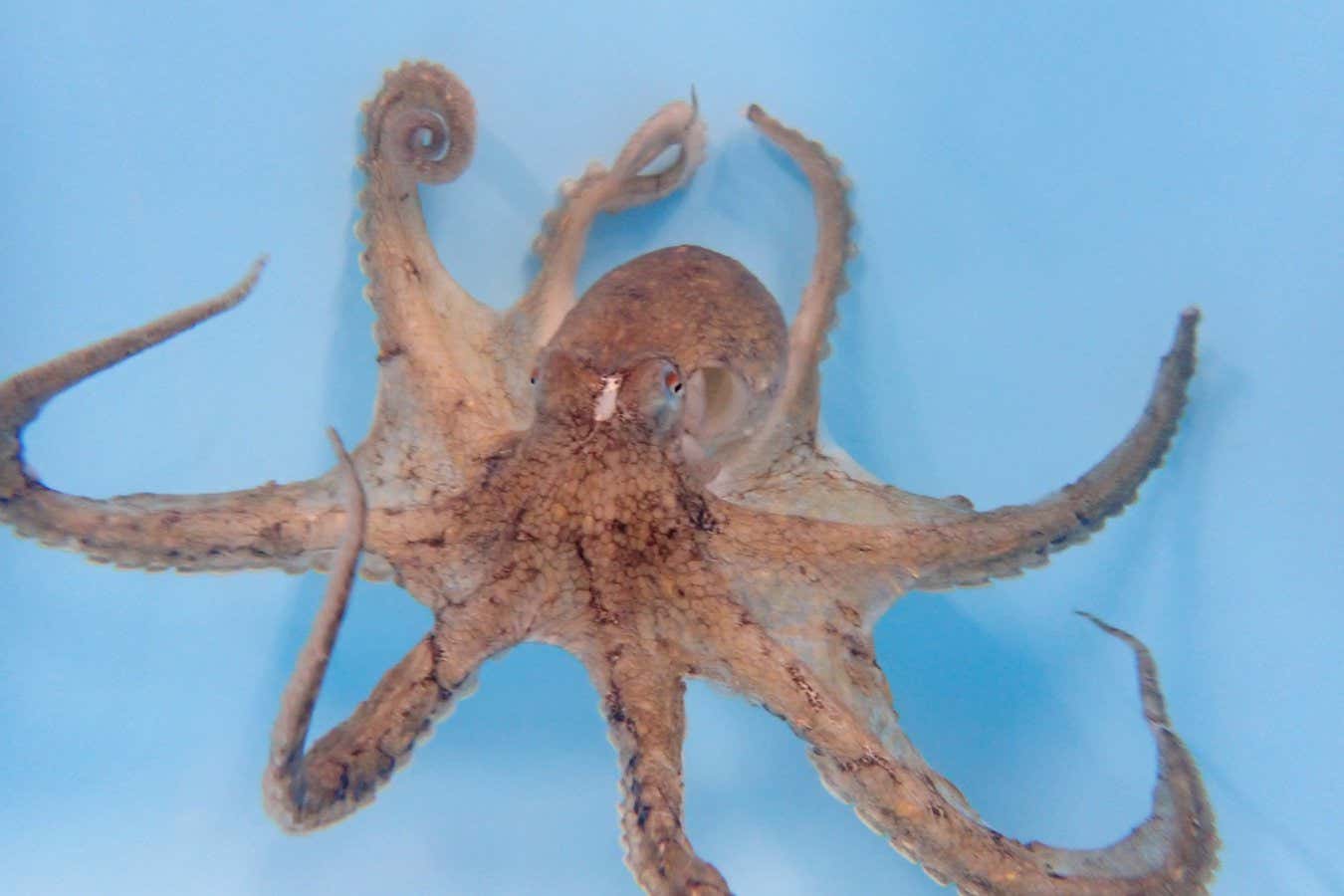
    A male webfoot octopus (Amphioctopus fangsiao) with its hectocotylus curled up (upper left)

    Keijiro Haruki

    For a male octopus, there is one appendage it cannot afford to lose. This is its third right arm, which has a specialised role in sex. Therefore, they take extra care to protect it.

    A new study led by Keijiro Haruki at Nagasaki University, Japan, has revealed the lengths octopuses will go to ensure their most precious arm stays safe from getting damaged or bitten off by a predator.

    Haruki was inspired to conduct the research after softly touching each of a male octopus’s arms with his finger. “He would strongly resist when I touched one particular arm and pull it back towards his body,” says Haruki. “Thanks to this behaviour, I realised that there is an arm that is particularly important for males. Because even human males, who are evolutionarily quite distant from octopuses, feel fear and their penises and testicles shrivel.”

    The third right arm – denoted as R3 – on a male octopus is called a hectocotylus, and it is anatomically different to the other seven. R3 has the job of delivering sperm from a penis that is so small that it cannot reach the female on its own.

    Male octopuses have one testis, located in the mantle – the balloon-shaped part behind the head. Sperm are produced here and then stored in packages called spermatophores.

    During mating, the male inserts the tip of the hectocotylus into the female. Before ejaculation, males curl up the hectocotylus to form a tube-like structure, which they force water into, in order to push the spermatophore from the penis into the female.

    To find out how protective octopuses are over their third right arm, Haruki and his colleagues collected 32 male and 41 female Japanese pygmy octopuses (Octopus parvus).

    Thirteen of the females had lost their R3 arm, but only one of the males had lost this arm. The team then conducted two experiments to compare how males and females use their R3.

    A male Octopus parvus during an experiment, with its hectocotylus curled up (lower right)

    Keijiro Haruki

    First, the team placed a lead sinker in the middle of the tank to see how the octopuses would use their limbs to find out what the sinker was. Significantly more females used their R3 arm to explore the unfamiliar object than the males.

    Then, frozen shrimp were placed inside a box in their tank. Males spent much more time exploring with their other seven arms before putting their hectocotylus at risk.

    Haruki says this complicated system of using an arm as a sex aid probably evolved “because the cost of specialising one of the eight arms as a hectocotylus and protecting it is lower than the cost of enlarging the penis”.

    If they do lose R3, a male’s sex life is over until a new one grows back, which can take several months, he says. “But in fact, since very few individuals lose their hectocotylus, it is likely that protecting a specific arm from loss is not particularly difficult for males.”

    Topics:


    Source link

    Share. Facebook Twitter Pinterest LinkedIn Tumblr Email Telegram Copy Link

    Related Posts

    Science

    How do earthquakes end? A seismic ‘stop sign’ could help predict earthquake risk

    April 24, 2026
    Science

    ‘Kraken’ fossils show enormous, intelligent octopuses were top predators in Cretaceous seas

    April 24, 2026
    Science

    Largest ever octopus was great white shark of invertebrate predators

    April 24, 2026
    Science

    Do you need to worry about Mythos, Anthropic’s computer-hacking AI?

    April 23, 2026
    Science

    How many dachshunds would it take to get to the moon?

    April 23, 2026
    Science

    The Age Code review: Can you slow ageing with your diet? A new book gives it a go

    April 23, 2026
    Editors Picks

    UN seeks independent probe into deadly Kabul clinic strike

    March 17, 2026

    Norway crown princess says she was ‘manipulated’ by Epstein

    March 20, 2026

    ‘Zombie’ cells created by transplanting genomes into dead bacteria

    March 23, 2026

    Climate change threatens the Winter Olympics—even snowmaking won’t save it

    February 4, 2026

    Government demands Musk’s X deals with ‘appalling’ Grok AI

    January 6, 2026
    About Us
    About Us

    Welcome to Benjamin Franklin Institute, your premier destination for insightful, engaging, and diverse Political News and Opinions.

    The Benjamin Franklin Institute supports free speech, the U.S. Constitution and political candidates and organizations that promote and protect both of these important features of the American Experiment.

    We are passionate about delivering high-quality, accurate, and engaging content that resonates with our readers. Sign up for our text alerts and email newsletter to stay informed.

    Latest Posts

    When is London Marathon 2026? Start time and how to watch race for FREE

    April 24, 2026

    Pentagon Requests $54 Billion For AI War

    April 24, 2026

    Clavicular Hit With New YouTube Crackdown

    April 24, 2026

    Subscribe for Updates

    Stay informed by signing up for our free news alerts.

    Paid for by the Benjamin Franklin Institute. Not authorized by any candidate or candidate’s committee.
    • Privacy Policy
    • About us
    • Contact us

    Type above and press Enter to search. Press Esc to cancel.