

Feedback is New Scientist’s popular sideways look at the latest science and technology news. You can submit items you believe may amuse readers to Feedback by emailing feedback@newscientist.com
Ready for Eurovision
Prepare to have fun, whether you want to or not, as the 2026 Eurovision Song Contest rumbles into view, with the final taking place on Saturday 16 May.
In a piece of judicious timing, the journal Royal Society Open Science has published a big study of Eurovision’s history. The researchers compiled data on every contest from 1956 until 2024, a total of 1763 songs. They then classified the songs based on the language used, the themes and lyrics, and musical attributes such as genre. For some of this they used AI tools, which Feedback can understand because the thought of listening to 1763 Eurovision entries caused our tympanic membranes to briefly fold back on themselves.
All sorts of things fell out of this analysis. For instance, a previous study had identified 12 main themes that describe the most popular songs, including aspiration, desire, breakup and pain. However, Eurovision entries really use only 11: “We excluded ‘Jaded’ because it appears in fewer than 5% of the songs,” the authors wrote. Feedback feels we could have told them that, because the contest’s gloriously naff sensibilities don’t really allow for anything as complicated as feeling jaded. But maybe that is our own jadedness talking.
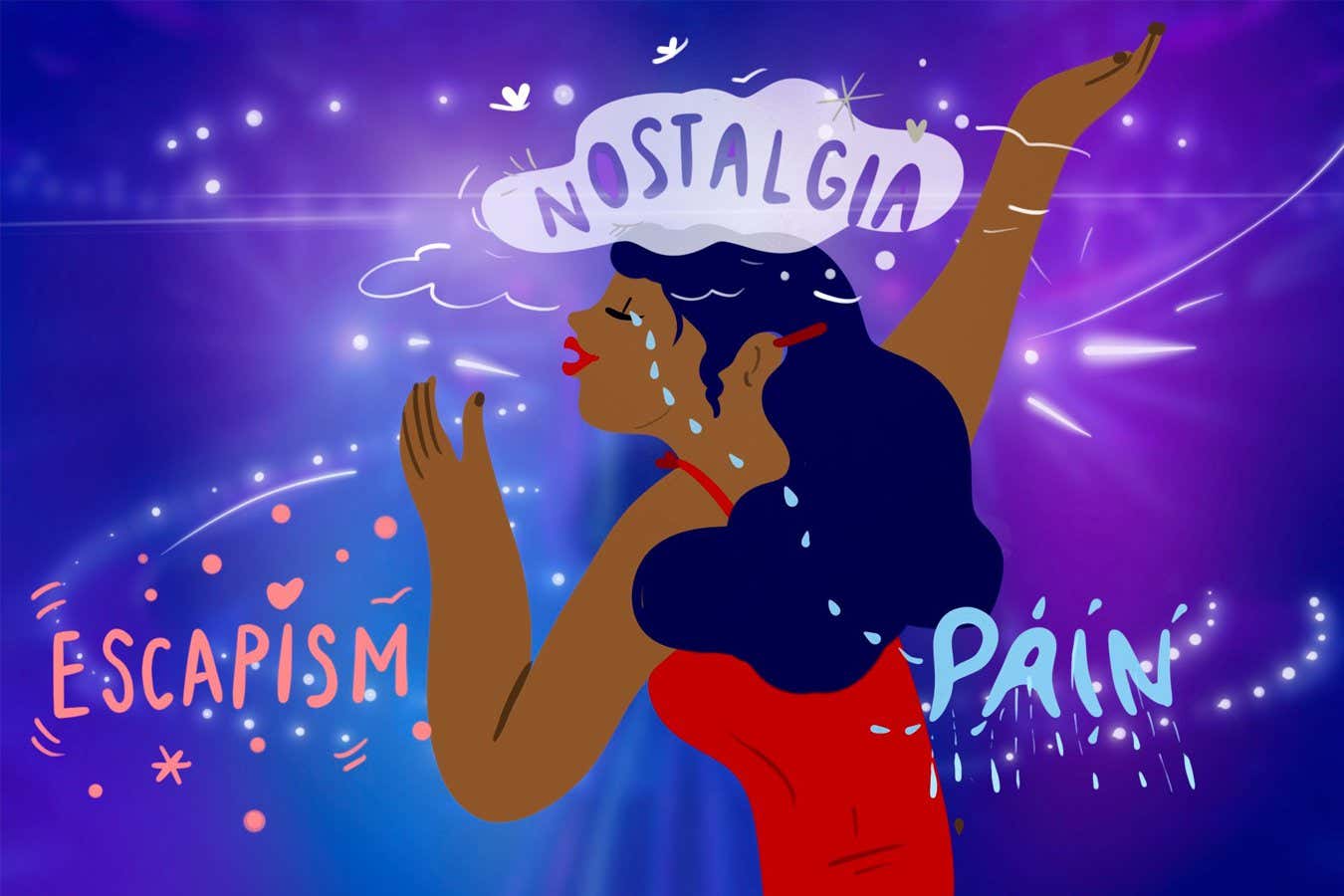
One of the steepest declines has been in songs expressing nostalgia, which evidently isn’t what it used to be. However, pain, rebellion, desperation, confusion and escapism have become more prevalent. There was a significant increase in both confusion and escapism in the 1970s, which the researchers suggest was “a response to all the crises of the 1970s”. However, pain started rising only in the 2000s. “It may not be a coincidence that this is occurring after the Great Recession,” the authors write. Yet desperation remains fairly rare. “This may be due to the emotional weight of a feeling such as desperation, which could turn voters off,” they say. Feedback cannot shake the feeling that this could all be summarised concisely as “we don’t know”.
Over the decades, songs have become less acoustic and more electronic. They are mostly written in English, as opposed to countries’ national languages. And they tend to be pop, as opposed to any other musical genre, with high levels of “danceability”. “Participants actively adjust their entries to match the standards set by recent winners,” it seems.
Finally, there are some curious exceptions to these trends. France, Italy, Portugal and Spain have all resisted the temptation to use songs with English lyrics. Apparently, “paying a cost for promoting their own languages is a rational choice in a geopolitical context that extends beyond winning at [Eurovision].” Feedback always knew Eurovision was part of the Great Game.
The researchers sum all this up as “organizational level learning at the levels of organizers and participants”. Feedback thinks that means “people keep trying to game the contest”.
Moss appeal
In a previous item, Feedback described a park filled entirely with sculptures of microscopic foraminifera, and wondered if there were any scientifically themed tourist attractions that were even more niche. Specifically, we wondered whether there might be “a museum dedicated solely to mosses” (11 April).
Reader John Wilson wrote in to tell us about the Serenity Moss Garden in North Carolina. The mosses cover about 900 square metres of a mountainside and can be viewed from a trail. It’s not a museum, says John, “as in a climate-controlled box with pillars and curators sans social skills” (ouch), but nevertheless “it’s a thing, for those so inclined”.
Clearly, Feedback was insufficiently ambitious in our quest for niche attractions. Can anyone find a museum of Plecoptera (stoneflies), or a curated set of beach pebbles?
New new math
Despite our place of employment, Feedback still gets nervous about certain kinds of maths. We know intuitively what it means to divide two fractions, but actually doing it requires a pencil and paper. As for converting through orders of magnitude, like changing square kilometres into square metres – oof.
No such nerves afflict Robert F. Kennedy Jr., the US secretary of health. He faced criticism after claiming that the price of a drug had fallen by 600 per cent, which rival politicians pointed out was mathematically impossible.
Feedback is fairly sure that, in this case, RFK Jr.’s rivals are correct, because if the price of something drops by 100 per cent that means it has dropped to zero, and that seems like a natural limit. We suppose the company could start paying people to take the drug off its hands, meaning the item had a negative price. However, translating that into a percentage change is something we are happy to leave to the mathematicians, and in any case, no pharma company is doing that.
Into this mathematical quagmire stepped RFK Jr. “Well, if the drug was $100 and it raises to $600, that would be a 600 per cent rise,” he said. “If it drops from $600 to $100, that’s a 600 per cent savings.”
We can only conclude that RFK Jr. has invented a new kind of logical reasoning. Unlike a syllogism, where the conclusion follows inescapably from the premise, this is an anti-syllogism, where, despite a clearly correct premise, the conclusion is 100 per cent wrong.
Got a story for Feedback?
You can send stories to Feedback by email at feedback@newscientist.com. Please include your home address. This week’s and past Feedbacks can be seen on our website.