

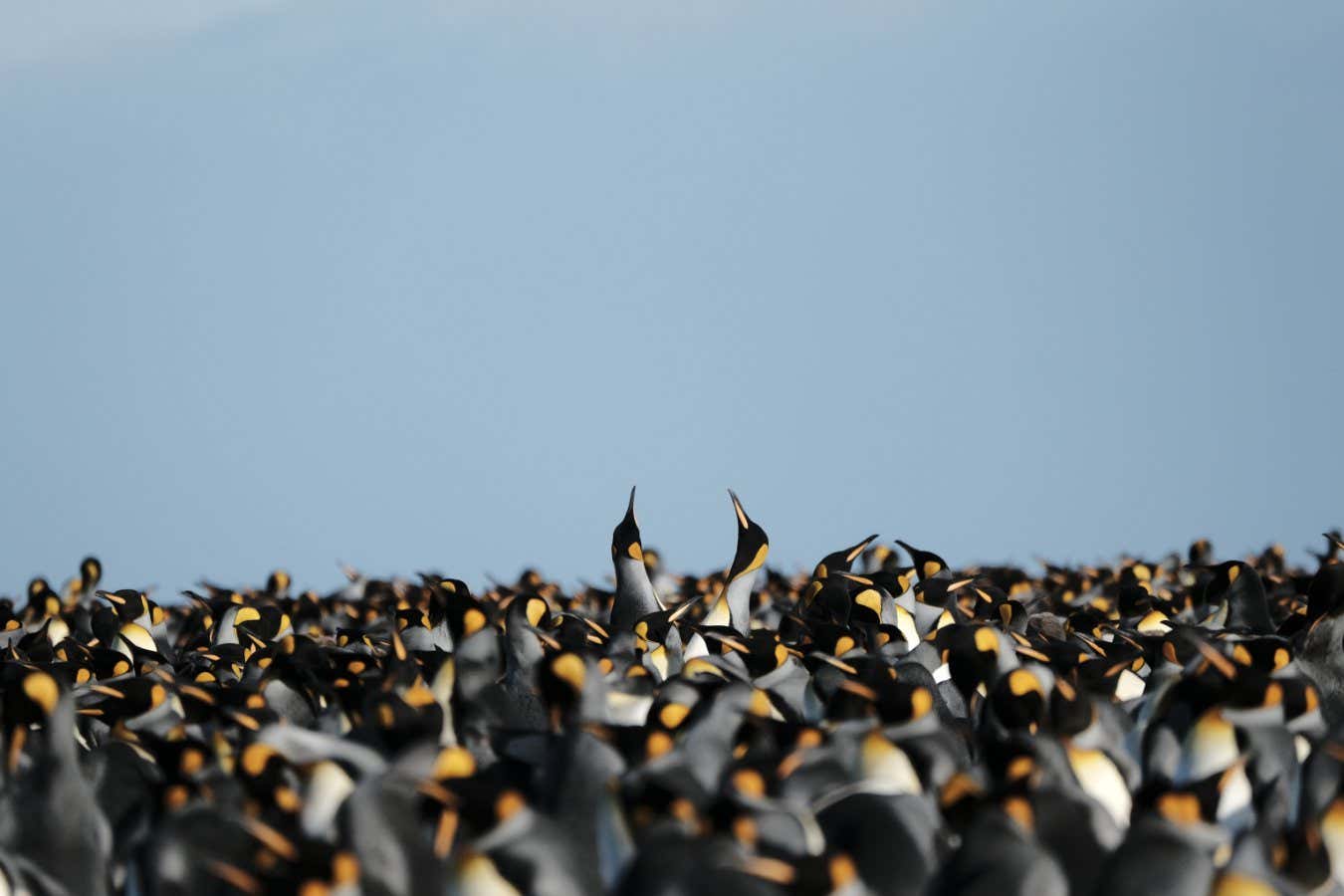
Two king penguins calling in the middle of a colony on Possession Island, a French territory in the southern Indian Ocean
Gaël BARDON (CSM/CNRS/IPEV)
King penguins are not just surviving, but thriving as temperatures rise in the sub-Antarctic, with more of their chicks surviving to maturity. Yet although the species looks like a climate change winner, some researchers fear it could eventually lose access to crucial food sources and decline.
King penguins (Aptenodytes patagonicus) on Possession Island, a French territory midway between Antarctica and Madagascar, began breeding about 19 days earlier in 2023 than they did in 2000. Thanks to this longer breeding season, 62 per cent of chicks now survive on average, up from 44 per cent in 2000, according to research by Gaël Bardon at the Monaco Scientific Center and his colleagues.
“With king penguins, we can see that there are super-fast changes in the Southern Ocean that are good for them for the moment, but for the long term, we don’t really know,” says Bardon.
Pairs of king penguins, which are recognisable by the brilliant yellow-orange feathers on their neck, look after a single egg during the austral summer, from which a fluffy brown chick hatches about two months later.
Parents leave chicks on their home island and swim hundreds of kilometres south to the polar front, an area where the mixing of warm and cold currents brings up nutrients that ramp up plankton growth. The penguins catch small lanternfish that feed on plankton, bringing some fish back to the chicks.
Warmer waters can boost lanternfish numbers. The study found that early breeding was mainly correlated with higher sea surface temperatures and lower plankton concentrations, a combination that suggests an abundance of lanternfish.
This earlier breeding gives the chicks more time to fatten up on fish before the long, hungry winter, so fewer of them starve, says Bardon.
Although better chick survival hasn’t actually increased the population on Possession Island, which appears to be at carrying capacity, more penguins may be moving to other islands and growing the colonies there, he says.

A group of king penguins on Possession Island
Gaël BARDON (CSM/CNRS/IPEV)
At the same time, the king penguins’ shift towards earlier breeding, which has happened faster than in almost any other polar species, is an “alarm call” that shows how rapidly the environment is changing, according to team member Céline Le Bohec, also at the Monaco Scientific Center.
In previous years of unusual warmth, the polar front has retreated southwards and the king penguins have had to swim further to catch fish, leading to lower chick survival and a decrease in the population on Possession Island. Because there are no islands further south where the penguins can move, they have had to extend their foraging range, and a previous study found this population would decline in coming decades if the polar front continues to gradually shift south.
“This fast change, which increases the window for the breeding cycle, is positive, but once the food availability at the polar front will be… too far away from the colony, it will collapse,” says Le Bohec. “You will reach a tipping point.”
Other researchers are more optimistic. Lewis Halsey at the University of Roehampton, UK, who witnessed the Possession Island penguins rebound after a mini-tsunami in 2004, points out they also eat other food like squid closer to the island. He says the population may shrink, but not die out. “I don’t see a collapse, as I see them as inherently very flexible.”
At best, scientists would have expected king penguins’ breeding to remain stable as they adapt to climate change, so the fact it actually improved is a very positive sign, says Tom Hart at Oxford Brookes University, UK.
“This is a good news story, and sure, things could change, but when we’re looking at other penguins particularly, most of them as a whole family are in decline,” he says. “This is a rare win.”
Travel to Churchill in northern Canada, the ‘Polar Bear Capital of the World’, to witness the planet’s greatest concentration of these iconic Arctic predators. Explore their evolutionary history, observe their behaviours in the wild, and gain insight into the delicate balance of Arctic ecosystems. Topics:
Churchill polar bear adventure: Canada