

Imagine you are video chatting with a distant friend who is eating lunch, and your pal’s sandwich looks delicious. What if you could ask your friend to dip a sensor into the meal, and give you a taste?
Remote snacking has moved a bit closer to virtual reality. In a paper on Friday in the journal Science Advances, Yizhen Jia, a graduate student in materials engineering at Ohio State University, his adviser Jinghua Li and their colleagues report that they helped volunteers taste flavors meant to represent distant samples of coffee, lemonade, fried eggs, cake and fish soup.
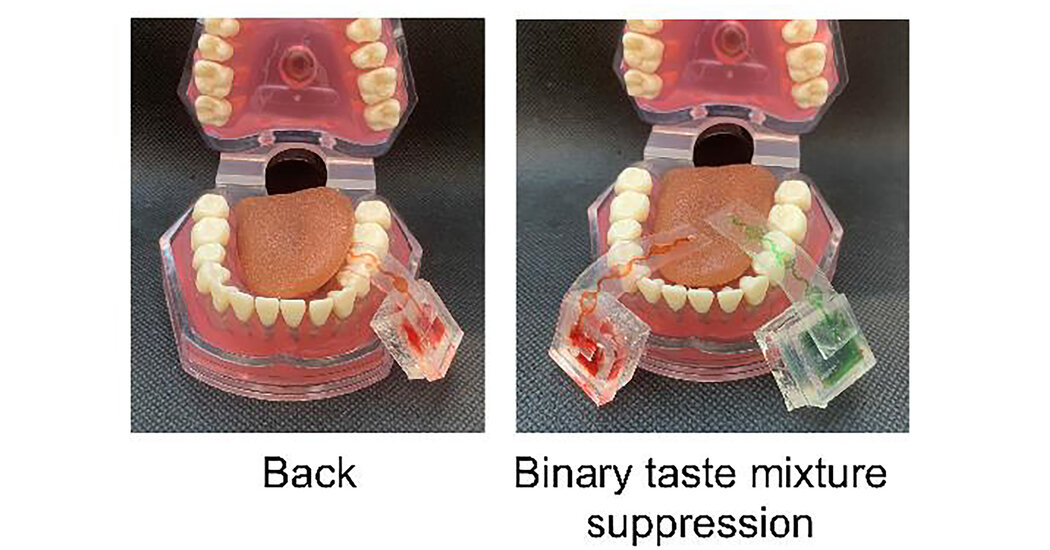
In an interview, Mr. Jia discussed a picture of him modeling one version of a device he and his colleagues built, which relies on microfluidics. Dangling from his lip are what look like five or six sauce packets that you’d add to instant ramen. The packets feed into a little tube slipped into his mouth. When miniature pumps in the packets receive a signal from a sensor dipped into a fluid far away, they get to work. In this case, the researchers’ aim was to accurately transmit the taste of a glass of lemonade.
In a more complex version of the setup, packets containing a variety of substances such as salt water, citric acid and glucose are arrayed in a semicircle on a table, allowing a person at the end of the tube to receive other tastes.
Why, you might ask, would you want to taste someone else’s fish soup? Mr. Jia points out that it’s commonplace to be able to see and hear what’s going on far away. Why not be able to taste it? Or maybe you’d like to taste recipes in a cookbook before you commit to making them. Maybe someday there might be a button on online grocery shopping services so you could virtually taste test different hot sauces before buying them.
Right now, these scenarios might seem a bit whimsical and the device, to put it mildly, a tad cumbersome. The researchers behind the new paper, however, are not the only ones working on devices that could allow us to taste and smell things that are not in our immediate vicinity.
“There are people trying to do it with direct electrical stimulation on your tongue,” Mr. Jia said. “There are people trying to use other ways to deliver the chemicals. We are using a water pump.”
In this paper, the team’s pump sent various concentrations of lemonade flavoring to volunteers. They demonstrated that the study’s participants could reliably rate the samples by sourness. Whether the researchers dipped a sensor in lemonade to generate the flavor, or simply used a recipe to mix chemicals transmitted by the pump, the effects were similar.
When volunteers were sent the flavors of coffee, fried eggs, cake, lemonade and fish soup generated via chemical recipes, they were able to correctly identify which of the five tastes they’d been fed most of the time. With a wider variety of chemicals and more recipes, more foods could be simulated, the researchers suggest.
It is trickier than it sounds, however: Not all tastes are equally easy to simulate. When you are working with tiny amounts of fluid, it can be difficult to nail the concentrations of taste molecules so that a subject has an experience similar to the real thing. The smell and the texture of food and drink are intertwined with the experience of taste, as well. Think of the aroma of coffee and the way in which the liquid feels ever-so-slightly thicker than water.
“Everything has to come together for you to say, ‘This is good coffee,’” Mr. Jia said. “A drop of chemicals on your tongue is going to feel different.”
The team is now investigating whether faint vibrations on the tongue might be able to help simulate the texture of foods. They are also curious whether scents could be used to help round out the sensory picture. And they think they might be able to get the miniature pumps to be a bit more miniature.
Ideally, you would not have to dangle any such device from your lip. Someday, perhaps, the whole affair might be quite dainty — a locket or a pendant, transmitting tastes from far away.