

Happy now?
Assuming you are reading this issue promptly, it’s the post-Christmas lull: the weird interregnum between Christmas and the New Year when nobody is quite sure what to do with themselves (unless they are keen shoppers, in which case the January sales have you covered).
Anyway, Feedback recently learned something new about Christmas. This snippet came courtesy of freelance writer Michael Marshall, who wrote a story about a study of whether children behave better in the run-up to Christmas. If you didn’t read it, the short answer is “no, they don’t”. Parents, feel free to take a moment to grieve that one of your best levers to get the little blighters to behave apparently does literally nothing. We will add that the data did suggest that some types of behaviour improved if children were exposed to a lot of Christmas rituals, like putting up a tree and going carolling, and that these rituals might act as a kind of social glue encouraging kids to be kind and cooperative. Maybe try doing more of that? But we wouldn’t count on a miraculous transformation.
That wasn’t the new thing, though. Michael, we understand, had to leave something out of the story for lack of space. So, since we’re in the post-Christmas period, let’s have some leftovers.
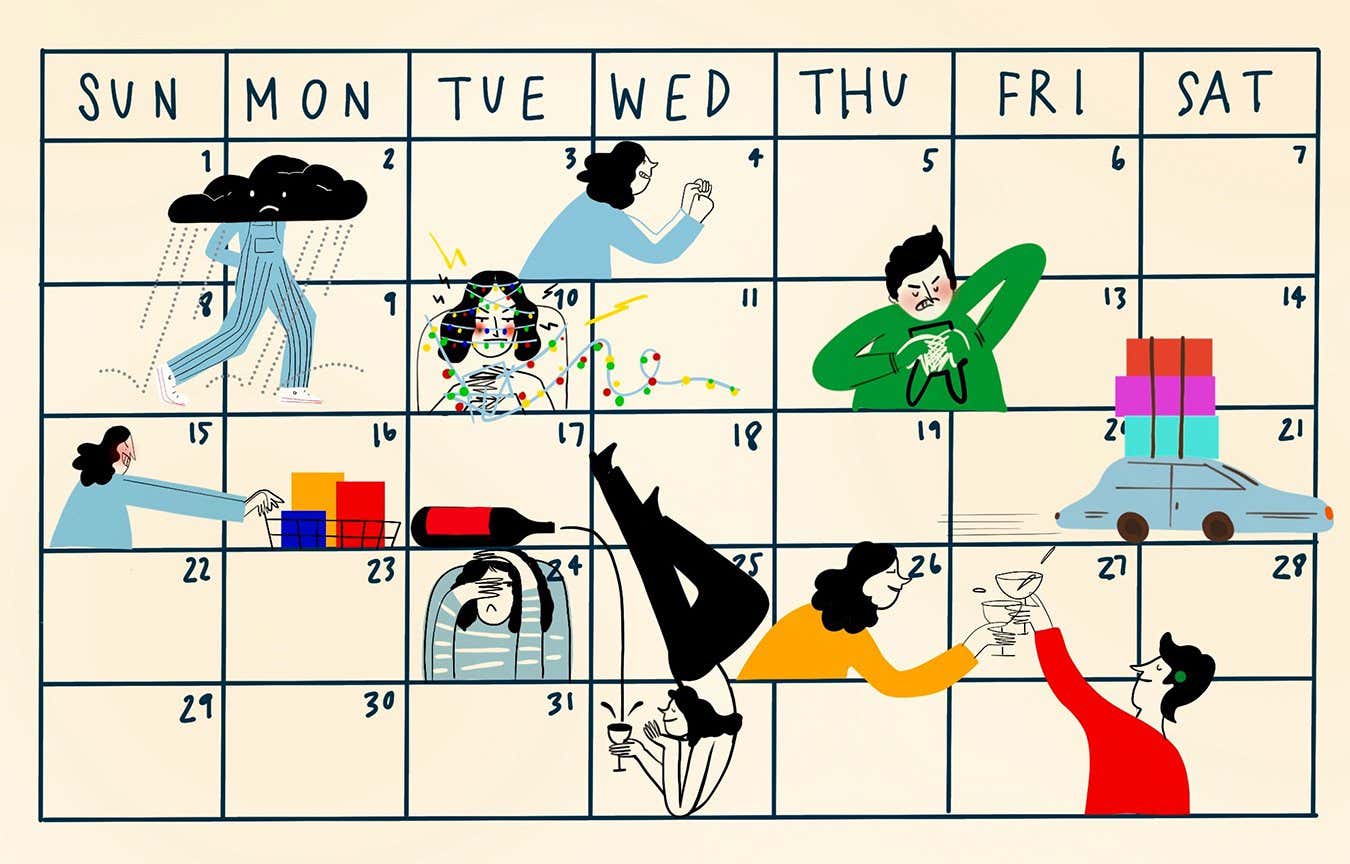
The study found that parents became more stressed as Christmas approached. In the run-up, they were often worried that it would be a disaster, that key presents wouldn’t turn up or that Great-uncle Ted would get drunk and say some slurs at the dinner table. This got worse in the week of Christmas, perhaps because they were working so hard preparing that they couldn’t relax and enjoy themselves.
Apparently, it’s common for people to only see major rituals as positive experiences once they’re over. It’s certainly true of weddings, which people describe as the happiest day of their lives when they look back, but if you ask them on the day, they will say they are so nervous they feel like throwing up. Feedback and Mrs Feedback can both attest that, yes, that’s what their wedding day was like (Feedback was fortified by a bacon-and-egg sandwich eaten in the bath and a stiff whisky).
It’s a curiously human thing to do something that you absolutely hate in the run-up and while it’s happening, and subsequently declare it the best thing you ever did. Feedback is not sure what to make of this, but this morning we noticed Feedback’s Felines sleeping peacefully in warm spots around the house, and we thought they might possibly be smarter than us.
Fake fake syndrome
Speaking of not being very smart, Feedback is launching a new recurring segment. We’re calling it “generative AIs say the stupidest things”. We suspect it will be a bottomless well of material, on a par with nominative determinism, and we hereby invite reader submissions to the usual address.
To kick things off, the anonymous neuroscience blogger Neuroskeptic recently saw something odd in the “AI Overview” that now appears at the top of Google Search. For readers unfamiliar with Neuroskeptic, they have written about the limits of functional brain imaging – especially when it’s wildly overinterpreted as “revealing people’s thoughts” – and about bad scientific publishing practices.
Neuroskeptic was surprised to see an AI Overview describing “kyloren syndrome”: “a disease caused by mutations in mitochondrial DNA” that is “often passed down from a force-sensitive woman to her children”. This is immediately and obviously nonsense: Kylo Ren is the baddie in the Star Wars sequel trilogy, and “force-sensitive” people only exist in the fictional Star Wars universe.
But it’s actually worse than that. Neuroskeptic invented kyloren syndrome in 2017, as part of a sting to expose predatory scientific journals that don’t properly review studies. They wrote an entire fake paper filled with Star Wars references, attributed to Lucas McGeorge and Annette Kin, and submitted it to nine journals. Three of them published it – and another accepted it but didn’t publish because Neuroskeptic refused to pay a $360 fee.
Apparently Google’s generative AI has not fully grasped the concept of “context”.
Swiftquakes
Feedback is sad to see the end of Taylor Swift’s world-spanning Eras tour. This is partly because we didn’t get to go, because we failed to use our understanding of probability and only registered interest in one concert – severely limiting our chances of getting to the top of the ballot. Maybe Feedback isn’t as clever as a generative AI.
But also, the concerts have been so huge that they have produced detectable seismic events. In June, geophysicists at University College London installed nine seismometers near Wembley Stadium in London and recorded the ensuing tremors. Love Story produced the biggest earthquake, although, to be clear, it was a magnitude 0.8, so really quite small, followed, appropriately enough, by Shake It Off.
Now that Taylor has gone home to (presumably) work on another surprise album, Feedback looks forward to earth movements triggered by other tours. We can’t help but suspect that the upcoming Oasis reunion tour might be worth a seismometer or two – if only to detect the precise moment when Liam Gallagher loses his temper and stomps offstage never to return.
Got a story for Feedback?
You can send stories to Feedback by email at feedback@newscientist.com. Please include your home address. This week’s and past Feedbacks can be seen on our website.