

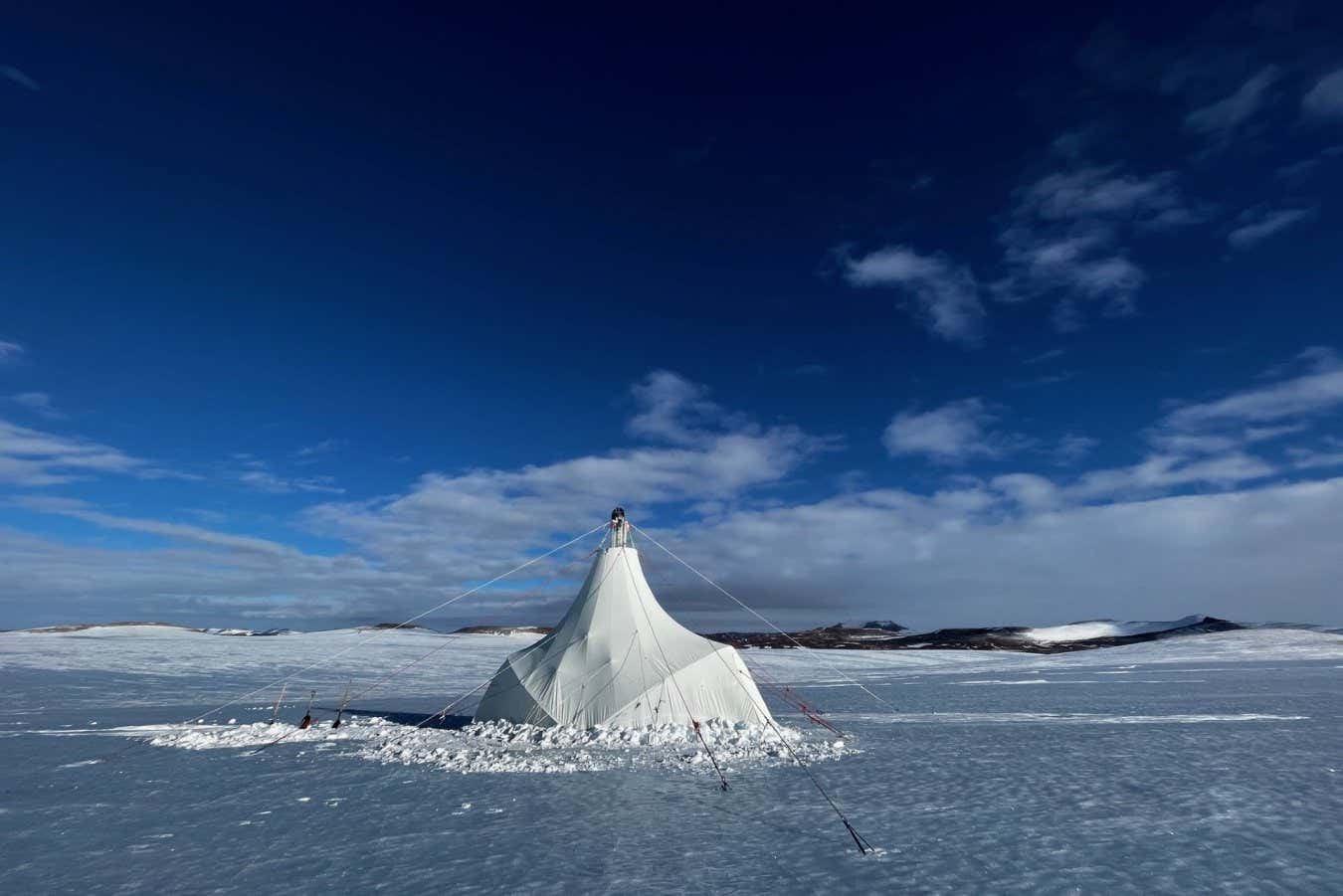
The drilling site at Allan Hills in Antarctica where researchers extracted a 3-million-year-old ice core
Austin Carter
Bubbles in a 3-million-year-old ice core have allowed researchers to measure gases in the atmosphere during the late Pliocene for the first time.
This epoch, when global temperatures are thought to have been around 1°C warmer than today and sea levels were as much as 25 meters higher, is often taken as a cautionary tale for our own time. But the levels of carbon dioxide and methane in the bubbles are much lower than today’s, which might mean Earth’s climate is more sensitive than we thought to small atmospheric changes.
In some parts of Antarctica, snow accumulates each year on top of the last year’s snow and gets squeezed into layers of ice containing air bubbles, giving us a continuous record of the past atmosphere. Last year, the Beyond EPICA group extracted the oldest continuous ice record so far, stretching back over 1 million years.
But scientists have also extracted even older ice in places where younger ice has been eroded by the wind and older “blue” ice is close to the surface.
Julia Marks-Peterson of Oregon State University and her colleagues used this ancient ice from Allan Hills to offer the first direct measurement of carbon dioxide and methane in the Pliocene’s atmosphere. The team found unexpectedly low levels of both gases around 3 million years ago: 250 parts per million for carbon dioxide, and 507 parts per billion for methane. During the subsequent cooling period, the team found a small decrease in carbon dioxide and no noticeable changes in methane.
The results are significantly lower than previous estimates based on indirect measurements, which had indicated carbon dioxide levels at 400 parts per million, closer to today. There are no indirect ways to measure past methane, which today hovers just under 2000 parts per billion.
“We definitely were a bit surprised,” says Marks-Peterson. If correct, the findings may suggest that even small changes to greenhouse gas levels could trigger major shifts in climate. “Maybe the Earth system is even more sensitive to changes in CO2 than we have understood,” she says. “That’s a little bit of a scary thought and something that I would say that our record can’t answer yet.”
“Ultimately, any new data that suggests Pliocene CO2 levels were lower than previously expected means future climate change might be worse than previously expected,” says Cristian Proistosescu at the University of Illinois Urbana-Champaign, who was not involved in the study.
But more work is needed before we can use the data to inform climate models, cautions Tim Naish at Victoria University of Wellington in New Zealand. “It’s way too early to throw the baby out with the bathwater,” he says. Naish wants to see the record carried back further in time, when the Pliocene was even warmer.
Thomas Chalk, of the European Center for Research and Education in Environmental Geosciences, says he is confident that the study’s low CO2 values are correct. However, he points out that distortion of ancient ice makes it impossible to know whether the low values represent a cold period, a warm period, or an accurate average. “It’s representative of something. We need to know what it’s representative of. Because it doesn’t come with its own little temperature estimate, and it certainly doesn’t come with a global temperature estimate,” he explains.
The team hopes to improve the reliability of their analysis by comparing their results with those of the continuous ice core from the Beyond EPICA group. “That will help us better understand our own record,” says Marks-Peterson. “We are all on pins and needles waiting to hear what they find.”
Topics: