

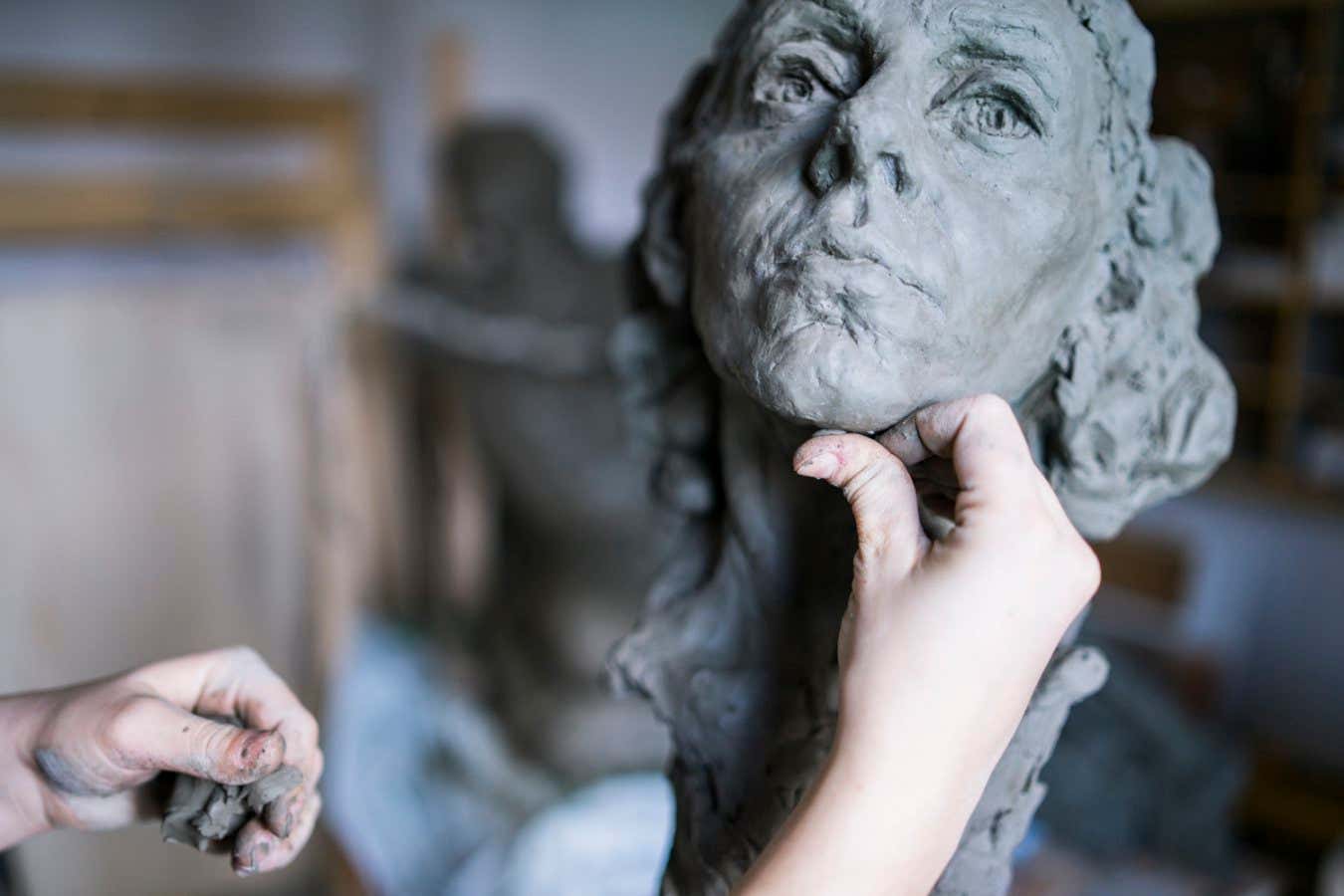
The human chin is an evolutionary oddity
Westend61/Getty Images
Humans are the only primates with a chin, leaving biologists to wonder why we acquired this unique feature. According to a new analysis of head anatomy in apes, it probably didn’t evolve for a specific reason of its own but instead emerged as a side effect of other changes driven by natural selection.
“There has been a tendency to assume that every feature that differs significantly between species has been shaped by natural selection for a specific purpose, but this ‘purposeful’ view of evolution is inaccurate,” says Noreen von Cramon-Taubadel at the University at Buffalo in New York state. “Evolution is often messier and less directed than people expect or assume.”
In simple terms, the chin is a bony projection of the lower jaw that extends beyond the front teeth. Even among our closest relatives, no other human species has a chin, so it has been used as a key identifying feature of Homo sapiens, but the reason why this trait evolved is a mystery.
Some researchers suggest it might reduce strain at the front of the jaw during chewing or that it supports our ability to form words. Others believe it evolved as part of sexual selection, with individuals preferring mates with this unique facial feature.
Still others question whether the chin has any purpose at all, suspecting the bony protrusion might have evolved incidentally as the skull and jaw went through other evolutionary changes.
Von Cramon-Taubadel and her colleagues wondered if it might be none of these theories, but rather the result of genetic drift – essentially, random evolutionary chance alone.
To find out, she and her colleagues investigated 532 skulls belonging to humans and 14 other species and subspecies of modern apes – including chimpanzees, bonobos, gorillas, orangutans and gibbons – housed in museums.
The researchers measured 46 distances between precise anatomical landmarks across the head and jaw – including nine along the region that forms the chin in humans – and mapped the results onto an evolutionary tree.
Next, they used that data to estimate the likely head and jaw shape of the last common ancestor of all apes. They then applied a standard quantitative genetic model to test whether changes along each family branch were greater or smaller than expected under random drift alone.
They found that three of the human chin-related traits were probably directly selected – meaning something about them was favorable enough to shape their evolution. But the other six traits appeared to be either unaffected by selection or simply by-products of evolution for other non-chin traits.
As our ancestors became more upright, the base of their skulls flexed, and their faces tucked beneath the braincase instead of projecting forward like it does in chimpanzees, von Cramon-Taubadel explains. Meanwhile, larger brains and dietary shifts reduced the need for large front teeth and powerful chewing muscles, shrinking the lower face and jaw. Over time, the upper jaw bones receded, leaving the lower jaw to project beyond the teeth – giving rise to the first chins.
As such, this unique feature appears to have emerged as a consequence of humans evolving an upright posture, larger heads and smaller teeth, highlighting how selection for one region of the body can have a knock-on effect on others, says von Cramon-Taubadel.
For Alessio Veneziano at the French National Museum of Natural History in Paris, the findings point to the chin as “a textbook example” of non-adaptation – a trait that appears without any direct activity of natural selection. “It’s always fascinating for me to see confirmation of important evolutionary trends occurring non-adaptively,” he says.
Evolutionary by-products like this are sometimes called spandrels – a term borrowed from architecture, where it refers to spaces that arise as a consequence of the shapes of other features such as arches. The human navel and the small arms of Tyrannosaurus rex have also been suggested to be spandrels.
The study highlights how tightly integrated the skull and jaw are as a unified system – so that when natural selection tweaks one part, other features can shift along with it, even if they weren’t the original target, says James DiFrisco at the Francis Crick Institute in London. “Just because an observable feature like the chin looks like a distinct ‘thing’ doesn’t mean it actually evolves as an independent unit,” he explains.
New Scientist regularly reports on the many amazing sites worldwide, that have changed the way we think about the dawn of species and civilisations. Why not visit them yourself? Topics:
Discovery Tours: Archaeology and palaeontology