

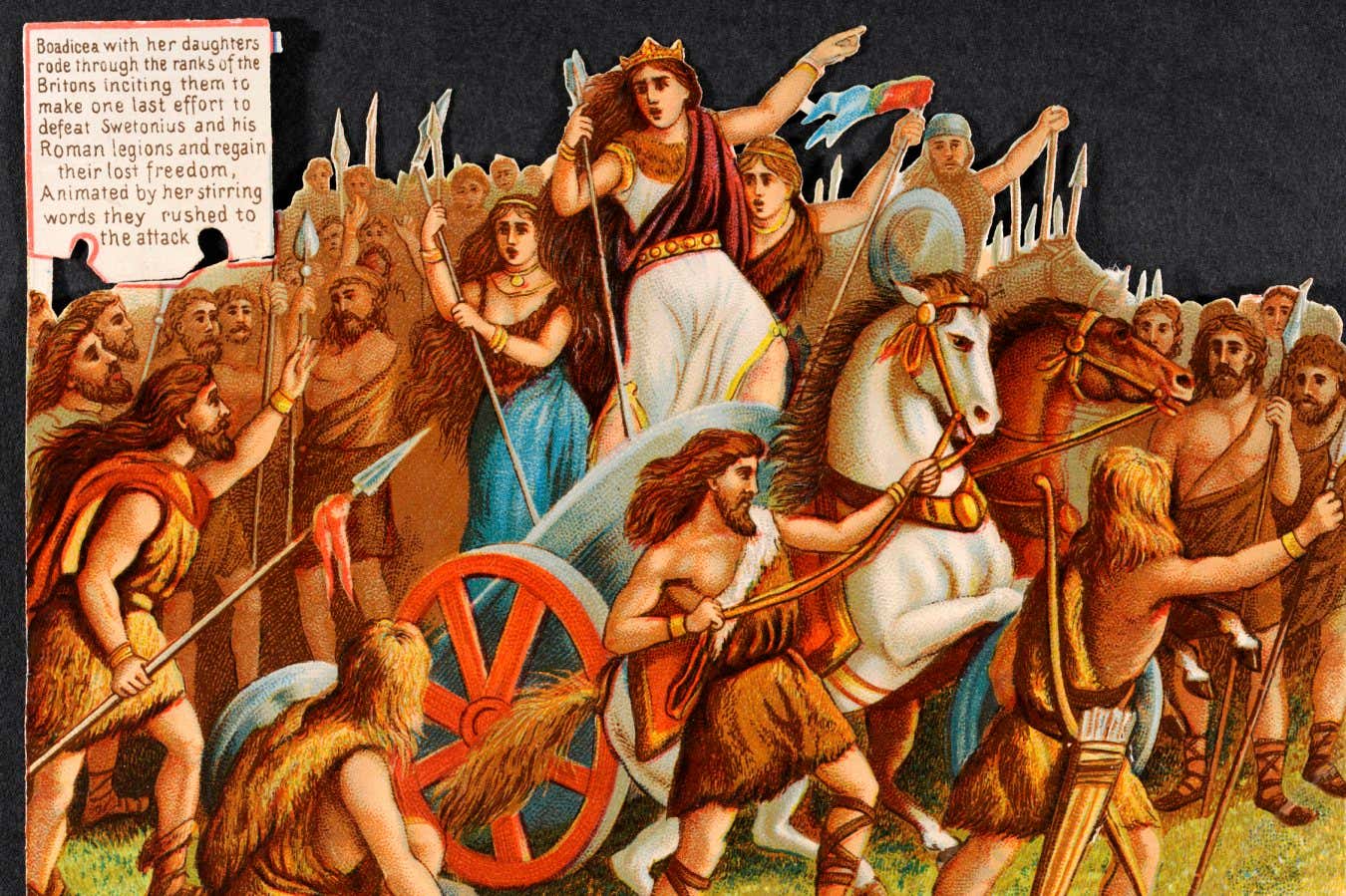
Boudica led an uprising against the Romans in around AD 60, as depicted in this Victorian-era chromolithograph
Popperfoto via Getty Images
Despite the Romans’ huge cultural and social impact on Britain, the genetic trace they left behind was surprisingly small, according to a study of more than a thousand ancient genomes.
“The Roman conquest was much less impactful in genetic terms than perhaps historically we have been led to believe,” says Rachel Pope at the University of Liverpool, UK, who wasn’t involved in the work.
Marina Soares Da Silva at the Francis Crick Institute in London and her colleagues analysed the genomes of 1039 people in Britain spanning from 2550 BC, in the Bronze Age, to AD 1150, after the Norman conquest. Roman occupation began in AD 43, immediately after the Iron Age, and lasted until 410.
They found that most people who lived under Roman rule in Britain traced 100 per cent of their ancestry to Iron Age Britain, with only 20 per cent carrying detectable ancestry from outside Britain.
“Evidence of only 20 per cent outside influence on the genetic structure, given the massive transformations to the way people lived, organised their lives, built their buildings and consumed material in the Roman period, is a surprise,” says Duncan Sayer at the University of Lancashire, UK, who wasn’t involved in the work. “I would have expected it to be bigger and to be more diverse.”
“This suggests that the Roman conquest isn’t really a conquest of biology, but a conquest of lifestyle,” he says. “What they’re doing is turning Britain into a series of exploitable markets and a small number of people were able to drive that transformation.”
The findings chime with earlier work that showed a low Roman genetic input in rural communities.
One key area where the Romans seem to have had an effect is in burial practices. In pre-Roman Britain, there is evidence that women in some areas were relatively empowered and remained in their ancestral homes while men moved in from other communities, a practice called matrilocality.
This means that people from such areas with Iron Age British blood tended to be buried according to their mother’s lineage, for example by resting alongside maternal kin, rather than spouses.
Silva and her colleagues identified further sites showing evidence that matrilineal burial continued until the late Iron Age in what is now south-west England.
“That was a surprise to me. The fact that we are seeing it even further west is really interesting,” says Pope.
However, in Roman-period cemeteries, Silva and her colleagues saw no clear patterns in family relationships, suggesting that Iron Age burial practices – and ways of life – were modified or abandoned.
Pope says it is no coincidence that the tale of Boudica, the queen of the British Iceni tribe who led an uprising against the Roman Empire in about AD 60, has survived. “It’s about a woman protesting that women were no longer able to inherit property.”
After the Romans left, however, the genetic picture changed dramatically. As part of a period of migrations across Europe between about AD 400 and 600, a collection of Germanic tribes, the Angles, Saxons and Jutes, established control over what is now England. The Anglo-Saxons, as we now know them, ruled until the Norman conquest in 1066.
Silva and her colleagues identified a widespread influx of ancestry associated with groups who probably spoke Germanic languages by the 6th century in over 70 per cent of individuals in southern Anglo-Saxon Britain.
This is very similar to the level identified by Sayer and his colleagues in a smaller sample of genomes from that period, around 76 per cent.
This led to a clustering of ancestry profiles, creating a population that Silva’s team calls early medieval Britain I. From the 8th to the 10th centuries, this early medieval Britain I ancestry became less prevalent, with many individuals instead carrying ancestries associated with central and southern Europe.
The team also found that the population-level genetic impact of the Vikings was limited, despite the establishment of a region in eastern Britain under Danish Viking control, the Danelaw, between the 9th and 11th centuries. Only 4 per cent of people in England between the 8th and 11th centuries retained ancestry thought to be from Iron Age Scandinavia.
This might be explained by the two phases of Viking Britain, says Sayer. In the first, the Vikings raided, taking people from Ireland and Britain back to Scandinavia as slaves, so the genetic impact is more likely to be seen in Scandinavia. Then, in the later invasion phase, the genetic mix of the people coming back to invade is very varied. “They’re coming into spaces where there are already individuals with the same sort of ancestries,” he says.
Silva and her colleagues found that the 69 genomes from after the Norman conquest revealed a similar lack of genetic influence following this invasion, but most of these genomes came from a single site in Leicester that was within the Danelaw region, so it might not be representative of the rest of the country.
Pope says the findings show how genetic input has always been coming into Britain from peoples all over Europe and beyond. “What is it to be English?” she asks.
“Perhaps we are driving ideas of ethnicity ourselves and it’s not something that’s so relevant in the past,” says Sayer.
Follow in the footsteps of the Romans on this immersive walking tour along Hadrian’s Wall, one of Britain’s most iconic, ancient landmarks and a UNESCO World Heritage Site. Topics:
Walking Hadrian’s Wall and Roman innovation: England