

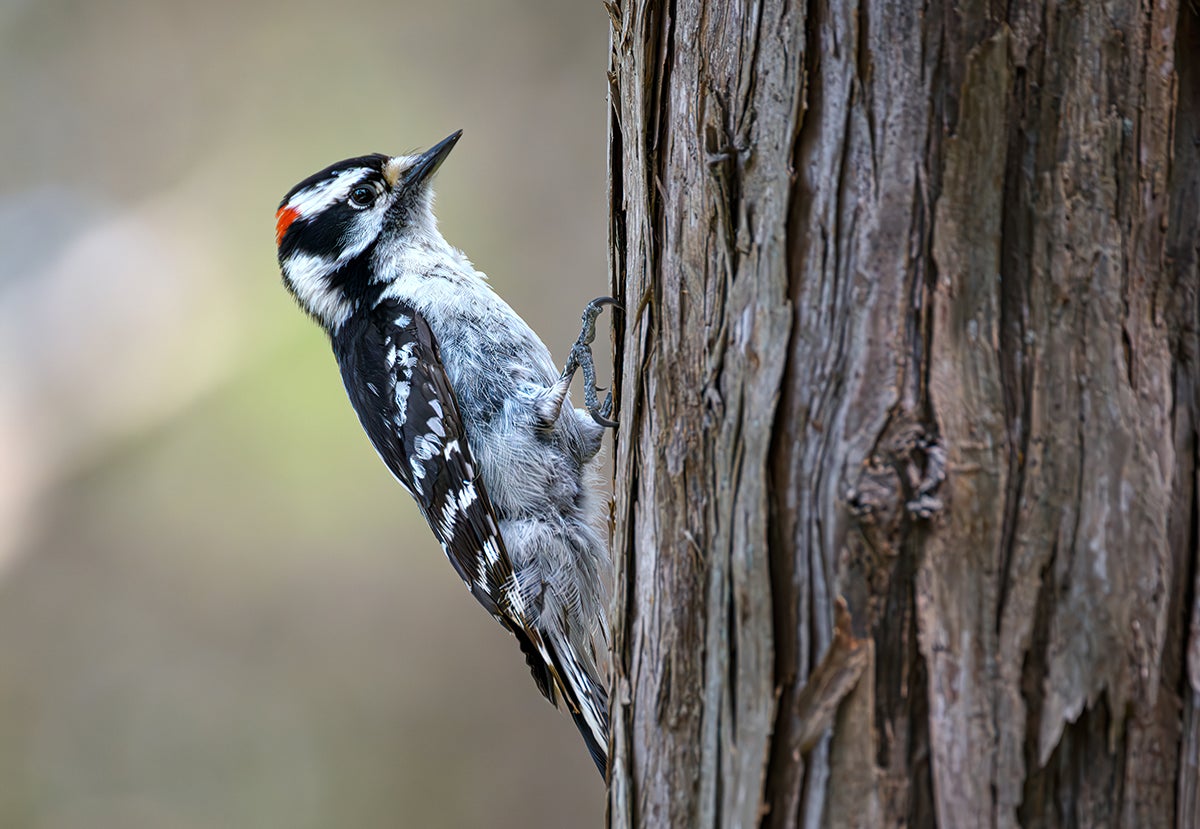
How Woodpeckers Turn Their Entire Bodies into Pecking Machines
These birds’ drilling approach is more like extreme tennis playing than weight lifting

Tapping woodpeckers harness their muscles more like tennis players than like weight lifters.
Diana Robinson Photography/Getty Images
Woodpeckers operate at an extreme level, boring through solid wood with forces more than 30 times their own weight and drilling up to 13 times a second. How do they never miss a beat while head banging so hard?
It turns out that the birds tense up their entire body to smash through wood, letting out short, explosive grunts with each strike, report Brown University biologist Nicholas Antonson and his colleagues in the Journal of Experimental Biology. “Woodpeckers really are nature’s hammer in a sense,” Antonson says.
To study how the birds tap, the researchers first humanely captured eight wild Downy Woodpeckers and carefully inserted electrodes into their muscles in the laboratory. The electrodes fed into a tiny, fitted backpack that recorded electrical signals from contracting muscles as the birds pecked. They also checked whether the woodpeckers held their breath during exertion (like weight lifters tend to do) or exhaled (like tennis players) while striking the wood by examining airflow through the birds’ air sacs—small, balloonlike structures that help them breathe in and out. By matching these measurements with high-speed videos, the scientists tracked the woodpeckers’ taps down to every four milliseconds.
On supporting science journalism
If you’re enjoying this article, consider supporting our award-winning journalism by subscribing. By purchasing a subscription you are helping to ensure the future of impactful stories about the discoveries and ideas shaping our world today.
Instead of using a single muscle to control the action, woodpeckers activated “every muscle from the head to the tail,” Antonson says. The birds used their powerful hip flexors to push forward, clenched their tail and abs to prepare for the strike, and stiffened the back of their head and neck on contact—similar to the way you might stiffen the back of your wrist when you hammer a nail. They then engaged a different set of hip and neck muscles to draw back.
The birds also perfectly paired their pecks with sharp exhalations “as another means of stabilizing their core muscles and powering through those strikes,” Antonson explains. “To be able to breathe out 13 times per second and inhale on the order of 40 milliseconds is really impressive.” Songbirds, which aren’t closely related to woodpeckers, are the only other birds known to so precisely time their breaths, which they do as they sing.
“Pecking is a full-body exercise,” says University of Alabama biologist Nicole Ackermans, who studies brain damage in woodpeckers and head-butting sheep. Coordinating “micro breaths” with muscle clenching and creating “this hammerlike structure in their whole body is such a unique approach,” she adds.
It’s Time to Stand Up for Science
If you enjoyed this article, I’d like to ask for your support. Scientific American has served as an advocate for science and industry for 180 years, and right now may be the most critical moment in that two-century history.
I’ve been a Scientific American subscriber since I was 12 years old, and it helped shape the way I look at the world. SciAm always educates and delights me, and inspires a sense of awe for our vast, beautiful universe. I hope it does that for you, too.
If you subscribe to Scientific American, you help ensure that our coverage is centered on meaningful research and discovery; that we have the resources to report on the decisions that threaten labs across the U.S.; and that we support both budding and working scientists at a time when the value of science itself too often goes unrecognized.
In return, you get essential news, captivating podcasts, brilliant infographics, can’t-miss newsletters, must-watch videos, challenging games, and the science world’s best writing and reporting. You can even gift someone a subscription.
There has never been a more important time for us to stand up and show why science matters. I hope you’ll support us in that mission.