
Close Menu
    Trending
    • When is London Marathon 2026? Start time and how to watch race for FREE
    • Pentagon Requests $54 Billion For AI War
    • Clavicular Hit With New YouTube Crackdown
    • Beijing’s new supply chain rules deepen concerns for US firms in China
    • India denounces ‘hellhole’ remark shared by Trump | Donald Trump News
    • New photos of Mike Vrabel and Dianna Russini emerge
    • AI search demands a new audience playbook
    • How do earthquakes end? A seismic ‘stop sign’ could help predict earthquake risk
    Benjamin Franklin Institute
    Friday, April 24
    • Home
    • Politics
    • Business
    • Science
    • Technology
    • Arts & Entertainment
    • International
    Benjamin Franklin Institute
    Home»International»How the Iran War, Then the U.S. Blockade, Has Changed the Strait of Hormuz: Maps
    International

    How the Iran War, Then the U.S. Blockade, Has Changed the Strait of Hormuz: Maps

    Team_Benjamin Franklin InstituteBy Team_Benjamin Franklin InstituteApril 16, 2026No Comments4 Mins Read
    Share Facebook Twitter Pinterest Copy Link LinkedIn Tumblr Email VKontakte Telegram
    Share
    Facebook Twitter Pinterest Email Copy Link


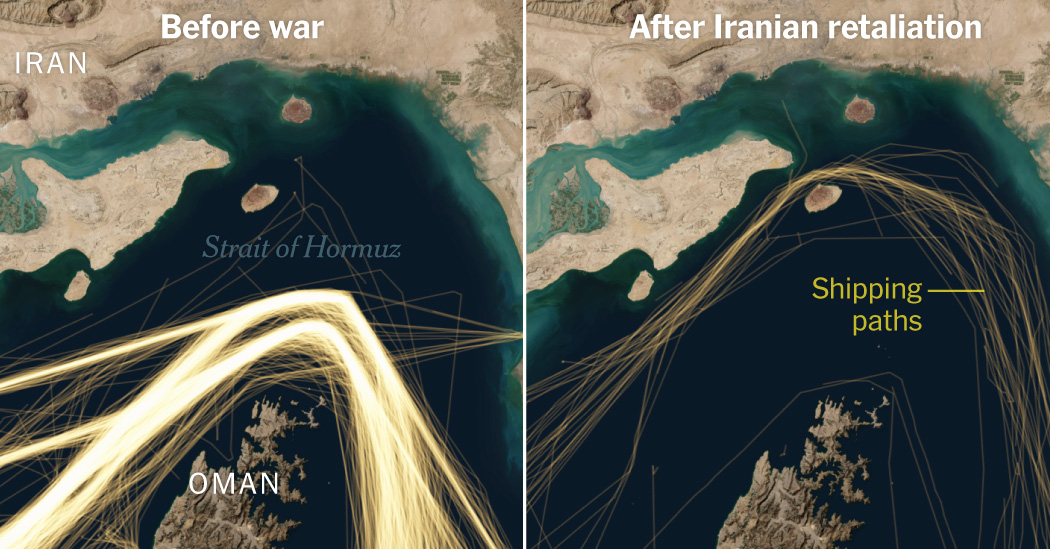
    Iranian threats hobbled shipping through the Strait of Hormuz during the war, moving what little remained north into its own waters.

    Before war Feb. 18–27

    After Iranian retaliation April 3–12

    Now the U.S. has mounted a blockade of its own, redrawing the board once again.

    After the U.S. blockade


    U.S. ships enforcing blockade in Gulf of Oman

    U.S. ships enforcing blockade in Gulf of Oman


    The American blockade aims to upend a dynamic that had become the new normal in the Strait of Hormuz since the United States and Israel launched the war in late February: Iran allowed ships carrying its own cargo to pass through the strait, even as it attacked commercial vessels and effectively halted shipping from almost everybody else.

    Though Iran was getting much-needed revenue from the Iranian-linked oil tankers it allowed to pass, the U.S. allowed them to keep transiting the strait. The goal was to temper the sharp increases in oil prices tied to the war.

    Most ships leaving the Persian Gulf came from Iranian ports

    Where ships exiting the strait after the war began last loaded cargo, oil or gas

    Note: Only ships that were loaded when exiting through strait are shown. Ships leaving other ports may also have Iranian ties, but their last port was not recorded as Iran. Ships entering the Persian Gulf are not shown. Source: Kpler. The New York Times

    On Monday, the United States imposed its own naval blockade, intent on ending Iran’s dominance of the waterway and cutting off its oil income by blocking all traffic to and from its ports.

    More than 12 American military vessels were stationed in international waters in the Gulf of Oman, beyond the strait, a U.S. official said on Tuesday. And the military is likely monitoring the region from a distance, using radar, patrol aircraft and drones, said Jennifer Parker, a former naval officer now at the University of Western Australia’s Defense and Security Institute.

    Since the U.S. blockade took effect, no ships linked to Iran have been spotted leaving the region, according to the vessel‑tracking company Kpler.

    Some ships appeared to have slowed or stopped. And at least two that had links to Iran, and are the target of U.S. sanctions, appeared to have turned around back toward the Persian Gulf as of Wednesday. One of the ships that reversed course, the Rich Starry, a Chinese tanker, was spotted traveling eastward through the strait on Tuesday toward open water before making a U-turn.

    ​​

    ​​Some ships without links to Iran did move through the strait on Monday and Tuesday, according to U.S. Central Command and companies like Kpler. The vessels stayed close to the Omani coast, keeping a distance from possible sea mines in the middle of the waterway.

    A precise accounting of how many vessels are crossing the strait is difficult, because vessels can hide or falsify information about their location, according to maritime intelligence experts.

    How Iran, then the U.S., changed shipping

    Vessel traffic in the strait slowed almost immediately after the United States and Israel attacked Iran on Feb. 28, from around 130 ships per day to just a handful.

    But even ships without ties to Iran may remain hesitant to attempt a passage. Amid fears that Iran may attack commercial vessels in response to the U.S. blockade, many shipping companies have been unwilling to risk the crossing. That might not change in the absence of a longer-term deal between the United States and Iran.

    Around 900 ships have been bottled up in the Persian Gulf over the course of the war, according to a New York Times analysis of Kpler data.

    How long ships have been stranded in the Persian Gulf

    Since start of war 10 to 42 days Less than 10 days

    OMANU.A.E.OMANQATARKUWAITIRAQIRANSAUDIARABIABAHRAINPersian GulfGulf of OmanStrait ofHormuz

    Note: Shows ship positions on April 12. Time spent in the Persian Gulf based on data from mid-February through April 12. The analysis includes oil tankers, cargo ships and gas carriers with a recent position in the Persian Gulf, excluding ships making routine deliveries between ports within the gulf. Source: Kpler (shipping data) The New York Times

    The standoff between the United States and Iran has spread concern that the vessels will be there even longer, giving the Iranians the upper hand, said Andreas Krieg, a senior lecturer in the School of Security Studies at King’s College London.

    “We’re getting to a place where everyone is very desperate, so the Iranians are trying to milk it as long as they can,” Mr. Krieg said. “I think we’ll have months and months of disruption around the Strait of Hormuz.”


    Source link

    Share. Facebook Twitter Pinterest LinkedIn Tumblr Email Telegram Copy Link

    Related Posts

    International

    When is London Marathon 2026? Start time and how to watch race for FREE

    April 24, 2026
    International

    Trump Announces Cease-Fire Between Israel and Lebanon

    April 24, 2026
    International

    Top Condom Producer to Increase Prices Due to War in Iran

    April 23, 2026
    International

    Ice Sculpture Promoting Drake Album Melted by Fire Crews

    April 22, 2026
    International

    Quiz: Can You Tell Real British Insults From Fakes?

    April 22, 2026
    International

    How China Is Building Its Next Outpost at Sea

    April 22, 2026
    Editors Picks

    Riley Keough Trying To Hold Family Together Amid Egg Donor Drama

    December 26, 2025

    US army says homeland, curbing China priorities; limited support for allies | Military News

    January 24, 2026

    The U.S. government has 3,000 AI systems in place. Will they fix anything?

    February 13, 2026

    TikTok closes deal to split US app from global business

    January 23, 2026

    Will UK porn age verification stop children seeing adult content?

    July 24, 2025
    About Us
    About Us

    Welcome to Benjamin Franklin Institute, your premier destination for insightful, engaging, and diverse Political News and Opinions.

    The Benjamin Franklin Institute supports free speech, the U.S. Constitution and political candidates and organizations that promote and protect both of these important features of the American Experiment.

    We are passionate about delivering high-quality, accurate, and engaging content that resonates with our readers. Sign up for our text alerts and email newsletter to stay informed.

    Latest Posts

    When is London Marathon 2026? Start time and how to watch race for FREE

    April 24, 2026

    Pentagon Requests $54 Billion For AI War

    April 24, 2026

    Clavicular Hit With New YouTube Crackdown

    April 24, 2026

    Subscribe for Updates

    Stay informed by signing up for our free news alerts.

    Paid for by the Benjamin Franklin Institute. Not authorized by any candidate or candidate’s committee.
    • Privacy Policy
    • About us
    • Contact us

    Type above and press Enter to search. Press Esc to cancel.