

Want more housing market stories from Lance Lambert’s ResiClub in your inbox? Subscribe to the ResiClub newsletter.
On Thursday, President Donald Trump announced that government sponsored enterprises (GSEs) Fannie Mae and Freddie Mac will buy an additional $200 billion in mortgage bonds.
Trump wrote:
“Because I chose not to sell Fannie Mae and Freddie Mac in my first term, a truly great decision and against the advice of the “experts,” it is now worth many times that amount—an absolute fortune—and has $200 billion in cash. Because of this, I am instructing my representatives to buy $200 billion in mortgage bonds. This will drive mortgage rates down, monthly payments down, and make the cost of owning a home more affordable.”
Long-term yields—like the 10-year Treasury yield and the average 30-year fixed mortgage rate—are set by demand / lack of demand for the underlying bond. Yields move inversely to bond prices. If demand for long-term bonds rises, prices go up and yields/mortgage rates fall. If bond demand falls, bond prices drop and yields/mortgage rates rise.
For example, when the Federal Reserve engages in quantitative easing, as it did during the pandemic, it buys long-term assets like Treasuries and mortgage-backed securities (MBS), increasing bond demand and pushing bond prices up and long-term yields down, including mortgage rates. The Fed’s MBS purchases put additional downward pressure on mortgage rates in 2020 and 2021.
Conversely, during quantitative tightening since 2022, the Fed has been letting MBS assets roll off its balance sheet without replacing them—effectively removing a major MBS buyer from the market—which can put additional upward pressure on 30-year fixed mortgage rates.
Effectively, Trump is proposing to use Fannie Mae and Freddie Mac—both in government conservatorship—to absorb a larger share of mortgage bonds, increasing relative market demand for MBS. That could put some short-term upward pressure on MBS prices and downward pressure on mortgage rates, further reducing the “mortgage spread.”
Around the same time the Federal Reserve began raising short-term rates and stopped buying long-term bonds in the spring of 2022, financial markets started pulling back from bonds, causing long-term yields—including mortgage rates—to surge. Only, without the Fed buying MBS, the 30-year fixed average mortgage rates saw a bigger jump than the 10-year Treasury yield.
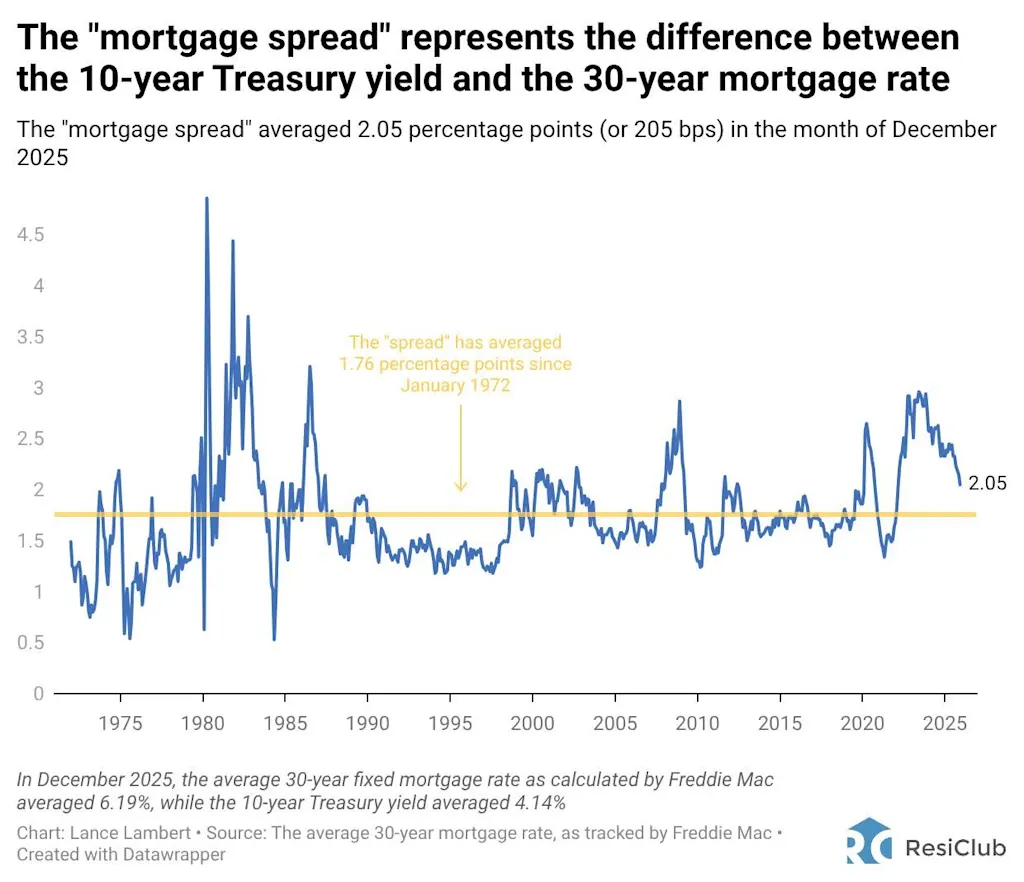
At its peak in June 2023, the “mortgage spread”—the difference between the 10-year Treasury yield and the average 30-year fixed mortgage rate—hit 2.96 percentage points (296 bps). That was far above the 1.76 percentage point (176 bps) historical average since 1972.
Over the past 2 years, the “mortgage spread” has slowly compressed—hitting 2.05 percentage points (205 bps) in December 2025.
The goal of Trump’s announcement on Thursday (i.e., Fannie Mae and Freddie Mac buying an additional $200 billion in mortgage bonds) is to accelerate that “mortgage spread” compression.

As reported by Bloomberg in December, Fannie Mae and Freddie Mac have already started to accelerate their retained mortgage holdings—with them climbing around $69 billion in the second half of 2025.
According to John Burns Research and Consulting, if Fannie Mae and Freddie Mac were to add another $200 billion in mortgage bond holdings in 2026, it would put the GSEs pretty close to their $450 billion legal limit ($225 billion each).
On Thursday, Alex Thomas, research manager at JBREC, tweeted:
“Fannie [Mae] and Freddie [Mac] have already added ~$70B to their retained mortgage portfolios since May of last year. Adding another $200B would basically put the GSEs at their legal cap ($225B each).”
Following Trump’s Thursday post, there was some immediate MBS pricing movement.

That said, it’s unclear exactly just how much impact an additional $200 billion in GSE retained mortgage bonds would have on the “mortgage spread” and the average 30-year fixed mortgage rate.
Through the end of June 2025, there is $9.26 trillion in agency mortgage-backed securities (MBS), according to data the Urban Institute recently provided to ResiClub. Below is the breakdown:
- —> $3.00 trillion held by depositories (banks)
- —> $2.74 trillion held everyone else
- —> $2.14 trillion held by the Federal Reserve
- —> $1.33 trillion held by foreign buyers
- —> $0.06 trillion held by GSEs (Fannie Mae and Freddie Mac)
The chart below is the same as the one above, but it shows MBS holders by distribution.

Prior to the Great Financial Crisis, the GSEs (Fannie Mae and Freddie Mac) used to be much bigger buyers of mortgage-backed securities.
In an Urban Institute report published in January 2026, Laurie Goodman and Jim Parrott explain what happened:
“For years, Fannie Mae and Freddie Mac were the buyers of last resort in the market, stepping in to profit from widening spreads and, in doing so, putting a comforting outer bound on MBS volatility. Once they went into conservatorship, the government-sponsored enterprises (GSEs) were replaced in that role by the Federal Reserve, which stepped into the agency MBS market to calm much larger swings in the economy. All of this went unnoticed outside of the MBS market until recently, when the Federal Reserve finally ended its time in the stabilizing role, leaving the MBS market without a buyer of last resort for the first time in decades.”
“The GSEs gave up their role as market stabilizer when they went into conservatorship and began reducing their portfolio under the terms of their bailout by the Treasury. The Federal Reserve then promptly stepped into the role. As part of its broader effort to shore up the market in the wake of the financial crisis, the Federal Reserve bought $1.25 trillion in agency MBS between January 2009 and March 2010 and bought another $823 billion between 2012 and 2014. Largely because of that aggressive posture, along with the bailout of the GSEs, the MBS market and mortgage liquidity generally remained stable through the depths of the crisis, a remarkable feat given the level of dislocation in the rest of the economy.”
“The Federal Reserve was then well positioned to handle the next major disruption in the MBS market, when financial markets seized up in the early days of the COVID-19 pandemic. In February and early March 2020, the financial markets froze, and investors were forced to sell their agency MBS to build cash reserves, pushing mortgage spreads wider by 75 basis points. The Federal Reserve stepped in in March, committing to buying agency MBS and Treasury securities “in the amounts needed to support smooth market functioning and effective transmission of monetary policy to broader financial markets and the economy.” 1 True to its word, the Federal Reserve, over the next month, bought more MBS than the entire gross production of the securities, stabilizing spreads and, with them, mortgages rates. Spreads ultimately settled a bit higher than they had been before the pandemic, but that was attributable to volatility in fixed income and a refinance wave triggered by the drop in Treasury rates.”
“The Federal Reserve relinquished its role as the stabilizer of the agency MBS market when it pivoted to quantitative tightening in March 2022, ending its purchases of MBS and committing to running off its MBS portfolio. With the GSEs still operating under the portfolio constraints imposed in conservatorship, that left the market without a stabilizer for the first time in recent history.”