

Feedback is New Scientist’s popular sideways look at the latest science and technology news. You can submit items you believe may amuse readers to Feedback by emailing feedback@newscientist.com
Caped crusaders
It has been some time since Mrs Feedback was pregnant, but she still remembers the bother of trying to get a seat on public transport while having a belly the size and shape of a volleyball. Other passengers couldn’t always be counted on to give up their seats.
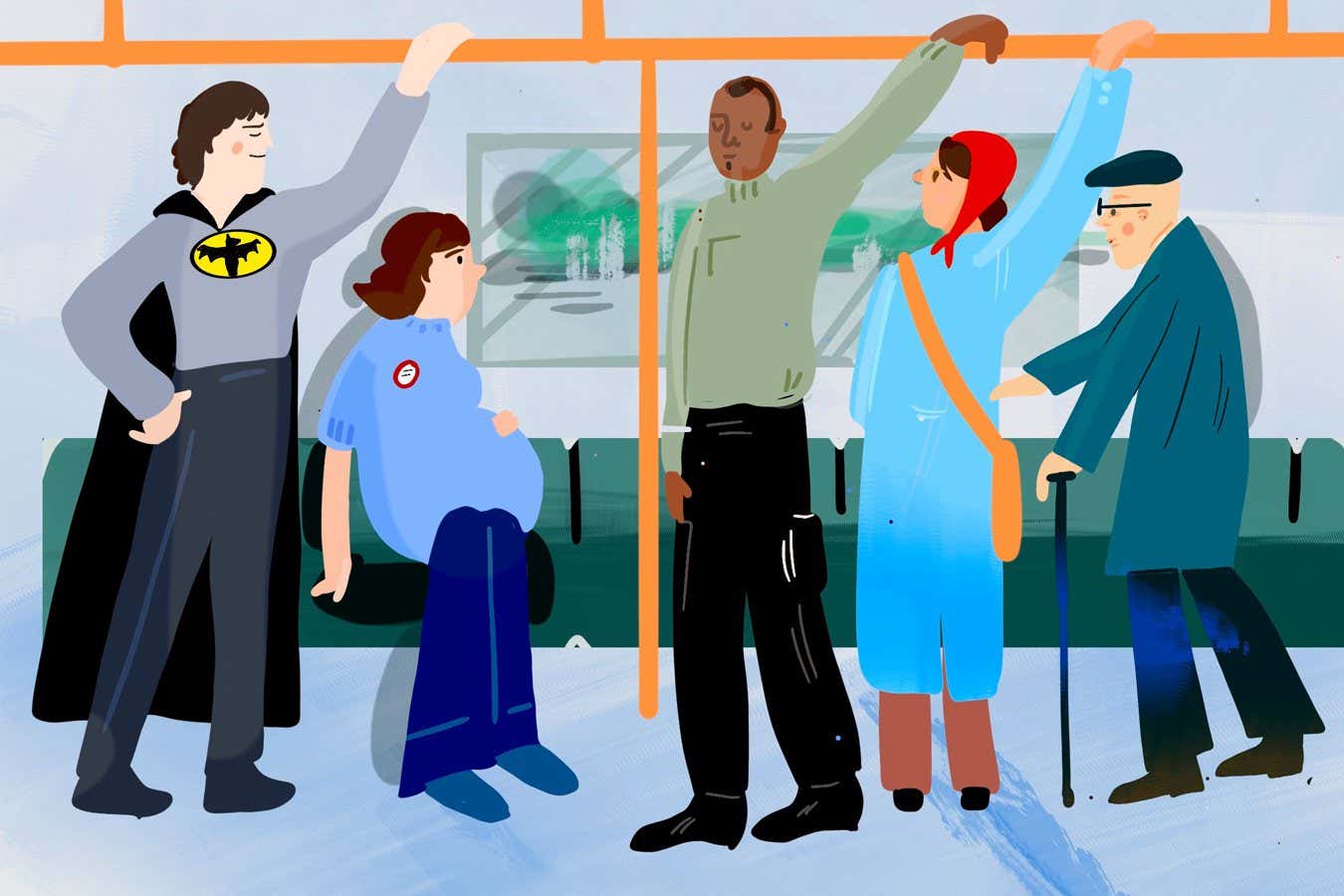
But what if Feedback had snuck onto the bus, dressed as Batman? To our surprise and bafflement, this might have made a difference. Researchers led by Francesco Pagnini tried this experiment on the Milan metro system, in a study published in npj Mental Health Research in November 2025.
On 138 occasions, a female team member wore a prosthetic bump and got onto a train, accompanied by an observer. In some of these trials, a third experimenter also boarded, in a Batman costume. The get-up included “the characteristic cape, logo, and pointed cowl, making it easily recognizable”, although they did leave out the mask “to avoid potentially scaring passengers”.
Feedback has looked at the photo of the costume in the paper and we can say with confidence: nobody was going to be scared. It looks like the costume George Clooney wore in Batman and Robin, and that wouldn’t frighten anybody.
Anyway, passengers offered their seats to the “pregnant” woman 67 per cent of the time when Batman was present, compared with 38 per cent when he was absent. The implication, the team says, is that “unexpected events can promote prosociality”. Notably, the passengers often didn’t consciously notice Batman: 44 per cent of those who gave up their seats in the presence of the Caped Crusader reported not having seen him.
It occurred to Feedback that maybe Batman, being a social justice warrior of long standing, primed passengers to think about concepts like fairness and decency. The researchers also thought of this, but they point out that experiments on social priming have often failed to replicate, priming being one of the phenomena that fell foul of the “replication crisis” in the social sciences. Hence their focus on the unexpectedness of Batman.
Extrapolating, the team suggests “psychologists may consider ways to integrate ‘positive disruptions’ into daily life”, such as “artistic or theatrical interventions in public spaces” that would “momentarily break routine and engage individuals more deeply with their environment and community”. This all reminds Feedback of the concept of “nudging” people into better behaviour, which, like social priming, has generally failed to replicate. In any case, it would seem to require an awful lot of costumes.
Maybe this says something about the places Feedback has lived, but we would barely look twice if someone got on the train dressed as Batman. We would just assume they were going to their local comic convention. Maybe the Milan cosplay scene is less vibrant than elsewhere.
Read me
Feedback has remarked previously on the phenomenon of academics using pop culture references in paper titles, or otherwise writing whimsical titles in the hope of persuading us to read their work. It’s a delicate line to walk, but when it hits, it hits. Full marks, then, to Rebekah White and Anna Remington for their 2018 study titled “Object personification in autism: This paper will be very sad if you don’t read it“.
It explores how often autistic and non-autistic people personify non-living objects and how this affects their emotional lives. At first, Feedback thought we didn’t do this – our vacuum cleaner remains resolutely nameless – but then we remembered that we have tended to name our cars (we are currently driving Kitty, having sold Carol because she was rubbish) and our bicycles.
Clearly, we aren’t alone. When the paper was shared on social media recently, one user responded: “Well, we just had a serious discussion about whether the robot vacuum was a boy or a girl and what their name could be.” Feedback can answer that: put a brown floppy hat and some big black eyebrows on it, and name it after the iconic Mario baddie, the Goomba. That will rhyme with at least one brand.
Another said: “I always take one more croissant or bun from the counter if it’s the last one left after I’ve taken the amount I need. Otherwise, the poor thing will worry and be upset that no one needs it…” Feedback does that too, but for different reasons.
Reviewer 2 strikes again
Before an academic can get a paper published, they must first run the gauntlet of peer review, in which other researchers critique their work (often anonymously). Academics therefore talk about “reviewer 2” in the same way that the rest of us talk about Satan, Pol Pot or people who talk in the quiet carriage of trains.
Historian Andre Pagliarini took to social media to report a particularly egregious instance of peer review: “a first: in rejecting an article I submitted to a journal, reviewer 2 noted I failed to engage the work of one Andre Pagliarini”.
As others were quick to point out, this is a “damned if you do…” situation, because if Pagliarini had included more citations to his own work, he would either be accused of self-promotion or have his paper rejected for lack of novelty.
Feedback found ourselves mentally uttering the same line that others wrote in response: “But doctor, I am Pagliarini.” And if you don’t get that joke, tough luck, because Feedback has run out of room to explain it.
Got a story for Feedback?
You can send stories to Feedback by email at feedback@newscientist.com. Please include your home address. This week’s and past Feedbacks can be seen on our website.