

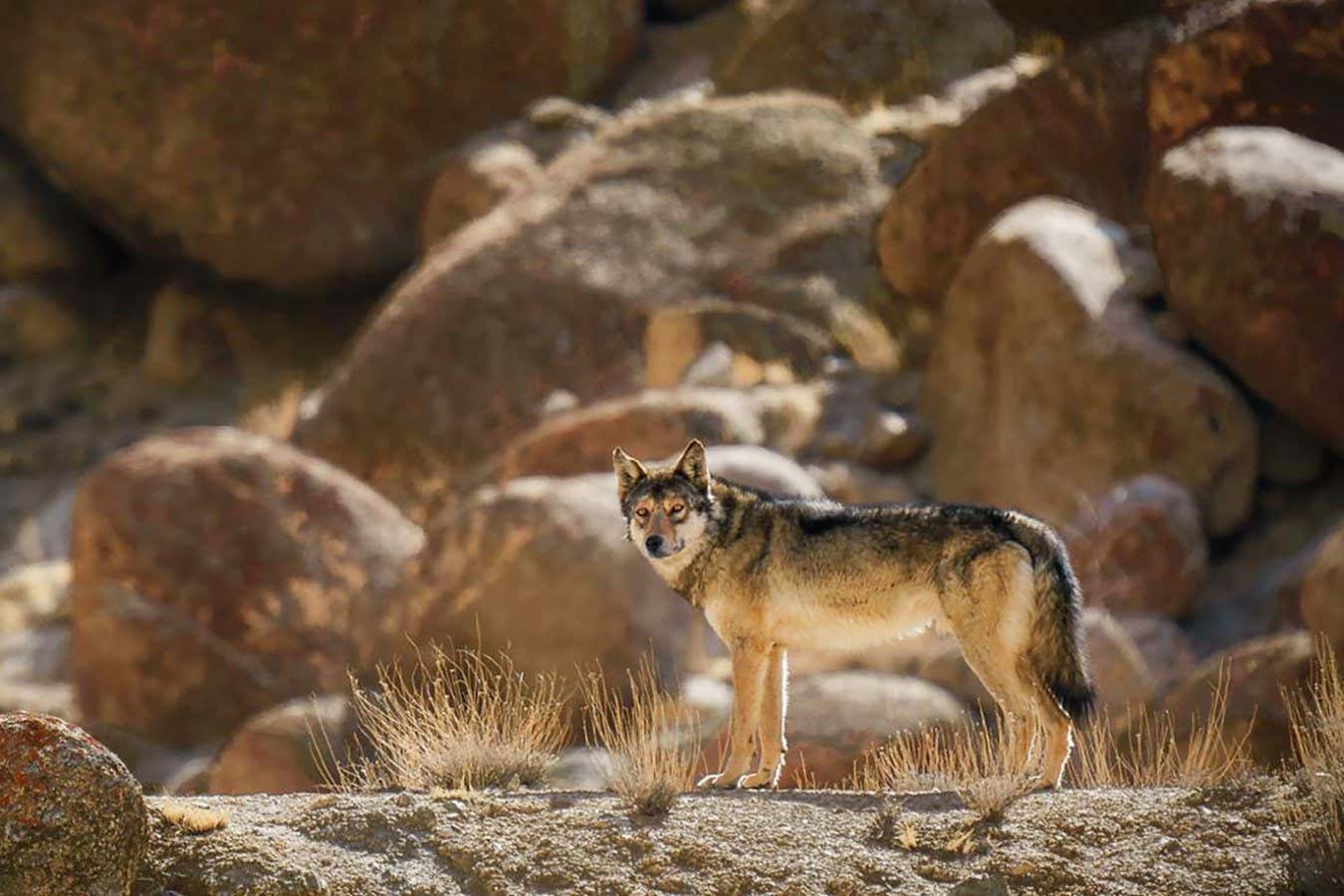
The hybrid known as khipshang is bigger than a wolf but smaller than a dog
Morup Namgail
There’s no doubt. The greyish coat, the effortless trot over soft snow, the way it stops, stalks, then strikes, picking off a marmot and ending it with one bite: it’s a wolf.
That’s what I’m watching at nearly 5000 metres of altitude here in the Indian-administered part of Ladakh, a region in the Himalayas. Life in the heights is harsh, but these wolves are among a cast of mammals making a living, along with snow leopards, Himalayan brown bears and Tibetan foxes.
Himalayan wolves are well adapted to the low oxygen and other harsh conditions found at altitude, and are believed to be the earliest lineage of the species (Canis lupus). Watching this one make quick work of the marmot as a blue spring day turns grey, it is obvious they are survivors, but their future is in jeopardy. These mountains are warming at double the global average rate. Mix in rapid urbanisation, trash, pollution, plus wary farmers and herders, and it is easy to see the threats.
Now there’s a new one: feral dogs. There are as many as 25,000 dogs in Ladakh compared with just a few hundred wolves. In the past decade, these dogs – pets and strays that form packs and take to the mountains where they hunt the same prey as their wilder relatives – have begun breeding with wolves and creating a new hybrid animal.
“We call it khipshang,” says Tsewang Namgail, the director of the Snow Leopard Conservancy India Trust, which studies mammals in Ladakh. The term is a portmanteau of khi, which means dog in Ladakhi, and shangku, which means wolf.
“People have just begun noticing it in the last five to 10 years,” says Namgail. “It’s not really a wolf, not really a dog. It’s a cross.”
Bigger than a dog, but smaller than a wolf, this hybrid is known to lead packs of dogs, has a tawny coat and the potential to outcompete other carnivores.
“And they don’t fear humans,” says Mohammad Imran, a Ladakhi film-maker and naturalist.
Hybrids are also bold enough to enter a village and kill any livestock they see. “It has the fearlessness and habituation of a dog and the killing instinct of the wolf, and that’s a deadly combination,” says Namgail.
Dog bites, even attacks and death, are increasingly common here, with four to five dog bite cases every day in the hospital at Leh, the regional capital, according to Namgail. At least four locals have been killed by dogs this year, a problem experts fear could worsen due to hybridisation. That’s why they are seen as a threat to both wolves and people, says Namgail, who fears that hybrids will dilute the wolf population and endanger the future of local wolves. He estimates there are currently about 80 hybrids across the nearly 60,000 square kilometres of India’s Ladakh territory.
The hybrid is such a new phenomenon that no formal study has been conducted and little is known beyond anecdotal observations. What we do know is that the khipshang’s rise is directly linked to the explosion of feral dogs. Dog sterilisation is illegal in Ladakh and the region’s Buddhist beliefs disapprove of harming nature. With a history of border wars in the region, dogs are a first line of defence for army bases, as barking alerts troops and soldiers often feed dogs. But that permissive attitude affects other species, with cases of rabies and canine distemper thought to be causing drops in fox and wolf numbers.
With so many dogs and so few wolves, man’s best friend may become the dominant canid in the world’s highest mountains, mirroring environments like Italy and North America, where red and eastern wolves are increasingly diluted by hybridisation.
When wolves and people are forced to share space, competition over resources arises, and so does interaction with dogs, says Carter Niemeyer, a trapper who captured the Canadian wolves that were reintroduced to Yellowstone and Idaho in the 1990s. That’s why the widespread threat of species dilution makes him emphatic that wolf-dogs shouldn’t “be allowed to procreate and run wild. We must keep wolves pure.”
A few hours after seeing the wolf, we spot a pack of dogs by the side of the road. Some sleep on the blacktop despite the chilling wind; others beg for scraps. One stands apart and watches, ears back, posture different.
Morup Namgail, a wildlife photographer I am travelling with, wonders if it might be a khipshang. He has seen khipshang across Ladakh, and even photographed what he believes is another rare hybrid: a fox-dog cross.
Two years ago, Namgail and I watched a pack of dogs chase a mother snow leopard off an ibex kill. The dog on the road reminds me of the lead dog that day – something about its boldness, its build. I remember it didn’t bark and didn’t look scared. Maybe it wasn’t a dog?
What Namgail is sure of, he tells me as we drive off, is that khipshangs are symbolic of these rapidly changing mountains. No one knows what’s next, but we do know that wolves learn and teach behaviour. He worries that khipshang might not just teach dogs how to hunt – they may start acting like dogs and get into conflict with us.
“Since these are new species, they don’t have a place in the chain, like other animals, and it’s so fragile to disrupt,” says Namgail. “That makes them dangerous. For all of us.”
Topics: