
Close Menu
    Trending
    • Elon Musk’s Twitter deal looked like a $44 billion disaster. Now, his investors stand to make a 200% return—thanks to a brilliant (and controversial) M&A move
    • NASA data reveals weird x-ray changes in the exploded ruins of dead stars
    • Will Lebanon Become The Next Gaza?
    • DJ Fat Tony Defends Addressing Brooklyn Beckham’s Family Feud
    • Austria return from long World Cup absence with nervy 3-1 win over Jordan
    • England vs Croatia – World Cup 2026: Kane, predictions, TV channel, kickoff | World Cup 2026 News
    • Nike hoping two-time NBA MVP will save struggling brand
    • Why employers should treat domestic violence as a workplace issue
    Benjamin Franklin Institute
    Wednesday, June 17
    • Home
    • Politics
    • Business
    • Science
    • Technology
    • Arts & Entertainment
    • International
    Benjamin Franklin Institute
    Home»Science»Have we finally worked out how Venus flytraps snap shut?
    Science

    Have we finally worked out how Venus flytraps snap shut?

    Team_Benjamin Franklin InstituteBy Team_Benjamin Franklin InstituteJune 15, 2026No Comments3 Mins Read
    Share Facebook Twitter Pinterest Copy Link LinkedIn Tumblr Email VKontakte Telegram
    Share
    Facebook Twitter Pinterest Email Copy Link


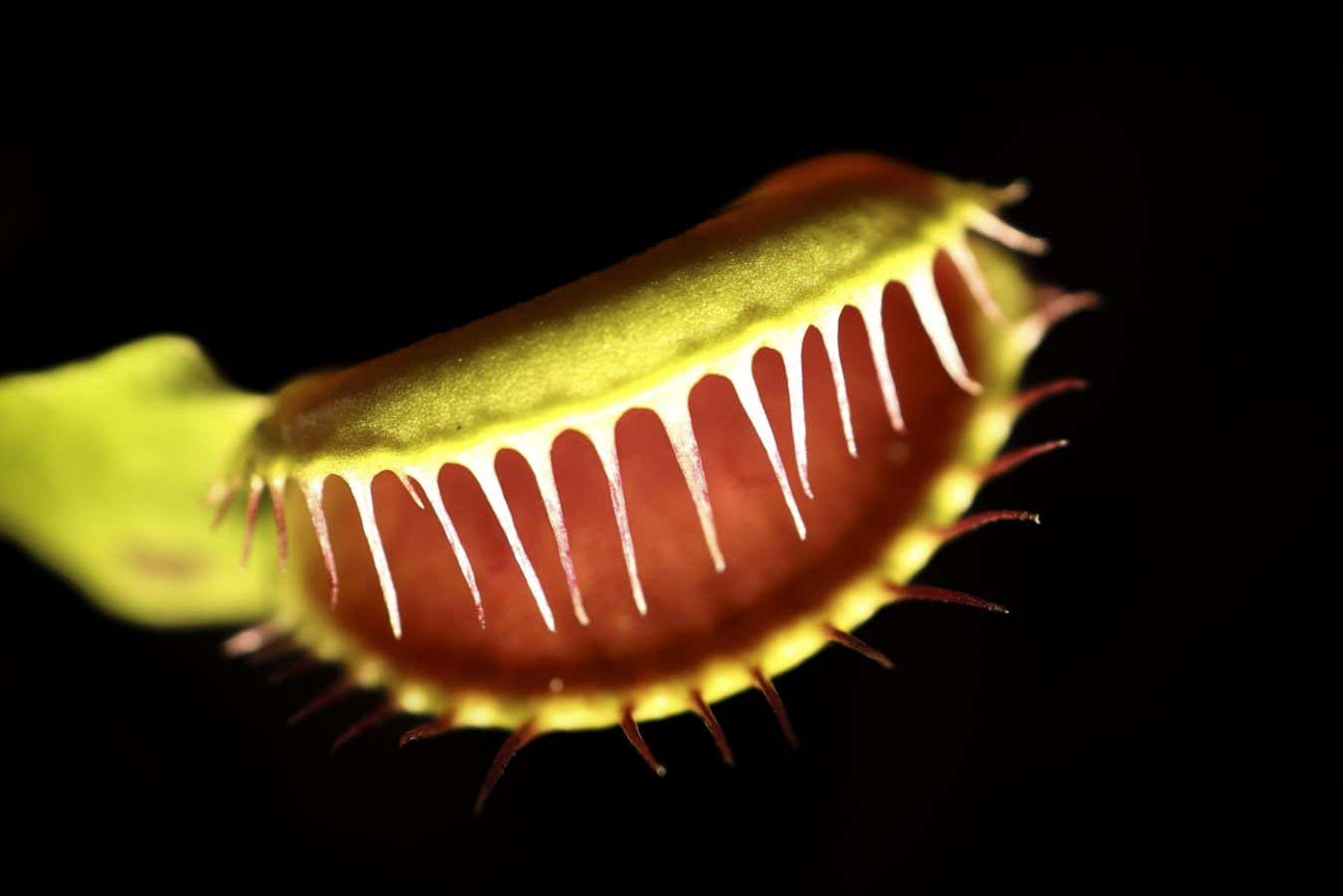
    Venus flytraps snap shut to make a meal of insects and spiders

    Jeanne Bourdier, Corentin Mollier

    The mystery of how a Venus flytrap closes fast enough to catch insect prey may have been partially solved.

    Venus flytraps (Dionaea muscipula) are triggered to snap shut once hairs in their traps are touched twice in short succession. They are known to be able to catch an array of insects, and even small frogs, and yet how they work has eluded scientists since Charles Darwin.

    It has been widely thought that the mechanism involves water being pumped from one side of the trap to the other through the tissue. This would cause one side to shrink and the other to swell, generating the curvature needed to close the trap.

    To test this hypothesis, Yoël Forterre at Aix-Marseille University in France and his colleagues measured how long it takes for water to move through the trap, both through the individual cells and the plant’s tissue.

    It took 30 to 60 seconds for water to move from one side to the other. At this rate, the team concluded that such a mechanism would be too slow, given an insect is typically trapped in less than a second.

    Next, the researchers noticed that the trap surface became bumpier after being triggered – a change that they say could only happen with a decrease in cell-wall stiffness. So, they examined whether some kind of softening in the cell walls may be responsible for closing the trap, by using tiny probes to measure the mechanical forces inside the epidermal cells.

    “We found that, when the trap is triggered, the cell walls of the outer epidermal layer rapidly soften,” says Forterre.

    Once the hairs are triggered, an electric signal and a wave of calcium ions are sent across the leaf. “These signals act as the plant’s equivalent of a nervous signal,” he says. “They allow information about the touch to be transmitted from the trigger hair to distant cells across the trap within a fraction of a second.”

    When it receives the signal, the outer surface of the trap quickly becomes mechanically less rigid, releasing the internal stresses stored in the tissue and allowing the pressurised inner cells to expand more on that side. As a result, the outer edges lengthen while the interior surface remains stiff, causing the trap to bend and close.

    However, the team is still unsure what molecules trigger the cell walls to undergo such a rapid transformation. “In other words, we understand the beginning of the chain of events, touch sensing, and the end, trap motion, but the molecular link connecting the two remains largely unknown,” says Forterre.

    Sergey Shabala at the University of Western Australia, in Perth, says he is not convinced by the team’s proposed mechanism. They have assumed that water would move through the cells consecutively, whereas it could be simultaneous, he says.

    He also has doubts that changes in the stiffness of the cell wall could happen quickly, and instead thinks that it would take at least several minutes. “Thus, despite all these elegant measurements using cutting-edge engineering tools, the findings of this work do not explicitly rule out [water movement driving the] mechanism,” says Shabala.

    Forterre says the team directly measured the swelling time of pieces of trap tissue, and these measurements show that water transport across the trap is far too slow to account for closure. On the other hand, the loss of stiffness in the cell wall was measured and found to be surprisingly rapid, he says.

    Topics:


    Source link

    Share. Facebook Twitter Pinterest LinkedIn Tumblr Email Telegram Copy Link

    Related Posts

    Science

    NASA data reveals weird x-ray changes in the exploded ruins of dead stars

    June 17, 2026
    Science

    Math predicts humans could go extinct in about 17,000 years

    June 17, 2026
    Science

    Proposed White House regulations could kill 5,000 clinical trials, analysis finds

    June 17, 2026
    Science

    Ozempic maker Novo Nordisk breach exposed patients’ clinical trial data

    June 16, 2026
    Science

    The secrets to keeping your brain sharp in old age

    June 16, 2026
    Science

    Walking shark found in Papua New Guinea is new to science

    June 16, 2026
    Editors Picks

    Erich von Daeniken, Swiss author who popularised ancient‑alien theories, dies at 90

    January 11, 2026

    Israel objects to US announcement of leaders who will play a role in overseeing next steps in Gaza

    January 17, 2026

    Australia observes day of mourning for victims of Bondi Beach mass shooting | Crime News

    January 22, 2026

    Iranians in Istanbul jittery but jubilant at US, Israeli strikes

    February 28, 2026

    AI Math Benchmarks: AI’s Growing Capabilities

    February 25, 2026
    About Us
    About Us

    Welcome to Benjamin Franklin Institute, your premier destination for insightful, engaging, and diverse Political News and Opinions.

    The Benjamin Franklin Institute supports free speech, the U.S. Constitution and political candidates and organizations that promote and protect both of these important features of the American Experiment.

    We are passionate about delivering high-quality, accurate, and engaging content that resonates with our readers. Sign up for our text alerts and email newsletter to stay informed.

    Latest Posts

    Elon Musk’s Twitter deal looked like a $44 billion disaster. Now, his investors stand to make a 200% return—thanks to a brilliant (and controversial) M&A move

    June 17, 2026

    NASA data reveals weird x-ray changes in the exploded ruins of dead stars

    June 17, 2026

    Will Lebanon Become The Next Gaza?

    June 17, 2026

    Subscribe for Updates

    Stay informed by signing up for our free news alerts.

    Paid for by the Benjamin Franklin Institute. Not authorized by any candidate or candidate’s committee.
    • Privacy Policy
    • About us
    • Contact us

    Type above and press Enter to search. Press Esc to cancel.