
Close Menu
    Trending
    • NHTSA considers new car door safety rules after fatal Tesla crashes
    • PlayStation Network outage resolved after thousands of gamers unable to play
    • Market Talk – July 24, 2026
    • Joe Biden Gives Up, Declines to Seek Further Review of Appeals Court Ruling on Release of Audiotapes with Ghostwriter
    • Meghan McCain Claps Back At Being Called ‘Old And Ugly’
    • Mixed day for global equities as oil prices retreat
    • Venezuela to exit International Criminal Court, accusing it of ‘bias’ | ICC News
    • Andy Reid shares massive Patrick Mahomes recovery update
    Benjamin Franklin Institute
    Friday, July 24
    • Home
    • Politics
    • Business
    • Science
    • Technology
    • Arts & Entertainment
    • International
    Benjamin Franklin Institute
    Home»Science»Hair conditioner made from wood is black and smelly, but eco-friendly
    Science

    Hair conditioner made from wood is black and smelly, but eco-friendly

    Team_Benjamin Franklin InstituteBy Team_Benjamin Franklin InstituteFebruary 23, 2025No Comments3 Mins Read
    Share Facebook Twitter Pinterest Copy Link LinkedIn Tumblr Email VKontakte Telegram
    Share
    Facebook Twitter Pinterest Email Copy Link


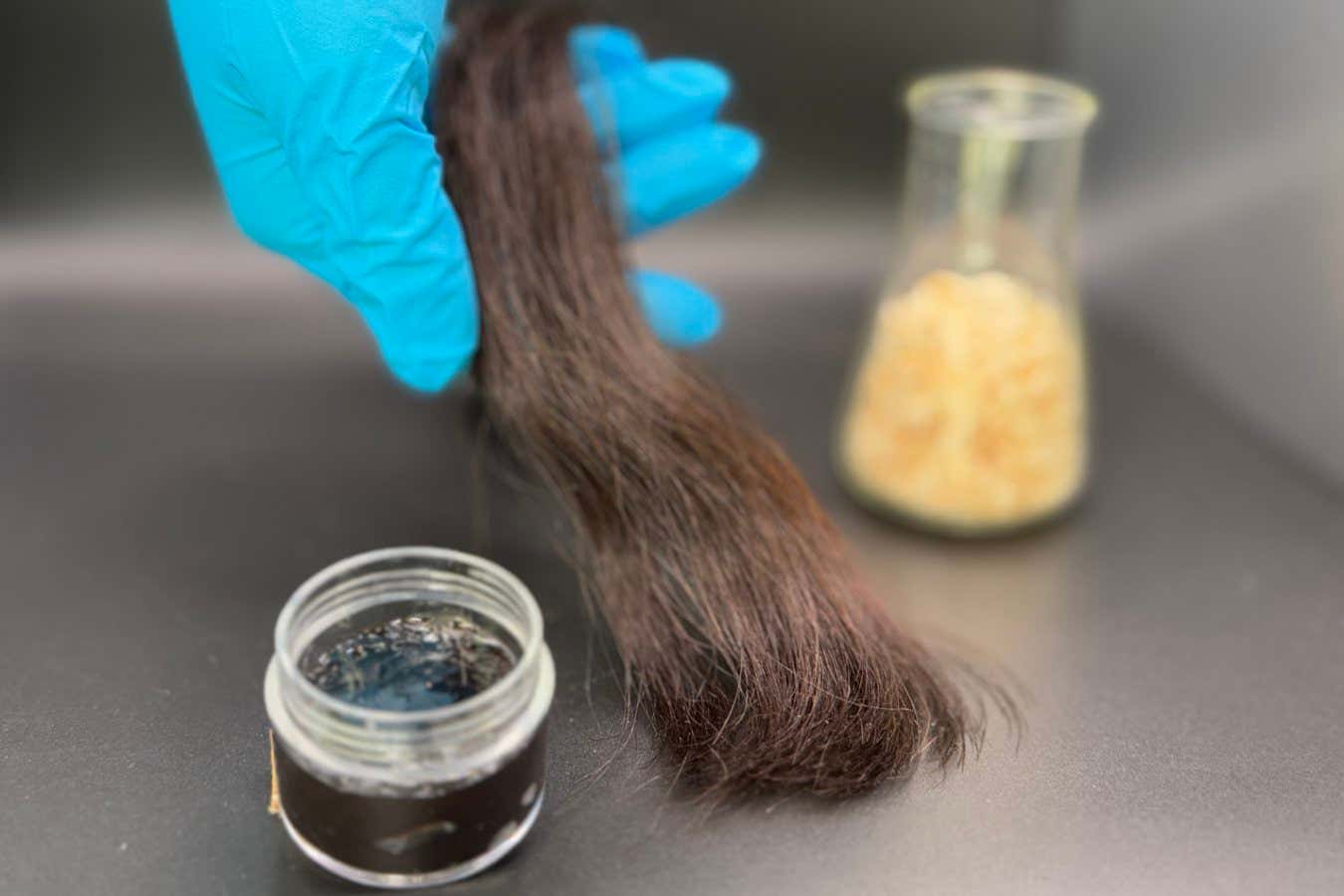
    The black hair conditioner on the left is derived from the wood powder on the right

    Fengyang Wang/Stockholm University

    This sustainable, wood-based hair conditioner may be pitch black and smell like peat, but its creators claim it could be the future of haircare after tests suggest it may work just as well as commercial products.  

    “We are using the power of nature,” says Ievgen Pylypchuk at Stockholm University in Sweden. “We combine a high level of science with old traditions… [to] get something really cool: simple, useful and quite effective.”

    Pylypchuk and his colleagues used lignin, a polymer that is a central component of wood and bark, as the starting point for their bio-based conditioner. When extracted from wood, lignin naturally interacts with water while also acting as a surfactant, a key component of detergents. It also contains natural antioxidants, which help to preserve the conditioner, and provides UV protection, says Pylypchuk. “Lignin serves as a multifunctional platform in this context,” he says. “It protects against UV, it is moisturising.”

    The researchers combined a lignin gel developed in their laboratory with coconut oil and water to make the end product. Team member Mika Sipponen, also at Stockholm University, claims it works almost as well as commercial conditioners. When used on samples of wetted bleached human hair and then washed out, it reduced the “drag” when combing the hair while it was still damp by 13 per cent, compared with the commercial product they tested, which reduced drag by 20 per cent.

    One potential downside is that the current formulation of the conditioner is “pitch black” and smells like “cooked wood”, similar to peat, says Sipponen. That hasn’t deterred the researchers from contemplating commercialising it. They tested the formula on hair, towels and pig skin, and say it washes off without leaving stains. Even the smell is quite pleasant, says Pylypchuk. “I personally like it very much, and most of the people in our lab – maybe because they work with lignin – they liked it.”  

    Pylypchuk and Sipponen have a patent for the lignin gel and hope their conditioner can become a consumer product, offering people a more sustainable alternative to current products that rely on ingredients derived from fossil fuels. They say the next step is to see if it causes eye and skin irritation ahead of any trial on living hair.

    But US-based cosmetics researcher Trefor Evans, formerly at the Textile Research Institute Princeton, New Jersey, has doubts about how well the product would perform compared with commercial rivals. “I’ve been doing these experiments for 30 years, and a conventional conditioner product will lower the combing forces by 80 per cent, maybe even 90 per cent,” he says. Sipponen thinks variation in the testing methods and condition of the hair under analysis could explain why his team only found a 20 per cent reduction for the commercial conditioner.

    The wood-based conditioner’s appearance and unusual smell may also put consumers off, says Evans. “The patent literature is absolutely chock-a-block with potential hair conditioner formulas that never went anywhere,” he says. “And the reason is because you don’t just need efficacy – for the consumer to buy it, what you really need as well is aesthetics.”  

    So, would a black, wood-smelling, eco-friendly conditioner be a hit with consumers? “Sounds like a bit of a non-starter,” says Evans.


    Topics:


    Source link

    Share. Facebook Twitter Pinterest LinkedIn Tumblr Email Telegram Copy Link

    Related Posts

    Science

    NHTSA considers new car door safety rules after fatal Tesla crashes

    July 24, 2026
    Science

    Fungus made fashion—researchers turn living organisms into textiles

    July 24, 2026
    Science

    How a 99-year-old mathematician unraveled a century-old braid mystery

    July 24, 2026
    Science

    Is it possible to regain a sense of smell? These scientists are working on it

    July 24, 2026
    Science

    Why don’t insects live in the ocean?

    July 24, 2026
    Science

    Why environmental groups are suing over SpaceX’s land swap deal

    July 24, 2026
    Editors Picks

    Trump’s Leaked Peace Plan Reportedly Causing ‘Panic’ In Ukraine, Europe

    February 19, 2025

    SIA cancels Dubai flights until May 31 as Middle East conflict continues

    March 31, 2026

    How to get your dream job in 2026

    January 2, 2026

    Experimental immune therapy shows promise against deadly childhood brain cancer

    July 15, 2026

    Trump warns Netanyahu: ‘You’ll be on your own’ if attacks on Iran continue | US-Israel war on Iran News

    June 9, 2026
    About Us
    About Us

    Welcome to Benjamin Franklin Institute, your premier destination for insightful, engaging, and diverse Political News and Opinions.

    The Benjamin Franklin Institute supports free speech, the U.S. Constitution and political candidates and organizations that promote and protect both of these important features of the American Experiment.

    We are passionate about delivering high-quality, accurate, and engaging content that resonates with our readers. Sign up for our text alerts and email newsletter to stay informed.

    Latest Posts

    NHTSA considers new car door safety rules after fatal Tesla crashes

    July 24, 2026

    PlayStation Network outage resolved after thousands of gamers unable to play

    July 24, 2026

    Market Talk – July 24, 2026

    July 24, 2026

    Subscribe for Updates

    Stay informed by signing up for our free news alerts.

    Paid for by the Benjamin Franklin Institute. Not authorized by any candidate or candidate’s committee.
    • Privacy Policy
    • About us
    • Contact us

    Type above and press Enter to search. Press Esc to cancel.