
Close Menu
    Trending
    • When is London Marathon 2026? Start time and how to watch race for FREE
    • Pentagon Requests $54 Billion For AI War
    • Clavicular Hit With New YouTube Crackdown
    • Beijing’s new supply chain rules deepen concerns for US firms in China
    • India denounces ‘hellhole’ remark shared by Trump | Donald Trump News
    • New photos of Mike Vrabel and Dianna Russini emerge
    • AI search demands a new audience playbook
    • How do earthquakes end? A seismic ‘stop sign’ could help predict earthquake risk
    Benjamin Franklin Institute
    Friday, April 24
    • Home
    • Politics
    • Business
    • Science
    • Technology
    • Arts & Entertainment
    • International
    Benjamin Franklin Institute
    Home»Science»Fossil may solve mystery of what one of the weirdest ever animals ate
    Science

    Fossil may solve mystery of what one of the weirdest ever animals ate

    Team_Benjamin Franklin InstituteBy Team_Benjamin Franklin InstituteJanuary 16, 2026No Comments3 Mins Read
    Share Facebook Twitter Pinterest Copy Link LinkedIn Tumblr Email VKontakte Telegram
    Share
    Facebook Twitter Pinterest Email Copy Link


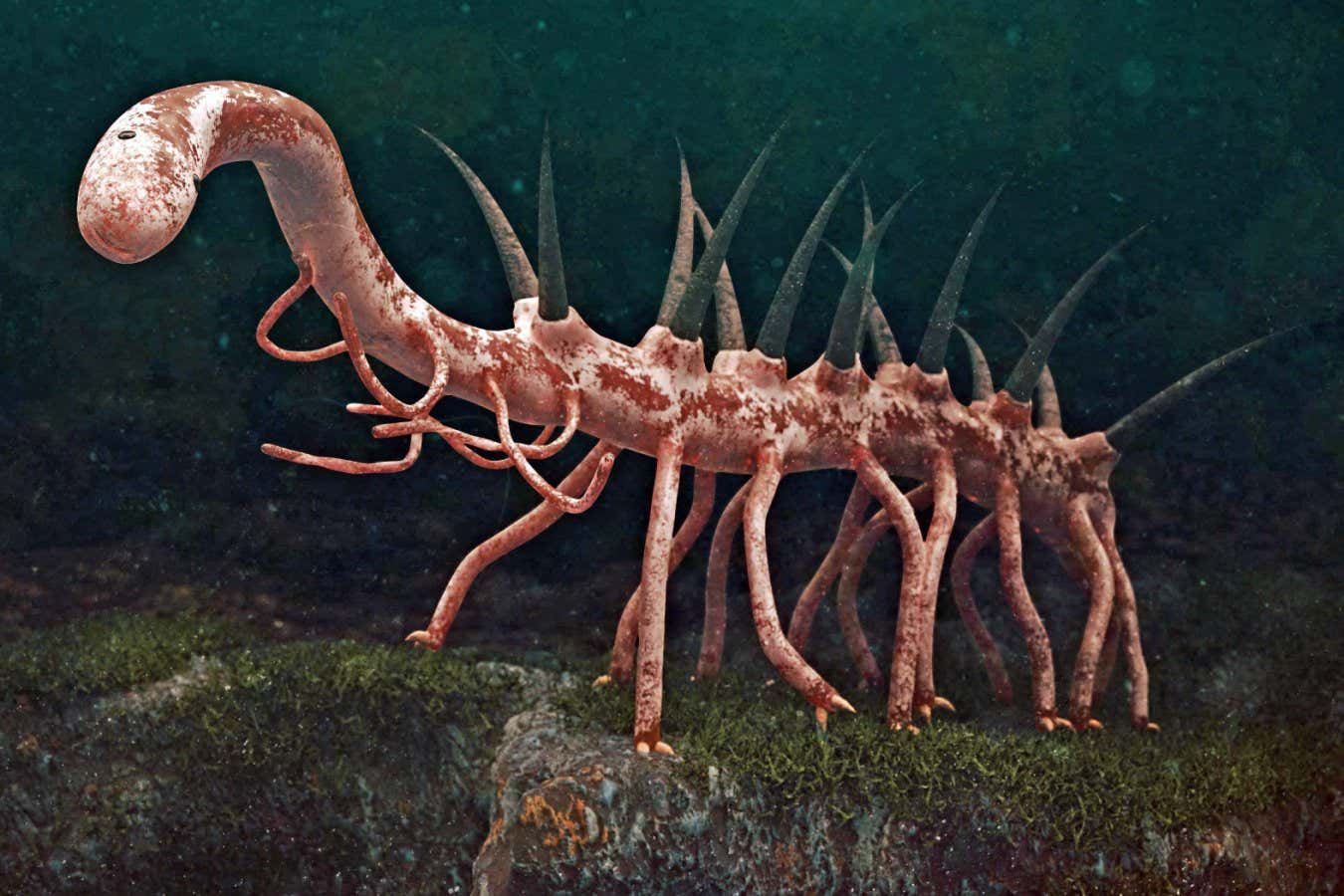
    Hallucigenia, one of the strangest animals of all time

    Alamy

    One of the weirdest animals that ever lived may have been a scavenger. A re-examination of fossils first described in the 1970s seems to show a swarm of Hallucigenia feeding on the corpse of a comb jelly.

    Hallucigenia was a small animal, up to 5 centimetres long. It had a worm-like body with multiple legs, as well as long, sharp spines on its back. Because of its peculiar appearance, palaeontologists at first reconstructed the animal upside-down, supposing the spines to be legs.

    It lived in the deep seas during the Cambrian period (about 539 million to 487 million years ago), when many major animal groups emerged. Hallucigenia was first identified in rocks from the Burgess Shale deposits in British Columbia, Canada. It is related to velvet worms, tardigrades and arthropods (the group that includes insects and spiders).

    Little is known about the ancient animal’s lifestyle. For instance, none of the Hallucigenia fossils found to date have preserved gut contents, so we don’t know what they ate.

    Javier Ortega-Hernández at Harvard University re-examined a fossil from the Burgess Shale that was used in the original description of Hallucigenia in 1977, but which hadn’t been looked at since.

    It is the remains of a soft-bodied, gelatinous organism, 3.5 cm by 1.9 cm, which has been severely damaged. Ortega-Hernández identified it as a comb jelly, or ctenophore.

    Scattered over the comb jelly, Ortega-Hernández identified Hallucigenia spines, representing seven individuals. He suggests the comb jelly died and sank to the sea bed, where the Hallucigenia swarmed on it and fed, probably by suction feeding. While they were doing this, they were all buried in mud and eventually fossilised.

    Ortega-Hernández declined to be interviewed by New Scientist because the paper hasn’t yet been peer-reviewed.

    “I think it’s a convincing ecological interaction,” says palaeontologist Allison Daley at the University of Lausanne in Switzerland. She calls it a “snapshot”, representing “a moment in time that maybe only lasted some minutes or hours that happened to be caught in the fossil record”.

    Hallucigenia is known to have lived in deep water, says Daley, and nutrients are scarce in the depths. It makes sense that the species survived by quickly finding and eating rich food sources like a dead comb jelly. “Suction feeding would be very effective on such a soft animal,” she says.

    Jean-Bernard Caron at the Royal Ontario Museum in Toronto is less convinced. Just because the Hallucigenia and ctenophore fossils are found together, he says, doesn’t necessarily mean they were interacting in real life. It could be that undersea mudslides carried them to the same resting place.

    Because most of the known Hallucigenia fossils are just spines, Caron suggests an alternative interpretation: the animals may have moulted, shedding their skins to grow.

    New Scientist. Science news and long reads from expert journalists, covering developments in science, technology, health and the environment on the website and the magazine.

    Dinosaur hunting in the Gobi desert, Mongolia

    Embark on an exhilarating and one-of-a-kind expedition to uncover dinosaur remains in the vast wilderness of the Gobi desert, one of the world’s most famous palaeontological hotspots.

    Topics:


    Source link

    Share. Facebook Twitter Pinterest LinkedIn Tumblr Email Telegram Copy Link

    Related Posts

    Science

    How do earthquakes end? A seismic ‘stop sign’ could help predict earthquake risk

    April 24, 2026
    Science

    ‘Kraken’ fossils show enormous, intelligent octopuses were top predators in Cretaceous seas

    April 24, 2026
    Science

    Largest ever octopus was great white shark of invertebrate predators

    April 24, 2026
    Science

    Do you need to worry about Mythos, Anthropic’s computer-hacking AI?

    April 23, 2026
    Science

    How many dachshunds would it take to get to the moon?

    April 23, 2026
    Science

    The Age Code review: Can you slow ageing with your diet? A new book gives it a go

    April 23, 2026
    Editors Picks

    Thousands of new Epstein-linked documents released by US Justice Department

    December 23, 2025

    Opinion | The Best of 2024: The Books, Movies, Habits and Hobbies We Loved This Year

    December 27, 2024

    Iran to Lebanon: Four million people displaced by US-Israeli war | US-Israel war on Iran News

    March 26, 2026

    Three aid workers killed, 4 wounded in RSF drone attack in Sudan’s Kordofan | Sudan war News

    February 20, 2026

    Opinion | What Trump Didn’t Know About Iran

    March 14, 2026
    About Us
    About Us

    Welcome to Benjamin Franklin Institute, your premier destination for insightful, engaging, and diverse Political News and Opinions.

    The Benjamin Franklin Institute supports free speech, the U.S. Constitution and political candidates and organizations that promote and protect both of these important features of the American Experiment.

    We are passionate about delivering high-quality, accurate, and engaging content that resonates with our readers. Sign up for our text alerts and email newsletter to stay informed.

    Latest Posts

    When is London Marathon 2026? Start time and how to watch race for FREE

    April 24, 2026

    Pentagon Requests $54 Billion For AI War

    April 24, 2026

    Clavicular Hit With New YouTube Crackdown

    April 24, 2026

    Subscribe for Updates

    Stay informed by signing up for our free news alerts.

    Paid for by the Benjamin Franklin Institute. Not authorized by any candidate or candidate’s committee.
    • Privacy Policy
    • About us
    • Contact us

    Type above and press Enter to search. Press Esc to cancel.