

Chris BaraniukTechnology Reporter
 AFP via Getty Images
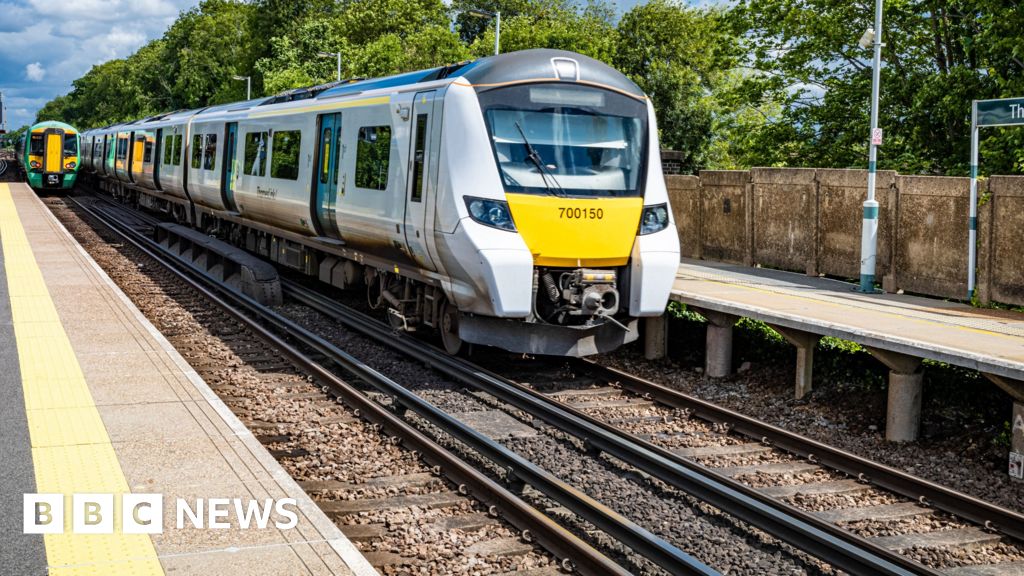
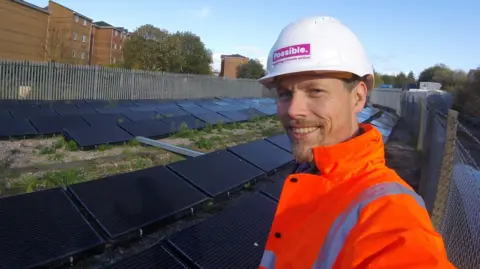
Every day, thousands of passengers heading south west on trains leaving Aldershot station pass a cluster of solar panels nestled by the tracks. Few, if any, may notice the installation. But the train they are on is drawing power from it.
“On a sunny afternoon, if you are catching a train through Aldershot, a little bit of the energy for that train will come from those solar panels,” says Leo Murray, co-founder and chief executive of Riding Sunbeams, a start-up aiming to use renewable energy resources for rail electrification projects.
Riding Sunbeams built the Aldershot array in 2019 . It’s small in scale at just 40 kilowatts – equivalent to roughly 10 of the rooftop solar arrays you would find on a typical British home. But it demonstrates how renewables can feed directly in to the railways.
Not only that, Mr Murray says it is currently the only solar array in the country that delivers power directly to rail to move trains. “If you are a railway, this is the cheapest electricity you can buy,” he adds.
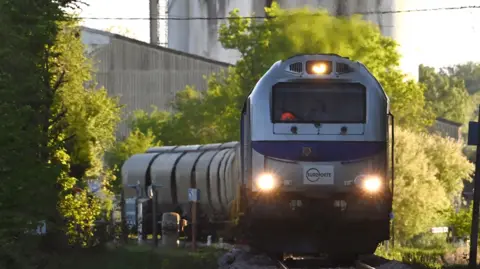
Around the country, and the world, many trains still run on diesel – a fossil fuel. To go electric, rail operators have traditionally had two options: electrified rail, or overhead lines that that trains connect to with arm-like pantographs on their roofs. Installing either of these systems can be expensive and technically challenging.
But engineers are working on new ways of implementing such technologies and completely different alternatives are also emerging, which could speed up electrification projects.
A key barrier to electrification is often the limitations of the local electricity grid – it’s hard to get access to a big connection for powering your trains. “That problem has only become much, much worse,” says Mr Murray.
This is why he views solar panels as so useful in enabling railway electrification projects.
Mr Murray says that, after the Aldershot project, he had hoped Riding Sunbeams would go on to build a full-scale commercial pilot. But funding problems got in the way.
Now, however, Network Rail, which owns and maintains railway infrastructure in Great Britain, is seeking suppliers for rail-side renewables projects.
“This is the big one,” says Mr Murray, explaining that his business is planning to bid for a contract.

 Riding Sunbeams
New projects bring new complexities, however. At Aldershot, the track was already electrified – it was a case of plugging solar panels in to that existing system.
But for trains that are switching off diesel and moving over to overhead lines, leveraging solar is harder. This is because solar panels produce direct current (DC) electricity whereas overhead lines use alternating current (AC).
Efforts are underway in England to develop a new converter device that could solve this problem, though.
Separately, Colton Junction between Leeds and York, the fastest railway junction in the UK – where trains speed through at up to 125mph – was electrified recently with the help of software developed at the University of Huddersfield.
The software makes a 3D model of the overhead line system, allowing engineers to plan its construction in minute detail – lowering costs by removing the need for certain forms of traditional testing and evaluation.
“Everything was specified in the software in terms of measurements,” says João Pombo, associate director of the university’s Institute of Railway Research. “All the trains are running at maximum speed at that junction since August.”
 Nevomo
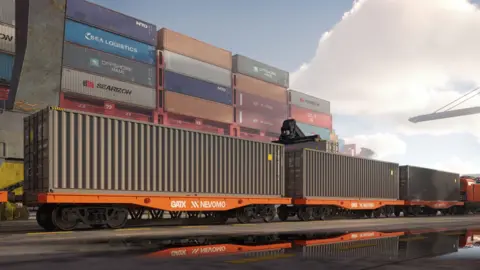
But there are completely different ideas for electrification out there. Polish start-up Nevomo has developed an electromagnetic propulsion system. It’s retrofitted onto existing track by fitting a thick aluminium cable into an enclosure that runs between the rails. This generates a magnetic field strong enough to propel freight wagons fitted with magnets.
“We eliminate locomotives completely,” says Ben Paczek, founder and chief executive. “Each wagon becomes independent. They can also operate in groups.”
A key benefit of the technology, says Mr Paczek, is that it allows operators to bring freight wagons to a stop very quickly – and, as a consequence, that means they could, in principle, safely put lots of independently moving wagons relatively close together on one stretch of rail, increasing the density of freight transportation in a particular area.
Nevomo hopes to launch working implementations of its technology at a steel plant in Bremen, Germany, and at a port in India next year.
These will be relatively small in scale, each covering track distances of less than 1km (0.6 miles). But Mr Paczek hopes to see bigger installations in the future. “In a quite conservative environment like rail, we need to demonstrate it properly first.”
It would be possible to automate the motion of electromagnetically-propelled wagons, he adds – though initially they will be controlled remotely by human operators.
 University of Birmingham
In the US, Parallel Systems is also working on electrifying individual freight wagons so that they can move independently around a rail network – but in a very different way, with batteries. The firm’s wagons would have a range of 800km, says co-founder and chief executive Matt Soule.
He describes it like moving packets around a distribution centre – “atomised freight”, and quite unlike traditional locomotive-pulled freight trains that can be more than 2km long. “We’re focused on doing the shorter stuff that they’re not doing,” says Mr Soule.
He adds that he does not aim to replace freight locomotives, but rather to offer a rail-based delivery service that could compete with trucking. “If we simply grab 10% of the trucking market, we’ve doubled the rail industry,” he says.
Stuart Hillmansen at the University of Birmingham, who has worked with Riding Sunbeams in the past, says organising the movement of individual freight trains on an existing rail network could be “quite challenging – certainly on [British] railways”.
But he says that new technologies are helping to facilitate electrification – and that electrified trains in general are now the “go-to” option for new railways.
“All of these technologies are physically feasible and can work, the thing is managing the business case,” he says.