
Close Menu
    Trending
    • How do earthquakes end? A seismic ‘stop sign’ could help predict earthquake risk
    • Trump Announces Cease-Fire Between Israel and Lebanon
    • Google Is Tracking Your Life – Photo Cloud Feeding AI System
    • Rachel Zoe Confronts Amanda Frances In ‘RHOBH’ Reunion Clip
    • China’s DeepSeek says it released long-awaited new AI model
    • China’s DeepSeek unveils latest models a year after upending global tech | Technology News
    • Malik Nabers’ reaction to Cowboys drafting Caleb Downs should thrill Dallas fans
    • AI is replacing creativity with ‘average’
    Benjamin Franklin Institute
    Friday, April 24
    • Home
    • Politics
    • Business
    • Science
    • Technology
    • Arts & Entertainment
    • International
    Benjamin Franklin Institute
    Home»Science»Diamonds are surprisingly elastic when you make them tiny
    Science

    Diamonds are surprisingly elastic when you make them tiny

    Team_Benjamin Franklin InstituteBy Team_Benjamin Franklin InstituteApril 21, 2026No Comments3 Mins Read
    Share Facebook Twitter Pinterest Copy Link LinkedIn Tumblr Email VKontakte Telegram
    Share
    Facebook Twitter Pinterest Email Copy Link


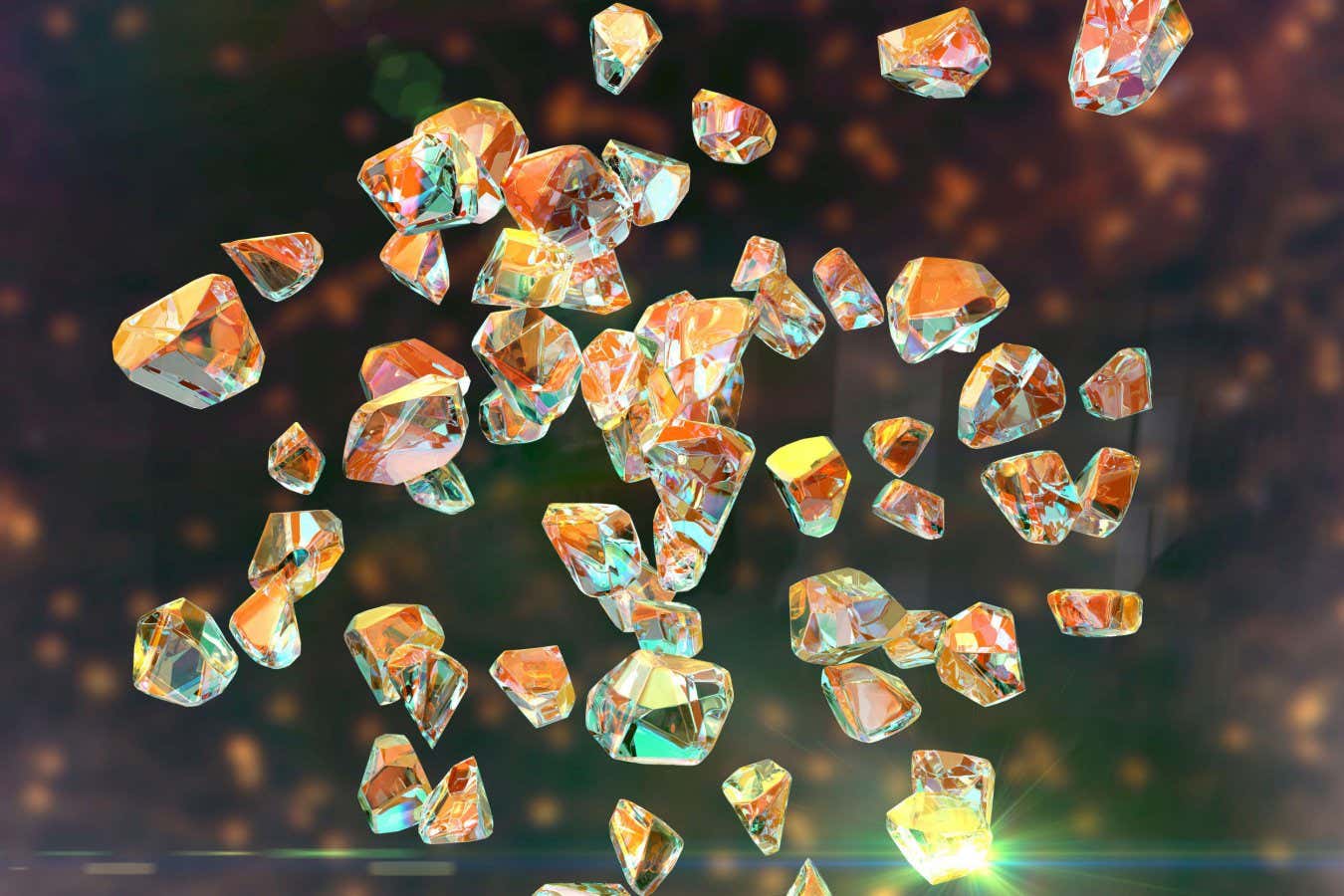
    An artist’s impression of nanodiamonds

    KATERYNA KON/SCIENCE PHOTO LIBRARY/Alamy

    Diamonds are forever, but if you make them ultrasmall, they can get a little squishy. An experiment with some of the smallest diamonds ever studied has now revealed why they become surprisingly elastic when they are ultrasmall.

    “Bulk diamonds are widely known for extreme stiffness and hardness. At the nanoscale, things can be different,” says Chongxin Shan at Zhengzhou University in China. He and his colleagues studied how diamonds as small as 4 nanometres across – hundreds of times smaller than some viruses – respond to pressure.

    The researchers clamped each tiny diamond between two cylinders that were diamond-tipped and capable of compressing the nanodiamond. The cylinders were connected to a force sensor that measured how much the diamond resisted and a special microscope that imaged the compressed diamond.

    Shan says that making reliable measurements at the nanoscale is challenging because all measured effects are very small and any tiny disturbance from the diamond’s environment can add noise to the data. To avoid this problem, the researchers repeated the experiment with about 100 different diamonds and took precautions like making measurements in high vacuum where no particles of air could disturb them. They found that as the diamonds’ diameter decreased from 12 to 4 nanometres, their stiffness decreased by about 30 per cent – meaning they became more elastic.

    The researchers then used their measurements and computer simulations of the diamonds to work out why. Shan says that because the diamonds were so small, the ratio between the number of atoms on their surface layer and the number of atoms comprising their core was large, but the chemical bonds between the two regions were weak. This made the nanodiamonds more elastic than larger diamonds where the surface-to-core ratio is smaller and the stronger bonds within the core dominate the diamond’s behaviour, he says.

    Yang Lu at the City University of Hong Kong says that the new experiment found unexpected changes in diamonds’ properties even compared with past studies of tiny diamonds. His team completed some of the first studies showing that diamonds at the nanoscale can be less hard and brittle, but the new work pushed the smallness level down tenfold. This is important because tiny diamonds are becoming an increasingly popular material for building novel electronics as well as quantum devices, says Lu. “And artificial diamonds are becoming extremely cheap nowadays so it’s a good time for putting diamonds in more and more [applications],” he says.

    Topics:

    • diamonds/
    • materials science


    Source link

    Share. Facebook Twitter Pinterest LinkedIn Tumblr Email Telegram Copy Link

    Related Posts

    Science

    How do earthquakes end? A seismic ‘stop sign’ could help predict earthquake risk

    April 24, 2026
    Science

    ‘Kraken’ fossils show enormous, intelligent octopuses were top predators in Cretaceous seas

    April 24, 2026
    Science

    Largest ever octopus was great white shark of invertebrate predators

    April 24, 2026
    Science

    Do you need to worry about Mythos, Anthropic’s computer-hacking AI?

    April 23, 2026
    Science

    How many dachshunds would it take to get to the moon?

    April 23, 2026
    Science

    The Age Code review: Can you slow ageing with your diet? A new book gives it a go

    April 23, 2026
    Editors Picks

    Leading candidate emerges for Dolphins’ head-coaching job

    January 18, 2026

    Iranian IRGC’s ties to Hezbollah deepen tensions in Lebanese politics | Israel attacks Lebanon News

    March 24, 2026

    Möbius strip-like molecule has an entirely new and bizarre shape

    March 6, 2026

    How To Trust Your Instincts During a Pivot

    June 24, 2025

    Market Talk – March 13, 2026

    March 14, 2026
    About Us
    About Us

    Welcome to Benjamin Franklin Institute, your premier destination for insightful, engaging, and diverse Political News and Opinions.

    The Benjamin Franklin Institute supports free speech, the U.S. Constitution and political candidates and organizations that promote and protect both of these important features of the American Experiment.

    We are passionate about delivering high-quality, accurate, and engaging content that resonates with our readers. Sign up for our text alerts and email newsletter to stay informed.

    Latest Posts

    How do earthquakes end? A seismic ‘stop sign’ could help predict earthquake risk

    April 24, 2026

    Trump Announces Cease-Fire Between Israel and Lebanon

    April 24, 2026

    Google Is Tracking Your Life – Photo Cloud Feeding AI System

    April 24, 2026

    Subscribe for Updates

    Stay informed by signing up for our free news alerts.

    Paid for by the Benjamin Franklin Institute. Not authorized by any candidate or candidate’s committee.
    • Privacy Policy
    • About us
    • Contact us

    Type above and press Enter to search. Press Esc to cancel.