

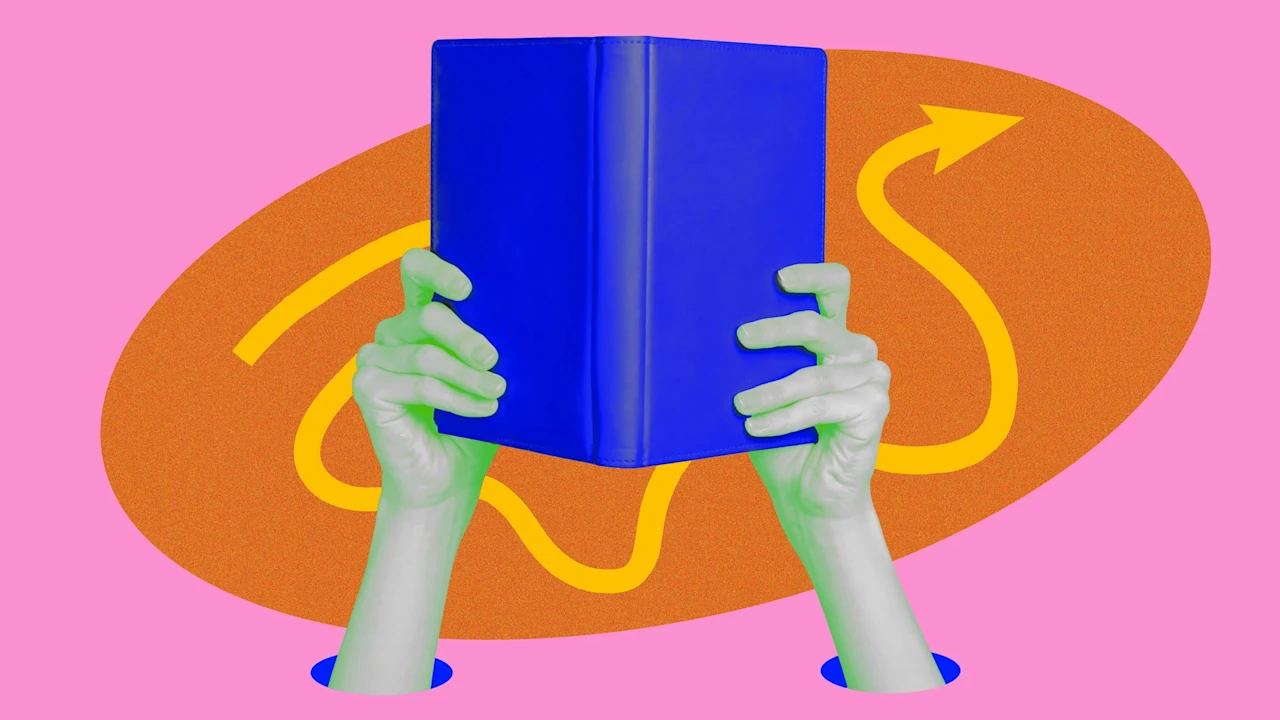
Have you found that you now struggle to get through a book? If so, I have good and bad news for you. The bad news is that losing your ability to read books may be common at the moment, but neuroscience says it is a very bad sign for how our brains are doing. The better news is that science also offers a simple plan to recover your ability to read deeply again.
Can’t read books anymore? You’re not alone
“Several people have told me lately that they’ve stopped being able to read, echoing my own experience,” author Katherine May confessed in her newsletter recently.
Statistics suggest May and her reading-challenged correspondents are far from alone. These days, we’re bombarded by short-form text and continually skim through headlines, texts, emails, and ads. But deep reading is a very different story. One recent study found that the number of Americans who read books on any given day fell 40 percent between 2003 and 2023.
You may have experienced this inability to focus on any text longer than a couple of lines yourself. Or maybe you read a page only to get to the end and realize you have no idea what happened at the beginning.
Neuroscience: This is your brain on deep reading
For once-dedicated readers, losing the ability to really sink into books can be sad and frustrating. For neuroscientists, it’s alarming. Studies show our eyes move in different patterns when we’re skimming content compared to when we’re deeply engaged with a text. And different eye patterns reflect different brain patterns.
“When the reading brain skims like this, it reduces time allocated to deep reading processes. In other words, we don’t have time to grasp complexity, to understand another’s feelings, to perceive beauty, and to create thoughts of the reader’s own,” Harvard-trained neuroscientist Maryanne Wolf explains.
“It affects our ability to navigate a constant bombardment of information. It incentivizes a retreat to the most familiar silos of unchecked information, which require and receive no analysis, leaving us susceptible to false information and demagoguery,” she warns.
Losing our capacity for deep reading means losing some of our capacity for deep thought. Critical thinking and logical reasoning aren’t guaranteed to us from birth. These skills are built up through the active practice of reading.
Harvard professor and author Joseph Henrich has explained how reading “has left you with a specialized area in your left ventral occipital temporal region, shifted facial recognition into your right hemisphere, reduced your inclination toward holistic visual processing, increased your verbal memory, and thickened your corpus callosum, which is the information highway that connects the left and right hemispheres of your brain.”
Leave the neuroscience jargon to the side and the message is still clear: Deep reading physically rewires your brain for complex, sustained, abstract thought. Give up reading books for too long and those circuits will wither.
The basic advice on how to start reading books again
If you want to fight back against this tech- and anxiety-related “brain rot,” what’s to be done? It’s no surprise that the main prescription is simple: Start reading whole books again.
But as the section above makes clear, that’s easier said than done. Many of us know we should read more but still struggle to do it. May, for instance, suggests experimenting with audio books (better than nothing, but not the same), revisiting old favorites, and hiding your phone from yourself.
These are all solid, if not revolutionary, suggestions. Does science have any more specific advice to add? Thankfully, yes. On The Conversation, cognitive scientist Jeff Saerys-Foy and literacy expert JT Torres recently shared a simple plan to help you get back to reading books again.
A neuroscience-backed way to reclaim your focus
The pair kick off with their own glum assessment of the state of our reading skills: “Reading comprehension scores have continued to decline.” The majority of Gen-Z parents are not reading aloud to their young children because they view it as a chore,” and “many college students cannot make it through an entire book.” Their prescription:
- Motivate yourself with science. Engaging deeply with a text is mentally taxing. To work up the necessary motivation, remind yourself of the science of how skipping deep reading affects your brain.
- Intentionally slow down. Reading deeply requires “slowing down as needed to wrestle with difficult passages, savor striking prose, critically evaluate information, and reflect on the meaning of a text. It involves entering into a dialogue with the text rather than gleaning information,” the pair write. So when you sit down to read, remember there are no prizes for speed.
- Start small. If a long book feels out of reach, “you can start small, perhaps with poems, short stories, or essays, before moving up to longer texts.”
- Find a reading buddy. Deep reading is hard, so it pays to find someone to keep you accountable and provide a spark of motivation. “Partner with a friend or family member and set a goal to read a full-length novel or nonfiction book,” suggest the scientists.
- Read in small chunks. Don’t wait until you get to the end of the book to start discussing it with your buddy. Set smaller goals, such as finishing a chapter or a set number of pages a day. Then, discuss what you’re reading regularly. Technology can help you here: Talking about what you’re reading on BookTok counts as much as meeting up in person.
Read like it’s 1999
These steps can help you retrain your brain for deep reading. But it all starts with the same first move: Pick up a book and recommit to long-form reading again. Manage that, and not only will your brain thank you, but you’ll regain the magic of losing yourself in a book once again. Who couldn’t use a little more imagination, escapism, and wonder at the moment?
—Jessica Stillman
This article originally appeared on Fast Company’s sister website, Inc.com.
Inc. is the voice of the American entrepreneur. We inspire, inform, and document the most fascinating people in business: the risk-takers, the innovators, and the ultra-driven go-getters that represent the most dynamic force in the American economy.