
Close Menu
    Trending
    • ‘Friends’ Star Confirms Astronomical Residual Earnings
    • Panama Canal reaffirms ‘neutrality’ amid Mideast war
    • How the Iran war is hitting the UK | US-Israel war on Iran News
    • Why Steelers made unexpected Aaron Rodgers decision
    • ‘I almost become paranoid’: Why anxiety is so much worse in the middle of the night
    • NASA chief Jared Isaacman hints at campaign to make Pluto a planet again
    • Energy War Breaks OPEC: UAE Walks Away As Oil Supply Collapses
    • Justin Baldoni Denies Role In Blake Lively’s Career Downfall
    Benjamin Franklin Institute
    Wednesday, April 29
    • Home
    • Politics
    • Business
    • Science
    • Technology
    • Arts & Entertainment
    • International
    Benjamin Franklin Institute
    Home»Science»Bubble feeding trick spreads through humpback whale social groups
    Science

    Bubble feeding trick spreads through humpback whale social groups

    Team_Benjamin Franklin InstituteBy Team_Benjamin Franklin InstituteJanuary 21, 2026No Comments3 Mins Read
    Share Facebook Twitter Pinterest Copy Link LinkedIn Tumblr Email VKontakte Telegram
    Share
    Facebook Twitter Pinterest Email Copy Link


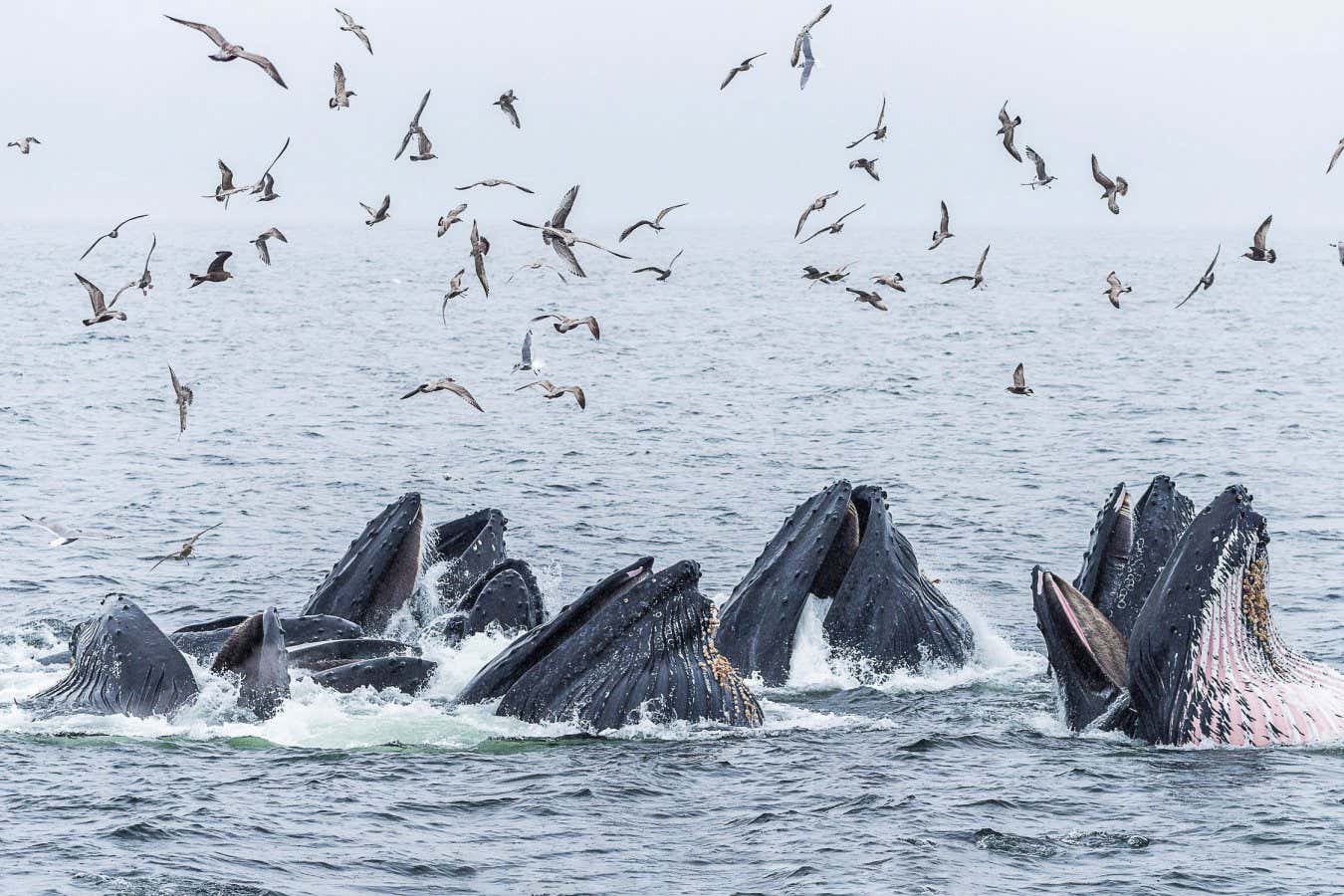
    Humpback whales work together to trap fish by surrounding them with bubbles

    Jenn Dickie/North Coast Cetatean society

    An innovative feeding behaviour has spread rapidly through humpback whales in the fjords of western Canada, in a clear example of how cultural knowledge can help animal populations to survive.

    Bubble-net feeding is a group hunting technique in which whales blow bubbles to corral fish, then surge upwards together to gulp them down.

    “It’s an activity that’s done cooperatively, given the level of coordination and division of labour involved,” says Ellen Garland at the University of St Andrews, UK.

    The behaviour has been documented for decades among humpbacks (Megaptera novaeangliae) in Alaskan waters, and researchers have started seeing it recently in the northeastern Pacific population off Canada.

    But it is tricky for researchers to establish whether complex behaviours like this are transmitted through social learning — rather than being independently discovered by multiple individuals.

    To tease apart the process, Éadin O’Mahony at the University of St Andrews and her colleagues analysed field observation data from 2004 to 2023, focusing on 526 individuals living in the Kitimat Fjord System in British Columbia, within Gitga’at First Nation territory.

    The team identified the whales using images of their tail flukes, which are unique to each animal. The data shows that 254 individuals performed bubble-net feeding at least once, and about 90 per cent of these events occurred in a cooperative context.

    The behaviour also appeared to take off after 2014, coinciding with a major marine heatwave in the north-east Pacific that reduced prey availability.

    “With the heatwave, as prey availability went down, a whale’s ability to change feeding behaviour would help it maintain its daily calorie intake,” says O’Mahony.

    Whales were more likely to adopt bubble-net feeding if they regularly associated with others that already used the technique. Bubble-net feeding was probably introduced in the region by whales migrating from elsewhere in the north-east Pacific, but the pattern points mainly to the behaviour spreading through local social networks, carried by stable groups and influential individuals.

    “What we see from the heatwave years onward is an increase in whales already in the area who previously didn’t take part in bubble-net feeding,” says O’Mahony.

    Humpback whales’ ability to pass on knowledge through social groups may be vital to their survival, and understanding their culture could help us protect them, the researchers say.

    “It’s not just about how many animals are left, but about whether the social behaviours that make the population function are coming back too,” says Ted Cheeseman, co-founder of the citizen science platform Happywhale, who wasn’t involved in the study.

    New Scientist. Science news and long reads from expert journalists, covering developments in science, technology, health and the environment on the website and the magazine.

    Arctic expedition cruise with Dr Russell Arnott: Svalbard, Norway

    Embark on an unforgettable marine expedition to the Arctic, accompanied by marine biologist Russell Arnott.

    Topics:



    Source link

    Share. Facebook Twitter Pinterest LinkedIn Tumblr Email Telegram Copy Link

    Related Posts

    Science

    NASA chief Jared Isaacman hints at campaign to make Pluto a planet again

    April 29, 2026
    Science

    Cancer is increasing in young people and we still don’t know why

    April 29, 2026
    Science

    People are betting on measles outbreaks – and that might be useful

    April 29, 2026
    Science

    Striking photo essay examines deadly spread of dengue fever in Nepal

    April 28, 2026
    Science

    Watch Astrobotic’s latest record-breaking ‘ring of fire’ rocket engine test

    April 28, 2026
    Science

    How I pay almost nothing to power my house and electric car

    April 28, 2026
    Editors Picks

    The ‘zombie internet’ has arrived—and it has devastating consequences for advertising, social media, and the human web

    February 15, 2026

    Why is Pakistan backing Bangladesh in its T20 World Cup row with India? | ICC Men’s T20 World Cup News

    January 27, 2026

    Hyatt Hotels chairman Thomas Pritzker steps down over Epstein ties | Donald Trump News

    February 17, 2026

    Chess can be made fairer by rearranging the pieces

    January 2, 2026

    Inside the wild experiments physicists would do with zero limits

    December 11, 2025
    About Us
    About Us

    Welcome to Benjamin Franklin Institute, your premier destination for insightful, engaging, and diverse Political News and Opinions.

    The Benjamin Franklin Institute supports free speech, the U.S. Constitution and political candidates and organizations that promote and protect both of these important features of the American Experiment.

    We are passionate about delivering high-quality, accurate, and engaging content that resonates with our readers. Sign up for our text alerts and email newsletter to stay informed.

    Latest Posts

    ‘Friends’ Star Confirms Astronomical Residual Earnings

    April 29, 2026

    Panama Canal reaffirms ‘neutrality’ amid Mideast war

    April 29, 2026

    How the Iran war is hitting the UK | US-Israel war on Iran News

    April 29, 2026

    Subscribe for Updates

    Stay informed by signing up for our free news alerts.

    Paid for by the Benjamin Franklin Institute. Not authorized by any candidate or candidate’s committee.
    • Privacy Policy
    • About us
    • Contact us

    Type above and press Enter to search. Press Esc to cancel.