

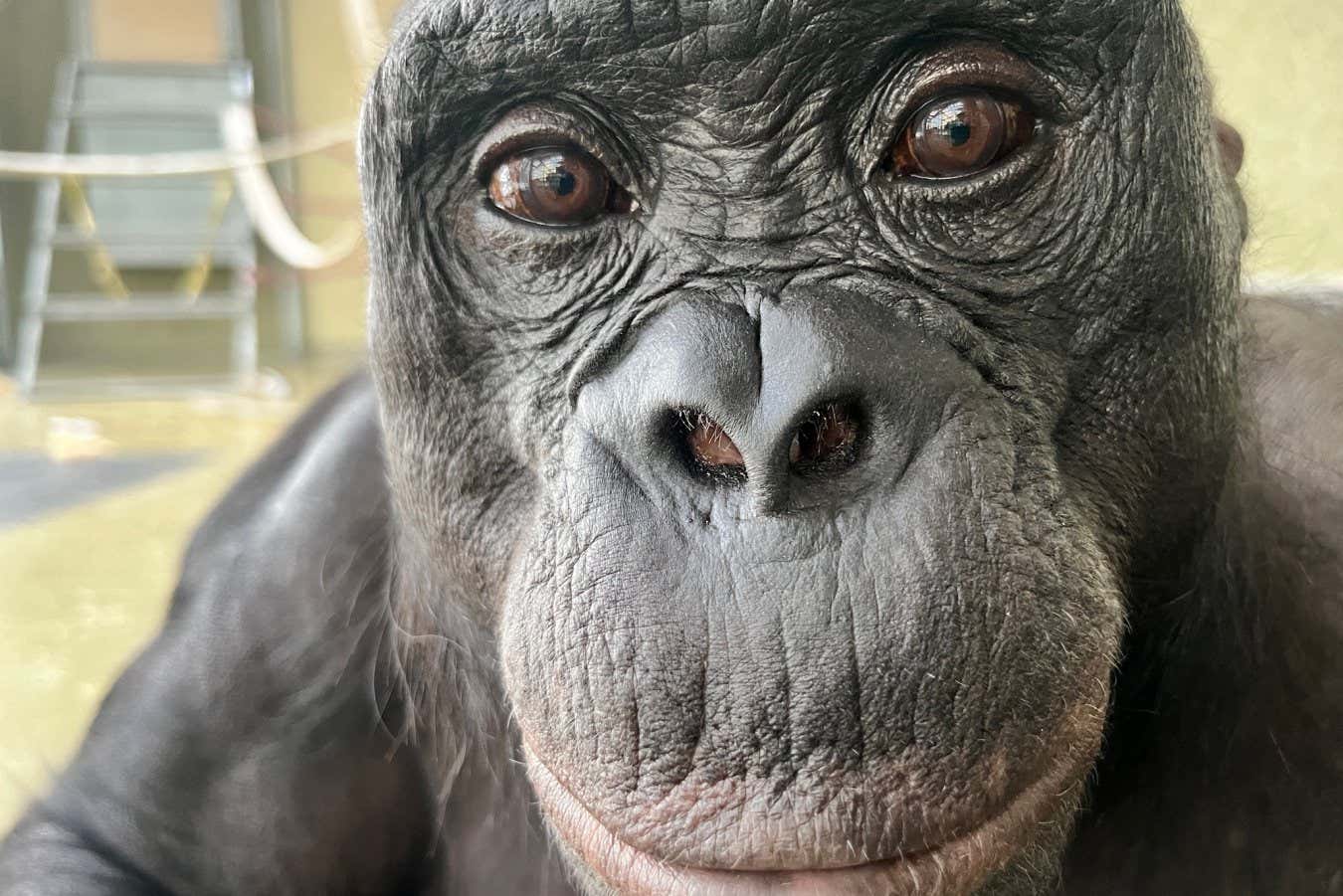
Kanzi, one of three captive bonobos whose mental abilities were tested in the study
Ape Initiative
Bonobos are quick to help a person who doesn’t know what they know, a sign that they can deduce the mental states of others.
The capacity to think about what others are thinking, known as theory of mind, is an essential skill that allows humans to navigate their social worlds. It enables us to recognise that someone may hold different beliefs or perspectives to our own, underpinning our ability to understand and help others appropriately.
The question of whether our closest living relatives also have theory of mind has been hotly debated for decades. Despite some mixed results, non-human great apes seem to have some aspects of this capacity, suggesting it is more evolutionarily ancient than once thought. For example, wild chimpanzees that see a nearby snake, albeit a fake one, seem to call out to alert group members they know haven’t already seen it.
But we have been missing clear evidence from controlled settings that primates can track a perspective that differs from their own and then act upon it, says Luke Townrow at Johns Hopkins University in Maryland.
To investigate this, Townrow and Christopher Krupenye, also at Johns Hopkins University, tested if three male bonobos at the Ape Initiative research centre in Iowa could identify ignorance in someone they were trying to cooperate with, and then gesture to them to help solve the task.
On a table between the bonobo and an experimenter were three upturned plastic cups. A second researcher placed a barrier between the experimenter and the cups, then hid a treat, like a juicy grape, under one of them.
In one version of the experiment, the “knowledge condition”, a window in the barrier allowed the experimenter to watch where the treat was placed. In the “ignorance condition”, their view was completely blocked. If the experimenter found the food, they would give it to the bonobo, providing a motivation for the apes to share what they knew.
Townrow and Krupenye looked at whether the ape pointed at the cup, and how quickly they pointed, after the barrier had been removed over 24 trials for each condition.
They found that, on average, the bonobos took 1.5 seconds less time to point and pointed in approximately 20 per cent more trials in the ignorance condition. “This shows that they can actually take action when they realise that somebody has a different perspective from their own,” says Krupenye. It appears that bonobos understand features of what others are thinking that researchers have historically assumed they didn’t comprehend, he adds.
This simple yet powerful research gives experimental support to existing findings from wild apes, says Zanna Clay at Durham University, UK. However, she warns that the findings may not apply to all bonobos because the study animals were raised in human-oriented environments. But that doesn’t detract from the results demonstrating that a capacity is there, she adds.
Indeed, finding this capacity in these three bonobos indicates that the potential exists within their biology and, very likely then, the biology of our common ancestor as well, says Krupenye.
“It suggests that our ancient human relatives likely also had these abilities and could use them to bolster cooperation and coordination with one another,” says Laura Lewis at the University of California, Berkeley. “By understanding when someone may be ignorant, especially about evolutionarily critical information like the location of food, our ancestors could have used these capacities to communicate and coordinate more effectively with their social partners.”
Topics: