
Close Menu
    Trending
    • What’s behind Pakistan’s mass deportation of Afghans? | Refugees News
    • Grant Enfinger wins chaotic NASCAR Craftsman Truck Series race
    • Portugal Just Made European Citizenship Much Harder to Get. Here’s Why It Matters.
    • How could loosened radiation exposure rules affect public health?
    • How Rosie O’Donnell Knew To End Her Talk Show
    • US delegation in Lebanon to discuss Israel ‘pilot zone’ withdrawal: Official
    • FIFA is not an independent sporting organisation; it is a political tool. | Opinions
    • Thunder rookie center Aday Mara has brutal Summer League debut
    Benjamin Franklin Institute
    Saturday, July 11
    • Home
    • Politics
    • Business
    • Science
    • Technology
    • Arts & Entertainment
    • International
    Benjamin Franklin Institute
    Home»Science»‘Bone collector’ caterpillar wears dead insect body parts as disguise
    Science

    ‘Bone collector’ caterpillar wears dead insect body parts as disguise

    Team_Benjamin Franklin InstituteBy Team_Benjamin Franklin InstituteApril 25, 2025No Comments3 Mins Read
    Share Facebook Twitter Pinterest Copy Link LinkedIn Tumblr Email VKontakte Telegram
    Share
    Facebook Twitter Pinterest Email Copy Link


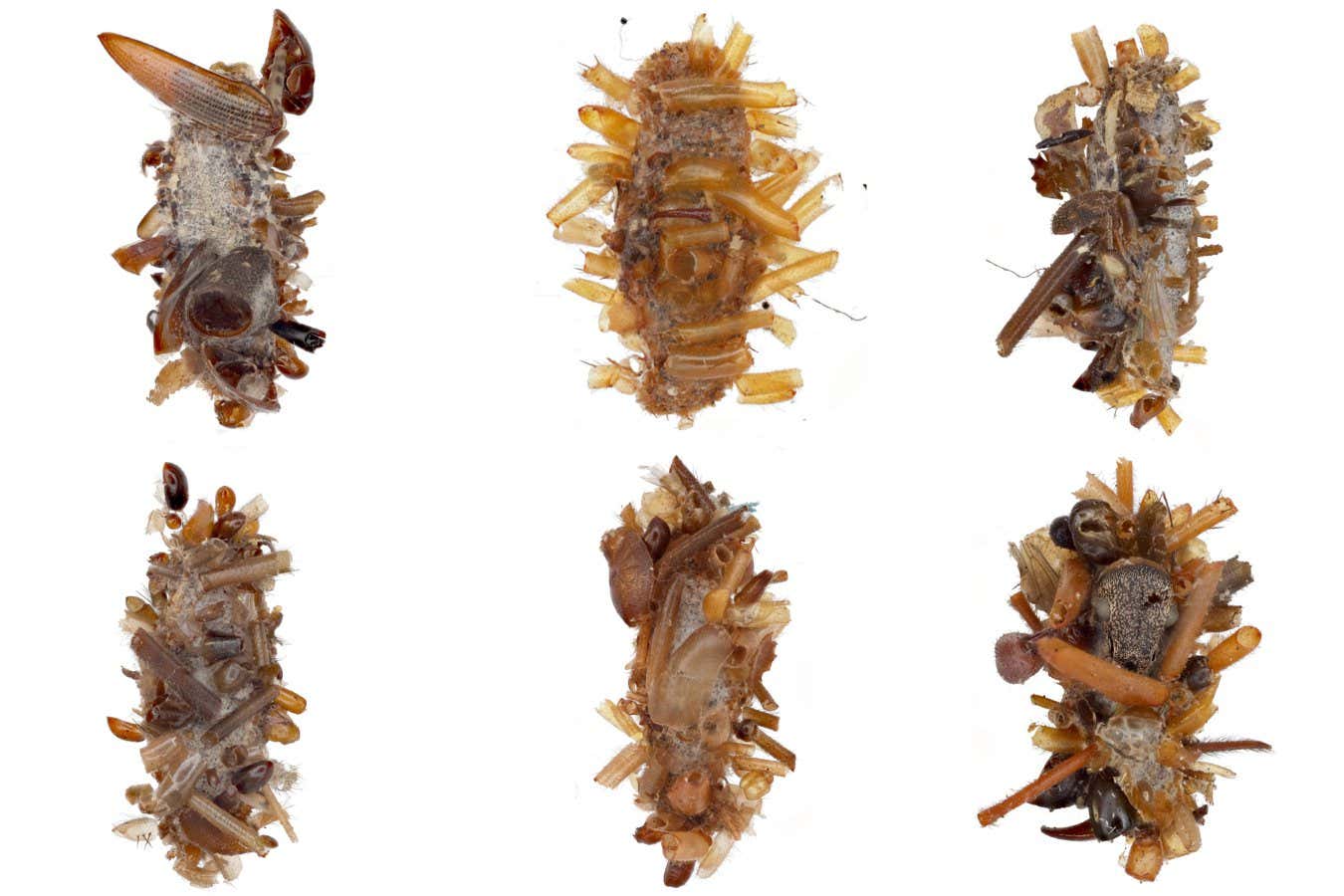
    Bone collector caterpillars from the Waianae mountain range in Oahu, Hawaii

    Daniel Rubinoff et al. 2025

    The newly described “bone collector” caterpillar species disguises itself with the body parts of dead insects so that it can live among spiders and poach their prey. This is the only caterpillar known to use such grisly camouflage or have spiders as roommates – and it’s a carnivore and a cannibal to boot.

    Daniel Rubinoff at the University of Hawai‘i at Mānoa and his colleagues discovered the caterpillar while hiking the Waianae mountains in Oahu more than two decades ago. They were searching for other species in the same genus, Hyposmocoma, also known as Hawaiian fancy case caterpillars. “We see this little, tiny sac covered in bug bits, and honestly, we weren’t sure what it was,” says Rubinoff. “And then we take it back [to the lab], and we realise there is a little caterpillar in there.”

    The newly described species of Hyposmocoma – which has not yet received a scientific name – lives on cobwebs inside tree trunks, among rocks and other enclosed spaces. It is about the length of a fingernail and feeds on insects trapped in spider webs. “Only 0.13 per cent of all caterpillars on the planet are carnivorous,” says Rubinoff. “So it is incredibly hard for a caterpillar to evolve to eat meat.”

    The bone collector avoids becoming prey itself with a macabre method: adorning its silken case with fragments of dead insects and the spider’s moulted exoskeleton. The critter carefully sizes up each body part – which might include ant heads, beetle abdomens or fly wings – before weaving it into its disguise.

    The bone collector caterpillar (left) uses its grisly disguise to live safely with a spider (right)

    Daniel Rubinoff et al. 2025

    “That’s the only way to survive, probably, living with a spider – by covering yourself in bits of the spider’s own shed skin and its past meals,” says Rubinoff. This leaves the caterpillar smelling and tasting more like a bag of trash than a juicy snack to its arachnid housemate. After about two to three months, it then metamorphoses into a moth smaller than a grain of rice.

    If the bone collector’s accessorising weren’t gnarly enough, this caterpillar is also a cannibal. The researchers learned this after placing two of the larvae in the same cage, leading to the larger one feasting on its smaller, weaker brethren. This is why you only ever see one bone collector per spider web, says Rubinoff.

    The researchers have found just 62 of these critters across more than 150 field surveys conducted over roughly 22 years, all within the same 15 square kilometres of the Waianae mountain range.

    Genetic analysis indicates its lineage is about 3 million years older than the island of Oahu, meaning it was once more widespread. “Since the arrivals of humans in a place like this, we’ve lost lots of native species,” says Rubinoff. “It is both a miracle that we were able to find [the bone collector], and really sad that they are so restricted to this one spot.”

    Topics:


    Source link

    Share. Facebook Twitter Pinterest LinkedIn Tumblr Email Telegram Copy Link

    Related Posts

    Science

    How could loosened radiation exposure rules affect public health?

    July 11, 2026
    Science

    How a 1,900-year-old latrine helps explain why Roman concrete lasts

    July 11, 2026
    Science

    Wimbledon 2026 opened with a 148 mph serve—here’s how tennis players brains track such fast balls

    July 11, 2026
    Science

    Odds of a Super El Niño are rising, and that could have deadly consequences

    July 11, 2026
    Science

    China’s Long March 10B rocket successfully launches—and lands—in a global spaceflight milestone

    July 11, 2026
    Science

    Global warming already causing crop losses of over $20 billion a year

    July 11, 2026
    Editors Picks

    California Parole Board Denies Parole for Erik Menendez

    August 24, 2025

    As Trump Meets Xi in China, A Closer Look at Who’s in the U.S. Delegation

    May 14, 2026

    UK PM insists he won’t resign over scandal of US envoy’s appointment

    April 22, 2026

    Former U.S. health official explains why the Trump administration ‘ignored’ a key alcohol study

    June 14, 2026

    A former Apple executive turned wine entrepreneur is choosing a ‘long-term strategy’ over scale

    January 15, 2026
    About Us
    About Us

    Welcome to Benjamin Franklin Institute, your premier destination for insightful, engaging, and diverse Political News and Opinions.

    The Benjamin Franklin Institute supports free speech, the U.S. Constitution and political candidates and organizations that promote and protect both of these important features of the American Experiment.

    We are passionate about delivering high-quality, accurate, and engaging content that resonates with our readers. Sign up for our text alerts and email newsletter to stay informed.

    Latest Posts

    What’s behind Pakistan’s mass deportation of Afghans? | Refugees News

    July 11, 2026

    Grant Enfinger wins chaotic NASCAR Craftsman Truck Series race

    July 11, 2026

    Portugal Just Made European Citizenship Much Harder to Get. Here’s Why It Matters.

    July 11, 2026

    Subscribe for Updates

    Stay informed by signing up for our free news alerts.

    Paid for by the Benjamin Franklin Institute. Not authorized by any candidate or candidate’s committee.
    • Privacy Policy
    • About us
    • Contact us

    Type above and press Enter to search. Press Esc to cancel.