
Close Menu
    Trending
    • Amsterdam Bans Meat Ads As The War On Food Expands
    • Katie Holmes And Joshua Jackson Spark ‘Soul-Level’ Love Chatter
    • Singapore Airlines, Southwest Airlines partner to expand access to nearly 120 US destinations
    • Trump warns Netanyahu: ‘You’ll be on your own’ if attacks on Iran continue | US-Israel war on Iran News
    • Cristiano Ronaldo, ‘The Bosnian Diamond’ headline the World Cup 40-and-over club
    • How housing market inventory is shifting across every state
    • What is a ‘normal’ memory slowdown, and when should I worry?
    • Ariana Grande And Ethan Slater Are ‘Still Friends’ Following Split
    Benjamin Franklin Institute
    Tuesday, June 9
    • Home
    • Politics
    • Business
    • Science
    • Technology
    • Arts & Entertainment
    • International
    Benjamin Franklin Institute
    Home»Science»Beetle larvae mimic flower scents to attract bee hosts
    Science

    Beetle larvae mimic flower scents to attract bee hosts

    Team_Benjamin Franklin InstituteBy Team_Benjamin Franklin InstituteApril 12, 2026No Comments3 Mins Read
    Share Facebook Twitter Pinterest Copy Link LinkedIn Tumblr Email VKontakte Telegram
    Share
    Facebook Twitter Pinterest Email Copy Link


    April 12, 2026

    2 min read

    Add Us On GoogleAdd SciAm

    These baby beetles work together to look—and smell—like flowers

    Parasitic beetles are the first animals known to imitate floral scents
    By Chris Simms edited by Sarah Lewin Frasier

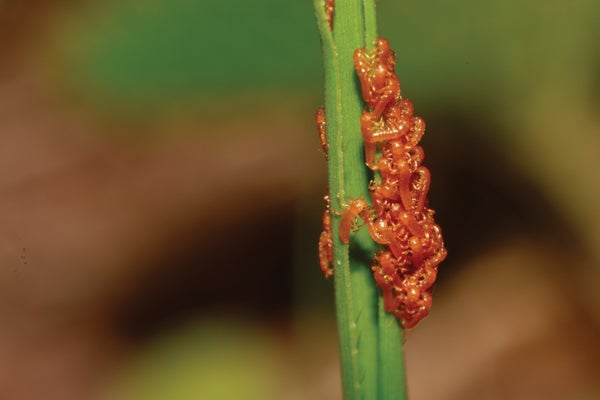
    Close up of beetles in a flower shape.

    Blister beetle larvae demonstrate a clumpy flower impression.

    The European blister beetle lays thousands of eggs in the spring. When they hatch, the bright-orange larvae shimmy up flower stems and sit in clumps, waiting for passing solitary bees to latch on to with hooklike appendages so they can grab a lift. Now researchers have found that these clumps give off a distinctly floral scent—making the larvae the first animal known to mimic a flower’s smell.

    Ryan Alam, a chemist at the Max Planck Institute for Chemical Ecology in Germany, and his colleagues found that the larvae attract bees by emitting a collection of 17 scented compounds often found in flowers, including linalool oxide and lilac aldehyde. Once a larva has been airlifted to a bee’s nest, it feeds on the bees’ eggs and supplies of pollen and nectar. It stays there until it pupates and then leaves as an adult to restart the cycle.

    In addition to attracting bees, the larvae’s perfume also draws other larvae, which could help them to form those flowerlike aggregations. The study was posted on the preprint server bioRxiv and hasn’t been peer-reviewed, but it “presents a convincing case that the beetle larvae are mimicking flowers chemically, and perhaps visually, so as to deceive and attract bees,” says Jim McLean, an evolutionary biologist at Macquarie University in Australia, who was not involved in the study.


    On supporting science journalism

    If you’re enjoying this article, consider supporting our award-winning journalism by subscribing. By purchasing a subscription you are helping to ensure the future of impactful stories about the discoveries and ideas shaping our world today.


    Animals such as the orchid mantis mimic the look of flowers, and the corpse flower emits a smell like rotting meat to attract insects, but these beetles add a new strategy to the mimicry playbook, Alam says.

    Dmitry Telnov, an entomologist at the Natural History Museum in London, who was also not involved in the study, notes that a different blister beetle species in the U.S. can mimic the sex pheromones of host bees. Mimicking smells “might be an evolutionary approach used by blister beetles to attract specific species,” he says, “which is absolutely surprising.”

    It’s Time to Stand Up for Science

    If you enjoyed this article, I’d like to ask for your support. Scientific American has served as an advocate for science and industry for 180 years, and right now may be the most critical moment in that two-century history.

    I’ve been a Scientific American subscriber since I was 12 years old, and it helped shape the way I look at the world. SciAm always educates and delights me, and inspires a sense of awe for our vast, beautiful universe. I hope it does that for you, too.

    If you subscribe to Scientific American, you help ensure that our coverage is centered on meaningful research and discovery; that we have the resources to report on the decisions that threaten labs across the U.S.; and that we support both budding and working scientists at a time when the value of science itself too often goes unrecognized.

    In return, you get essential news, captivating podcasts, brilliant infographics, can’t-miss newsletters, must-watch videos, challenging games, and the science world’s best writing and reporting. You can even gift someone a subscription.

    There has never been a more important time for us to stand up and show why science matters. I hope you’ll support us in that mission.


    Source link

    Share. Facebook Twitter Pinterest LinkedIn Tumblr Email Telegram Copy Link

    Related Posts

    Science

    What is a ‘normal’ memory slowdown, and when should I worry?

    June 9, 2026
    Science

    Wildlife thrives in solar farm built on restored peatland

    June 8, 2026
    Science

    You don’t need to worry about recursive-self-improving AI – yet

    June 8, 2026
    Science

    Understanding anorexia’s grip on the brain could unlock new therapies

    June 8, 2026
    Science

    Why GLP-1 drugs might reduce cancer risk

    June 8, 2026
    Science

    Landmark pancreatic cancer treatment paves way for targeting other tricky tumors

    June 8, 2026
    Editors Picks

    King Charles calls for NATO unity, Ukraine support in US Congress speech | Donald Trump News

    April 28, 2026

    Israeli attacks in Lebanon kill 10 people, including high-ranking soldiers | Israel attacks Lebanon News

    June 6, 2026

    Justin Timberlake Quells Marital Struggles With Mother’s Day Post

    May 12, 2026

    Opinion | China Will Be Thrilled if Trump Kills America’s Green Economy

    January 23, 2025

    A New York Times critic used AI to write a review, but good criticism can’t be outsourced

    April 4, 2026
    About Us
    About Us

    Welcome to Benjamin Franklin Institute, your premier destination for insightful, engaging, and diverse Political News and Opinions.

    The Benjamin Franklin Institute supports free speech, the U.S. Constitution and political candidates and organizations that promote and protect both of these important features of the American Experiment.

    We are passionate about delivering high-quality, accurate, and engaging content that resonates with our readers. Sign up for our text alerts and email newsletter to stay informed.

    Latest Posts

    Amsterdam Bans Meat Ads As The War On Food Expands

    June 9, 2026

    Katie Holmes And Joshua Jackson Spark ‘Soul-Level’ Love Chatter

    June 9, 2026

    Singapore Airlines, Southwest Airlines partner to expand access to nearly 120 US destinations

    June 9, 2026

    Subscribe for Updates

    Stay informed by signing up for our free news alerts.

    Paid for by the Benjamin Franklin Institute. Not authorized by any candidate or candidate’s committee.
    • Privacy Policy
    • About us
    • Contact us

    Type above and press Enter to search. Press Esc to cancel.