

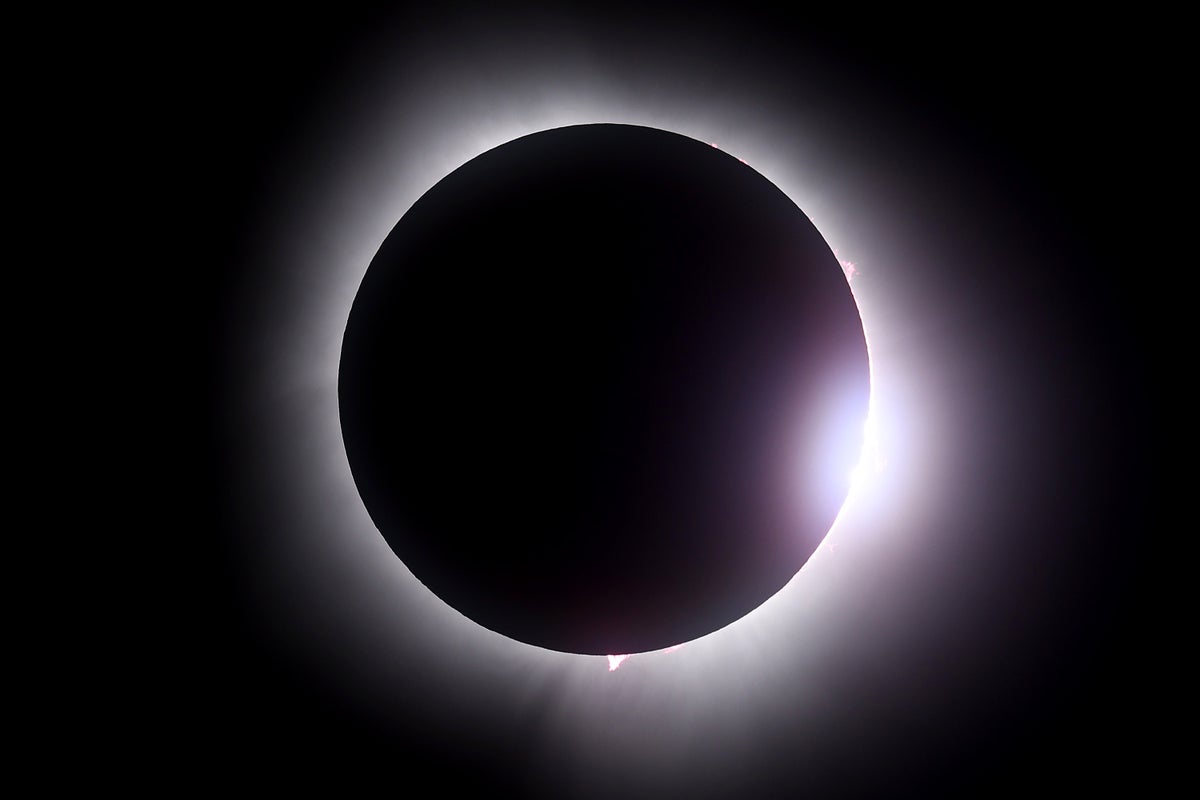
On August 12 the sky will go dark for just two minutes and 18 seconds, at longest, across a swath of the world that includes Greenland, Iceland and northern Spain—and scientists everywhere will be scrambling to gather as much data as they possibly can.
Total solar eclipses offer rare and brief opportunities to learn new information about everything from the physics of the sun to the behavior of animals and the dynamics of Earth’s atmosphere.
And the one in August will be no different. Some of the planned experiments will aim to gather data on heliophysics, measure the amount of radiation entering Earth’s atmosphere, monitor gravity waves and even re-create a famous test of one Albert Einstein’s most important theories.
On supporting science journalism
If you’re enjoying this article, consider supporting our award-winning journalism by subscribing. By purchasing a subscription you are helping to ensure the future of impactful stories about the discoveries and ideas shaping our world today.
Given how brief the totality of the eclipse will be, there won’t a second to waste. That’s why NASA will have three WB-57 high-altitude research planes in the air over Iceland. The jets reach speeds of around 470 miles per hour—that’s not fast enough to keep pace with an eclipse, but such speeds enable NASA to gather data on the sun’s corona, or outermost layer, using the planes’ cameras, which will capture images of our star’s fiery halo in visible, near-infrared and mid-infrared wavelengths of light.
Flying at 50,000 feet, the planes will be far above cloud level, putting them in a prime position to pick up these wavelengths without the interference of the vast majority of the atmosphere’s water vapor, says Amir Caspi, a solar physicist at the Southwest Research Institute, who is working with the space agency on the project.
“It’s a rare opportunity to be able to see and measure the sun’s outer atmosphere, the solar corona,” Caspi says. “The surface of the sun, the disk of the sun, is a million times brighter than the solar corona, at least in visible wavelengths. If you want to study and measure the solar corona, an eclipse gives you that opportunity by blocking out something that’s a billion times brighter.”
The jets will be joined in the air by many balloons, including some associated with an initiative called the Nationwide Eclipse Ballooning Project. Comprised of groups of students from across the U.S., the effort will deploy 80 balloons into the skies above both Spain and Iceland over the course of 30 hours. Some of the balloons will contain engineering experiments to “push the boundaries on what these type of inexpensive systems and balloons are capable of doing,” says Angela Des Jardins, the project’s lead and an associate research professor at Montana State University.
Des Jardins is looking for atmospheric gravity waves, which are essentially ripples of rising and sinking air in the atmosphere. These waves can cause undulating cloud patterns, as well as turbulence. They can also indicate extreme weather.
“Gravity waves happen all of the time, from temperature changes of day and night or when storms comes in, you have those kinds of pressure changes that make gravity waves,” Des Jardins says. “They even come from physical disturbances like mountain ranges, but it’s been theorized since the 1970s that the cold, dark shadow of an eclipse would make special, specific gravity waves that could travel really high in elevation, up into the stratosphere.”
Des Jardins ran a similar experiment during the 2024 total eclipse that was visible across parts of North America. At that time, she found evidence that these high-altitude gravity waves do, in fact, occur. Now she’s hoping to determine when and where those disturbances originate in the troposphere.
These results could help develop “better climate models, a better understanding of how pollution is affecting the world we live in,” she adds.
Another set of balloons, organized by the Spanish Federation of Astronomical Associations, will be launched almost 20 miles into the sky over Spain. These will be bearing instruments to measure atmospheric conditions, as well as a Geiger counter, a magnetometer and a device to count muons—tiny, short-lived elementary particles that are created when high-energy rays collide with air. The goal is to test a hypothesis that a total eclipse can affect the amount of cosmic radiation striking Earth from space.
“We don’t know exactly what will come out,” says Alex Mendiolagoitia, the federation’s secretary. “We have an open mind, and we will only get to conclusions once we have data. Since we are launching 16 balloons that day, we also may be able to compare from the different launches, depending on their position.”
Perhaps even more valuable than the data are the educational and outreach opportunities, he says.
A total eclipse is “the most exciting event that nature can give you,” he says. The sight of the sun being blotted out has long had religious and spiritual meaning. Mendiolagoitia and his team are planning to have video cameras on their balloons to share the best visuals possible with the general public.
Meanwhile other scientists are hoping to use the wondrous event to inspire people to get more personally involved in science. That’s the goal of Matthias Harksen, a Ph.D. student at the University of Iceland, who plans to re-create a 1919 experiment, co-led by British astronomer Arthur Eddington, that tested Einstein’s general theory of relativity.
Eddington, fascinated by Einstein’s hypothesis, knew that under its logic, the sun should bend spacetime so the light from stars would appear in a different spot in the sky than where it ought to be. (Isaac Newton had earlier predicted the sun’s gravity would bend the path of light, but his calculations for where the light would ultimately appear had far different results). The bright light from the sun obscures the stars during the daytime, however.
To get around this, Eddington traveled to the island of Príncipe off Africa, while other researchers were sent to the Brazilian city of Sobral, to photograph stars near the sun’s location in the sky during a total eclipse. The photographs they took through telescopes were then compared with the stars’ previously charted locations and, as predicted, they appeared where Einstein’s theory suggested they would.
The Eddington experiment, as it became known, was proof that Einstein’s general theory of relativity was accurate and that large objects did, in fact, curve spacetime. By redoing it, albeit with more high-tech equipment than was available in 1919, Harksen hopes to illustrate that even monumental experiments can be re-created by the average person.
“I don’t think we aim to learn anything new about general relativity from these measurements,” he says. “The purpose of this is basically just to tell people, ‘Hey, you can actually do what is probably the most famous experiment in human history.’”