

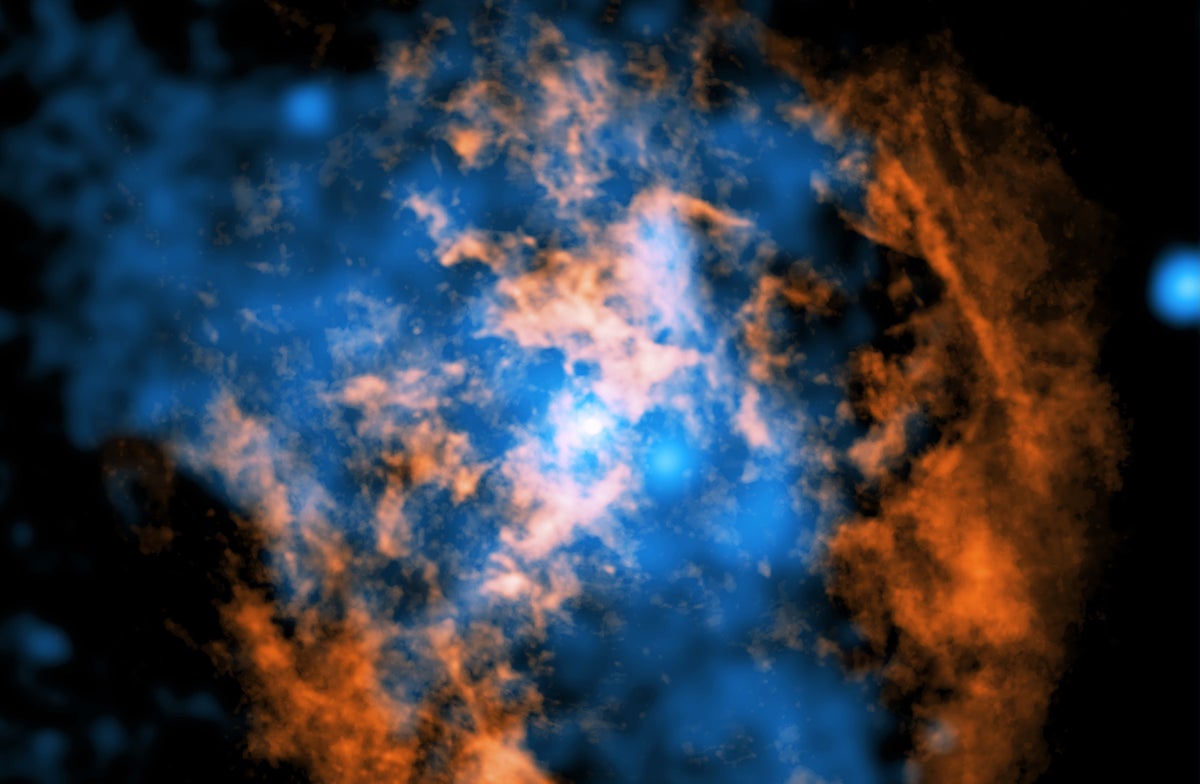
At the heart of our home galaxy lurks a gigantic black hole that’s more than a trillion times heavier than Earth, with all that mass stuffed into a region that is about 2,000 times wider than our planet. Now scientists have discovered the behemoth is throwing off a hot breeze.
The findings, detailed today in the Astrophysical Journal Letters, suggest not only that all black holes emit such a wind but also that these beasts are not total loners that are isolated from their environments.
“We have never seen a breeze from a black hole,” says study co-author Elena Murchikova of Northwestern University. “We usually see the consequences of outbursts or other violent activities. Seeing the black hole sitting there, being quiet but still dumping energy all over the region without doing anything violent, is terribly cute,” adds Murchikova, an assistant professor in Northwestern’s department of physics and astronomy.
On supporting science journalism
If you’re enjoying this article, consider supporting our award-winning journalism by subscribing. By purchasing a subscription you are helping to ensure the future of impactful stories about the discoveries and ideas shaping our world today.
Supermassive black holes are suspected to lurk at the centers of all galaxies. Despite plenty of investigations of our home galaxy’s monstrous resident, called Sagittarius A*, or Sgr A* for short, scientists have yet to detect gassy winds blowing from it—which they’ve long theorized to exist.
“To observe our own black hole, we have to look through the plane of our galaxy,” Murchikova said in a statement. “That means we have to peer through gas, dust and ionized structures, and you can’t really see through all of that easily.”
Murchikova and Northwestern’s Mark Gorski led a team that compiled five years of data captured by a radio telescope in Chile called the Atacama Large Millimeter/submillimeter Array (ALMA) to create an image of the cold molecular gas surrounding Sgr A*. Once the researchers removed bright radio light around the black hole from the resulting image, they could see previously invisible structures inside the gas. The most glaring of the structures was a cone-shaped cavity that was around three light-years long.
They also found this same cone-shaped void in data collected by NASA’s Chandra X-ray Observatory.
Here’s how the wind likely forms: as gas inches close enough to feel Sagittarius A*’s gravity, the material begins to heat up and orbit the cosmic heavyweight; the closer it gets to Sgr A*, the quicker that material orbits until it’s whizzing around at near the speed of light. The wildly whirling material is now trapped by the black hole’s gravitational hold, forming a flattened accretion disk that will soon become dinner for Sgr A*.
But not everything gets sucked in. “Near black holes, the gas is subject to a lot of radiation pressure—from the same gas but … even closer to the black hole—and also various eruptions can occur in it,” Murchikova says. That pressure flings some of the hot gas outward in the form of a wind. “In fact, more of the gas is ejected than falls into the black hole,” she says. When a strong magnetic field is present, that wide cone narrows and is then called a jet.
The team is excited about the discovery, which could lead to a deeper understanding of such strange objects. “It has always been somewhat peculiar to me that the black hole on the sky with which we have the most issues and which fits our theories the worst is our closest supermassive black hole and the one for which we have the most data,” Murchikova says. This new find at least helps explain one mystery, she adds. “The lack of winds from it was one of the most obviously uncomfortable facts.”
It’s Time to Stand Up for Science
If you enjoyed this article, I’d like to ask for your support. Scientific American has served as an advocate for science and industry for 180 years, and right now may be the most critical moment in that two-century history.
I’ve been a Scientific American subscriber since I was 12 years old, and it helped shape the way I look at the world. SciAm always educates and delights me, and inspires a sense of awe for our vast, beautiful universe. I hope it does that for you, too.
If you subscribe to Scientific American, you help ensure that our coverage is centered on meaningful research and discovery; that we have the resources to report on the decisions that threaten labs across the U.S.; and that we support both budding and working scientists at a time when the value of science itself too often goes unrecognized.
In return, you get essential news, captivating podcasts, brilliant infographics, can’t-miss newsletters, must-watch videos, challenging games, and the science world’s best writing and reporting. You can even gift someone a subscription.
There has never been a more important time for us to stand up and show why science matters. I hope you’ll support us in that mission.