
Close Menu
    Trending
    • Iran says return to war unlikely, but Trump ‘not satisfied’ with deal
    • EU states summon Russian envoys over Kyiv threat | Russia-Ukraine war News
    • The ‘Stanley Cup captains since 2000’ quiz
    • The FBI just dropped its 2025 internet crime report. Here are 6 big takeaways
    • Embryos made without sperm or eggs reveal why many pregnancies fail
    • Rescuers Reach Five Miners Trapped in Laos Cave
    • South Africa AI Policy Leverage as Africa’s Test Case
    • Even Therapists Have Become A Data Mine
    Benjamin Franklin Institute
    Wednesday, May 27
    • Home
    • Politics
    • Business
    • Science
    • Technology
    • Arts & Entertainment
    • International
    Benjamin Franklin Institute
    Home»Science»Ancient ‘weirdo’ reptile graduated from 4 legs to 2 in adolescence
    Science

    Ancient ‘weirdo’ reptile graduated from 4 legs to 2 in adolescence

    Team_Benjamin Franklin InstituteBy Team_Benjamin Franklin InstituteMarch 9, 2026No Comments3 Mins Read
    Share Facebook Twitter Pinterest Copy Link LinkedIn Tumblr Email VKontakte Telegram
    Share
    Facebook Twitter Pinterest Email Copy Link


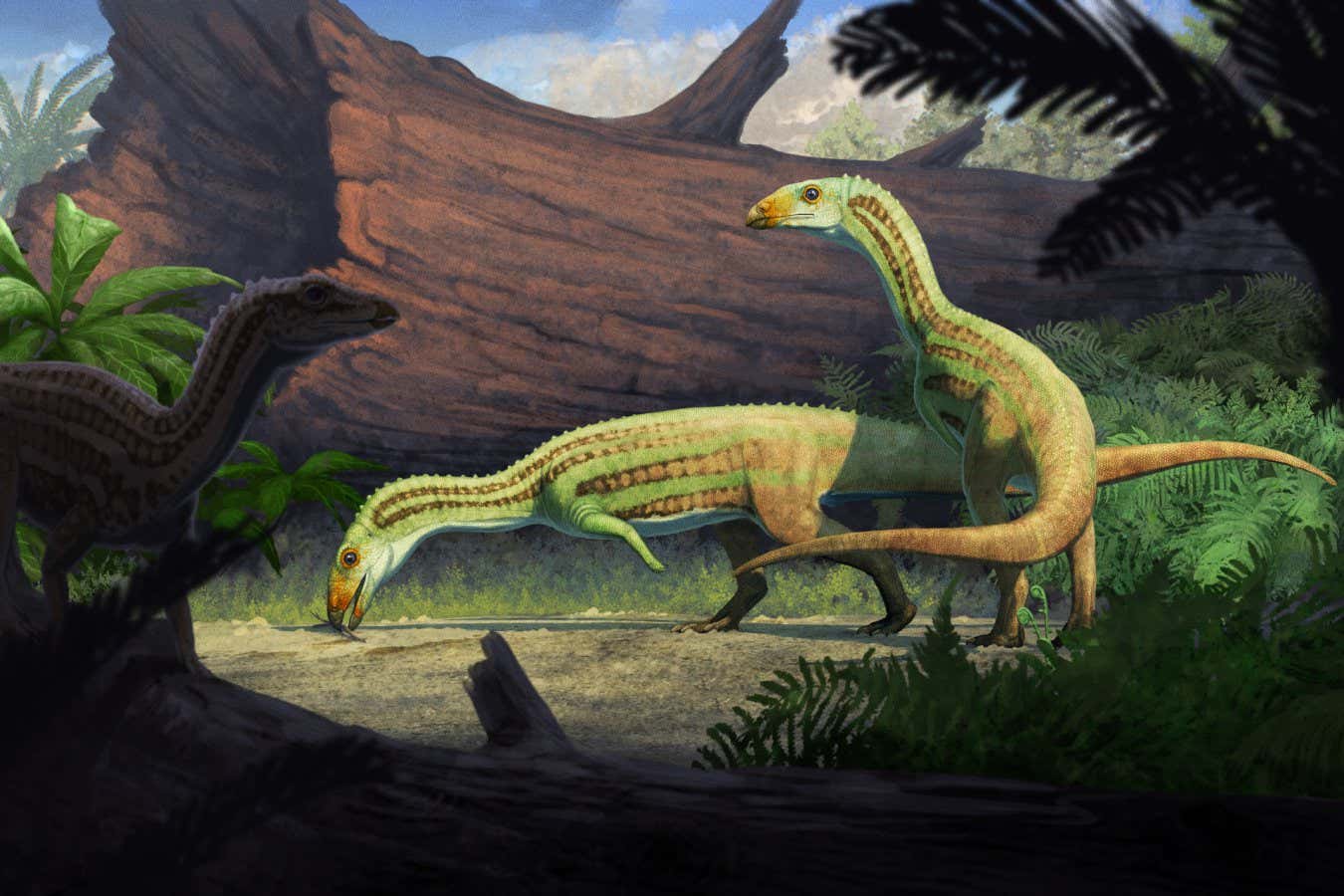
    Artist’s reconstruction of Sonselasuchus cedrus in its environment, 215 million years ago

    Gabriel Ugueto

    An early relative of crocodiles spent its juvenile years walking on all fours, then stood up on two legs as an adult.

    Its arm and leg bones grew at different rates to enable this transition. “The forelimb starts out like 75 per cent the length of the hind-limb, and then it ends up being more like 50 [per cent],” says Elliott Armour Smith at the University of Washington in Seattle.

    The finding adds to evidence that crocodile-like animals in the early dinosaur era were extremely diverse, with some even adopting bodies and lifestyles similar to those of modern ostriches.

    With Christian Sidor, also at the University of Washington, Armour Smith excavated Kaye Quarry in Petrified Forest National Park in Arizona. It consists of mudstones and sandstones deposited by a river that flowed about 215 million years ago, in the Triassic period.

    Armour Smith and Sidor found more than 3000 bones belonging to early relatives of crocodiles called shuvosaurids. “It’s a jumbled mess of individual limb bones that don’t necessarily have an association between the individual animals,” says Armour Smith.

    Nevertheless, the pair were able to identify a new shuvosaurid, which they called Sonselasuchus cedrus. Over 950 of the bones belonged to this species. It didn’t resemble a modern crocodile, but instead looked more like a flightless bird or theropod dinosaur. Its arms were short and instead of a mouth filled with teeth, it had a toothless beak.

    Other shuvosaurids have similar bodies. “Shuvosaurids are these absolute weirdos that live in the late Triassic,” says Michelle Stocker at Virginia Tech. “They really look like dinosaurs.” They most resemble ornithomimids, which were ostrich-like dinosaurs that lived in the late Cretaceous period, more than 100 million years after the shuvosaurids.

    Sonselasuchus cedrus seems to have started life walking on all fours. Bones from younger individuals show the front and rear limbs were relatively similar in size. But in older individuals, the hind-limbs grew much more and also showed signs of bearing more weight. “The larger femurs in the population are rather robust,” says Armour Smith, whereas “even the largest humerus is relatively delicate”.

    This is unusual, but not unique. A 2019 study found evidence of two dinosaur species transitioning from quadrupedal to bipedal walking as they grew. One was a sauropodomorph, an ancestor of the huge sauropods like Brachiosaurus, and the other was an early ceratopsian distantly related to Triceratops.

    It may be that juvenile and adult S. cedrus lived fairly separate lives and even ate different diets, as some crocodilians do today, says Stocker.

    Popular descriptions of the dinosaur era often give the impression that dinosaurs, especially birds, were evolving in very creative ways, while crocodiles pretty much stayed the same. That misrepresents the diversity of pseudosuchians – the branch of the reptile tree that includes crocodiles, says Stocker. “They’re actually doing a lot of the really unique, crazy stuff first, and then dinosaurs are picking it up later.”

    New Scientist. Science news and long reads from expert journalists, covering developments in science, technology, health and the environment on the website and the magazine.

    Dinosaur hunting in the Gobi desert, Mongolia

    Embark on an exhilarating and one-of-a-kind expedition to uncover dinosaur remains in the vast wilderness of the Gobi desert, one of the world’s most famous palaeontological hotspots.

    Topics:


    Source link

    Share. Facebook Twitter Pinterest LinkedIn Tumblr Email Telegram Copy Link

    Related Posts

    Science

    Embryos made without sperm or eggs reveal why many pregnancies fail

    May 27, 2026
    Science

    NASA plans a base on the moon spanning hundreds of square kilometres

    May 27, 2026
    Science

    We may finally know why gold stays so shiny

    May 27, 2026
    Science

    How the mathematician Gödel proved that not everything can be proven

    May 27, 2026
    Science

    Anthropic asks religious thinkers to help shape Claude as pope warns about AI

    May 27, 2026
    Science

    Attack on Iran’s oil released as much pollution as a volcano

    May 27, 2026
    Editors Picks

    Kanye West refused entry to UK, Wireless Festival cancelled

    April 7, 2026

    Opinion | All the President’s Wars — at Home and Abroad

    April 4, 2026

    Surprises and storylines from preliminary World Cup rosters

    May 14, 2026

    Australia Bans Free Speech | Armstrong Economics

    January 14, 2026

    The ‘Super Bowl receiving leaders’ quiz

    February 9, 2026
    About Us
    About Us

    Welcome to Benjamin Franklin Institute, your premier destination for insightful, engaging, and diverse Political News and Opinions.

    The Benjamin Franklin Institute supports free speech, the U.S. Constitution and political candidates and organizations that promote and protect both of these important features of the American Experiment.

    We are passionate about delivering high-quality, accurate, and engaging content that resonates with our readers. Sign up for our text alerts and email newsletter to stay informed.

    Latest Posts

    Iran says return to war unlikely, but Trump ‘not satisfied’ with deal

    May 27, 2026

    EU states summon Russian envoys over Kyiv threat | Russia-Ukraine war News

    May 27, 2026

    The ‘Stanley Cup captains since 2000’ quiz

    May 27, 2026

    Subscribe for Updates

    Stay informed by signing up for our free news alerts.

    Paid for by the Benjamin Franklin Institute. Not authorized by any candidate or candidate’s committee.
    • Privacy Policy
    • About us
    • Contact us

    Type above and press Enter to search. Press Esc to cancel.