
Close Menu
    Trending
    • City birds appear more afraid of women than men, and scientists have no idea why
    • Google Partners With The Pentagon To Sell Your Data
    • ‘Friends’ Star Confirms Astronomical Residual Earnings
    • Panama Canal reaffirms ‘neutrality’ amid Mideast war
    • How the Iran war is hitting the UK | US-Israel war on Iran News
    • Why Steelers made unexpected Aaron Rodgers decision
    • ‘I almost become paranoid’: Why anxiety is so much worse in the middle of the night
    • NASA chief Jared Isaacman hints at campaign to make Pluto a planet again
    Benjamin Franklin Institute
    Wednesday, April 29
    • Home
    • Politics
    • Business
    • Science
    • Technology
    • Arts & Entertainment
    • International
    Benjamin Franklin Institute
    Home»Science»Ancient society may have carved ‘sun stones’ to end volcanic winter
    Science

    Ancient society may have carved ‘sun stones’ to end volcanic winter

    Team_Benjamin Franklin InstituteBy Team_Benjamin Franklin InstituteJanuary 16, 2025No Comments4 Mins Read
    Share Facebook Twitter Pinterest Copy Link LinkedIn Tumblr Email VKontakte Telegram
    Share
    Facebook Twitter Pinterest Email Copy Link


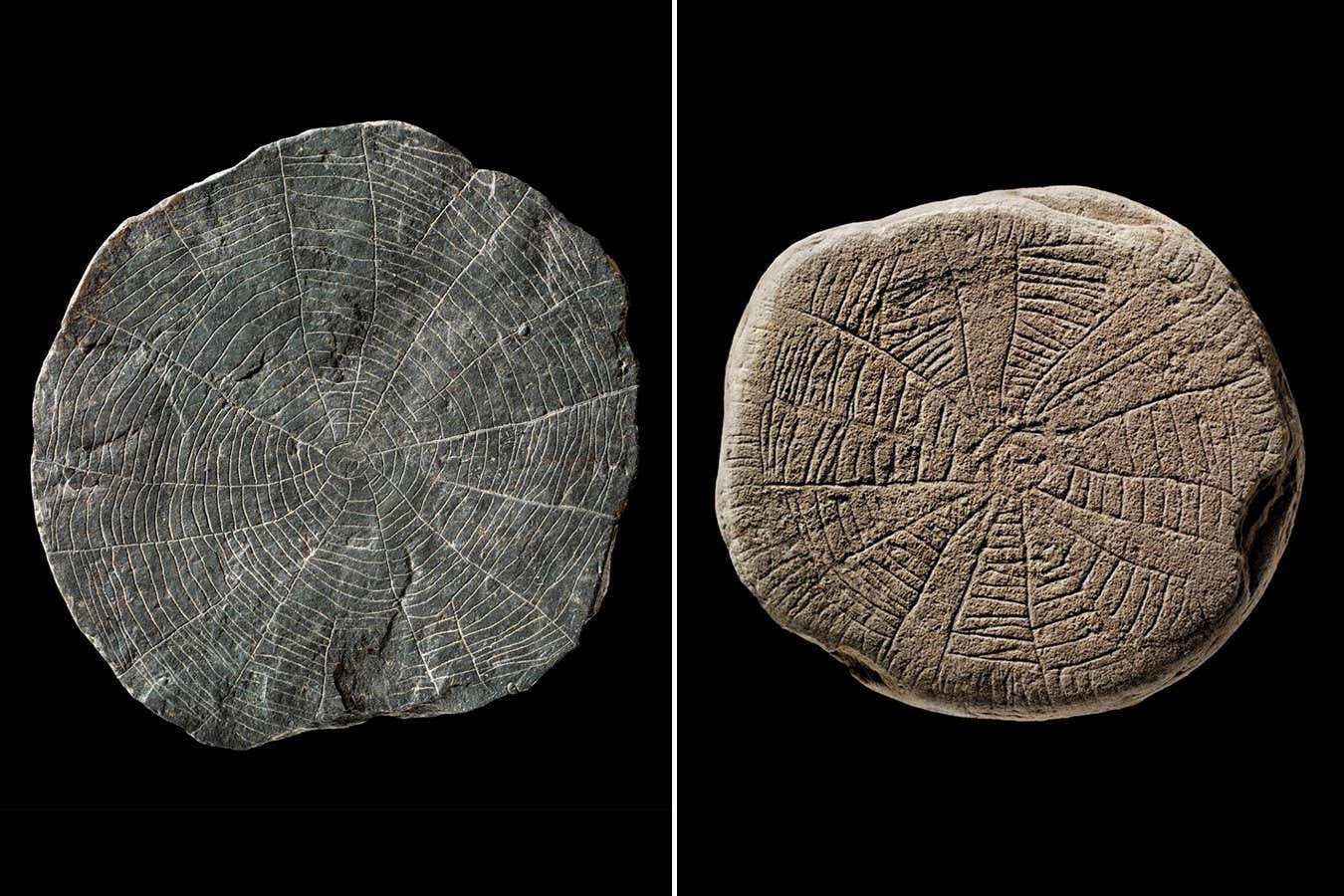
    Stone plaques with sun motifs found on Bornholm island, Denmark

    Antiquity Publications/John Lee, National Museum of Denmark

    Hundreds of mysterious engraved “sun stones” unearthed in Denmark may have been ceremonially buried because a volcanic eruption in about 2900 BC made the sun disappear.

    A total of 614 stone plaques and fragments of plaques engraved with decorative motifs of the sun or plants have been unearthed in recent years at the Vasagård West archaeological site on the Danish island of Bornholm. They were found in a layer that dates to some 4900 years ago, when Neolithic people were farming the area and building enclosures encircled by earthworks of banks and ditches.

    Most of the carved sun stones were found in the ditches around these enclosures and they had been covered by a stone pavement containing bits of pottery and other items. The pottery is typical of the late Funnel Beaker culture, which was present in this region until about 2900 to 2800 BC.

    It was originally proposed that the stone carvings of the sun were buried to ensure good harvests. The sun was the focal point for early agricultural cultures in northern Europe, says Rune Iversen at the University of Copenhagen in Denmark.

    “But why have they deposited all these images at the same time?” asks Iversen. “The last thing that they basically did here was depositing these sun stones and then covering them with pieces of animal bone, all the artefacts and stuff like that. And we see that reoccurring from ditch to ditch. So, it is kind of an act or an event.”

    Now, he and his colleagues have an answer. They looked at data from ice cores extracted in Greenland and Antarctica and found higher concentrations of sulphate, which is deposited in the years after a volcanic eruption, in the period around 2900 BC.

    The relative ratio of sulphate deposition in Greenland and Antarctica implies the eruption was somewhere close to the equator, say the researchers, and its effects seem to have covered a huge area. Ash clouds may have blocked out the sun, lowering temperatures for years.

    A period of severe cooling around 2900 BC is corroborated by sources including tree rings in preserved wood from the Main river valley in Germany and those of long-lived bristlecone pines in the western US.

    The eruption would been devastating for the Neolithic peoples of northern Europe. “If you don’t have the harvest and you don’t get the crops in, you won’t have anything to sow next year,” says Iversen. “They must have felt pretty punished at that time because it’s just an endless catastrophe coming at them.”

    He and his colleagues say that burying the carvings could have been an attempt to get the sun back or a celebration after the skies did finally clear.

    “It’s a good explanation,” says Jens Winther Johannsen at Roskilde Museum in Denmark. “You can be sure die-hard farming societies have to trust in the sun.”

    Lars Larsson at Lund University in Sweden asks why we have evidence of such behaviour only on Bornholm, and not elsewhere in southern Scandinavia, if the climate effect was widespread.

    It could be because people there had plentiful hard stone – slate ­– which they carved the sun images on, but much of the rest of southern Scandinavia is mostly clay, so there is less suitable stone to carve, says Iversen. “They could also have made engravings on pieces of wood or leather elsewhere,” he says, but these wouldn’t generally have been preserved.

    Alternatively, it might reflect cultural differences, says Johannsen. “These societies aren’t isolated, but you are more isolated on an island, which could be why they developed a unique practice and culture.”

    Topics:


    Source link

    Share. Facebook Twitter Pinterest LinkedIn Tumblr Email Telegram Copy Link

    Related Posts

    Science

    City birds appear more afraid of women than men, and scientists have no idea why

    April 29, 2026
    Science

    NASA chief Jared Isaacman hints at campaign to make Pluto a planet again

    April 29, 2026
    Science

    Cancer is increasing in young people and we still don’t know why

    April 29, 2026
    Science

    People are betting on measles outbreaks – and that might be useful

    April 29, 2026
    Science

    Striking photo essay examines deadly spread of dengue fever in Nepal

    April 28, 2026
    Science

    Watch Astrobotic’s latest record-breaking ‘ring of fire’ rocket engine test

    April 28, 2026
    Editors Picks

    Japan & The Future | Armstrong Economics

    December 26, 2025

    Songbirds reveal the dark side of making new brain cells as adults

    April 19, 2026

    ‘Change is inevitable’: What is next for Iran? | Conflict News

    January 24, 2026

    Russian ship under sanctions over North Korea arms sails for Europe

    February 18, 2025

    Nick Reiner’s high-profile lawyer quits as public defenders take over; arraignment postponed

    January 7, 2026
    About Us
    About Us

    Welcome to Benjamin Franklin Institute, your premier destination for insightful, engaging, and diverse Political News and Opinions.

    The Benjamin Franklin Institute supports free speech, the U.S. Constitution and political candidates and organizations that promote and protect both of these important features of the American Experiment.

    We are passionate about delivering high-quality, accurate, and engaging content that resonates with our readers. Sign up for our text alerts and email newsletter to stay informed.

    Latest Posts

    City birds appear more afraid of women than men, and scientists have no idea why

    April 29, 2026

    Google Partners With The Pentagon To Sell Your Data

    April 29, 2026

    ‘Friends’ Star Confirms Astronomical Residual Earnings

    April 29, 2026

    Subscribe for Updates

    Stay informed by signing up for our free news alerts.

    Paid for by the Benjamin Franklin Institute. Not authorized by any candidate or candidate’s committee.
    • Privacy Policy
    • About us
    • Contact us

    Type above and press Enter to search. Press Esc to cancel.