

‘An AlphaFold 4’—scientists marvel at DeepMind drug spin-off’s exclusive new AI
Isomorphic Lab’s proprietary drug-discovery model is a major advance, but scientists developing open-source tools are left guessing how to achieve similar results
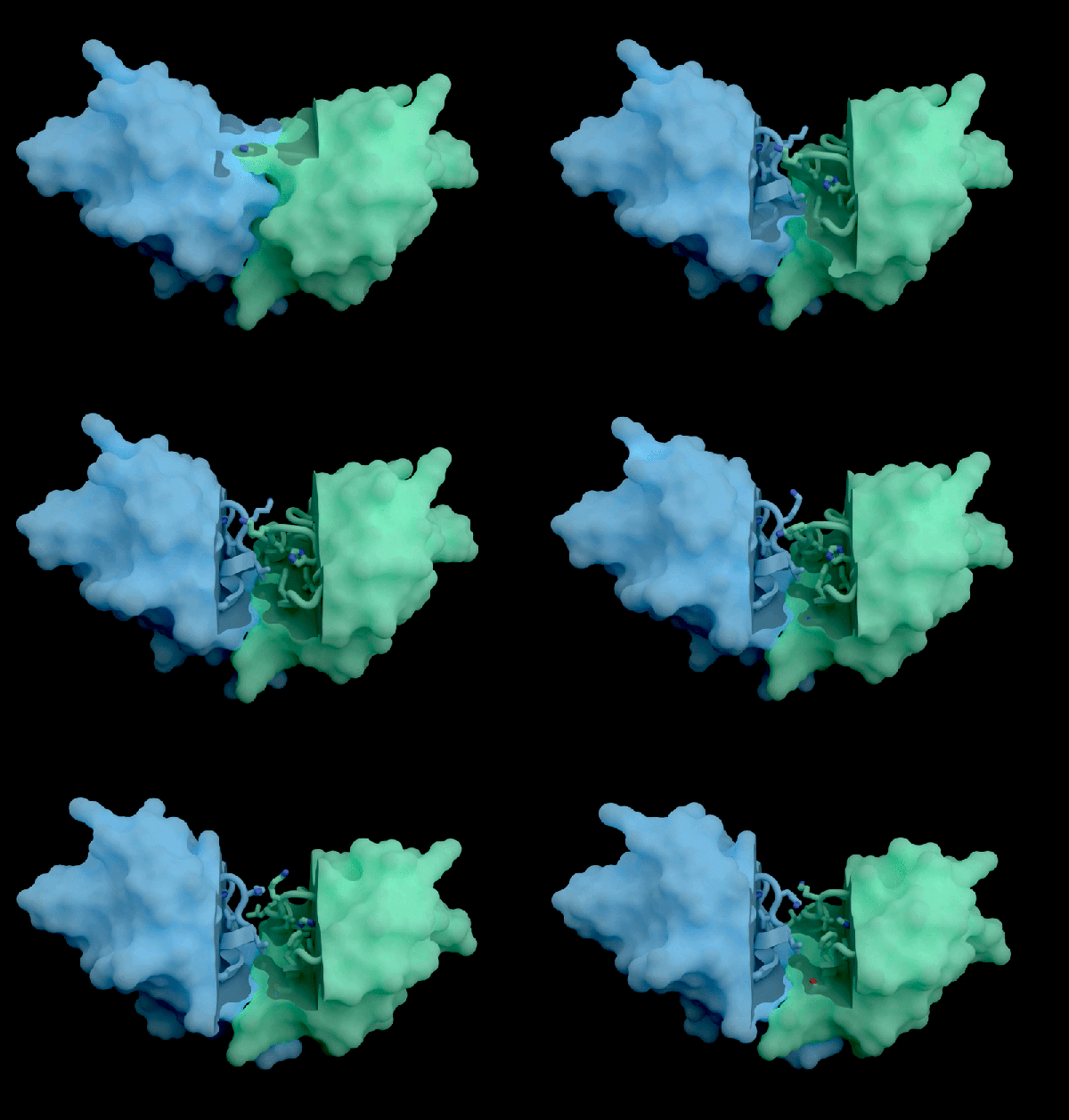
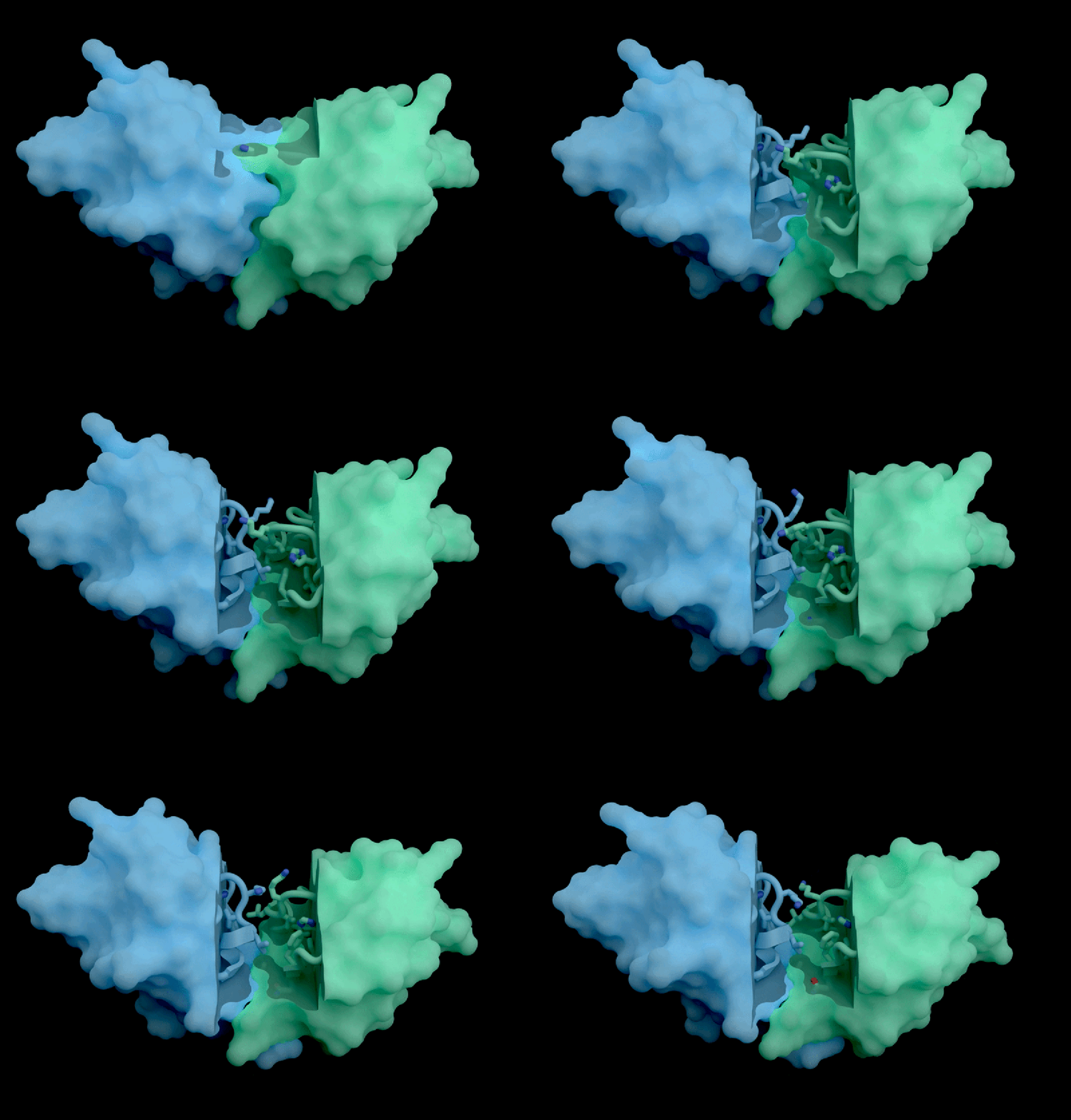
The AI tool includes predictions of how proteins interact with potential therapeutic molecules.
Nearly two years after Google DeepMind released an updated AlphaFold3 geared at drug discovery, its biopharmaceuticals spin-off, Isomorphic Labs, announced an even more powerful artificial-intelligence model — and they’re keeping it all to themselves.
Isomorphic Labs, based in London, touted the capacities of its ‘drug-discovery engine’ — which it calls IsoDDE — in a 27-page technical report, released on 10 February. Achievements, including precise predictions of how proteins interact with potential drugs and antibody structures, have impressed scientists working in the field.
Yet unlike the AlphaFold AI systems for predicting protein structure — which were made accessible to other researchers and described in depth in journal articles — IsoDDE is proprietary, and the technical paper offers scant insight into how to achieve similar results.
On supporting science journalism
If you’re enjoying this article, consider supporting our award-winning journalism by subscribing. By purchasing a subscription you are helping to ensure the future of impactful stories about the discoveries and ideas shaping our world today.
“It’s a major advance, on the scale of an AlphaFold4,” referring to an unreleased future generation of Google DeepMind’s technology,says Mohammed AlQuraishi, a computational biologist at Columbia University in New York City who is working to develop fully open-source versions of AlphaFold. “The problem, of course, is that we know nothing of the details.”
Drug–protein interactions
AlphaFold 3 was developed with drug discovery in mind. Unlike its Nobel-prizewinning predecessor AlphaFold2, the model could predict the structures of proteins interacting with other molecules — including potential drugs.
Similar AIs modelled after AlphaFold 3 have come close to fully matching its performance and have new capabilities. An open-source model called Boltz-2, developed by scientists at the Massachusetts Institute of Technology in Cambridge and released last year, could predict the strength to which potential drugs glom onto proteins, or binding affinity. This is a key property for developing therapeutics and is usually predicted with computationally intensive physics-based methods.
According to Isomorphic’s report, its new AI outperforms both Boltz-2 and physics-based methods at determining binding affinity. Predictions of how antibodies — which form the basis for therapies that rack up tens of billions of pounds in sales annually — interact with their targets is also state of the art, the report claims.
AlQuraishi says he is especially impressed by the IsoDDE’s ability to predict drug–protein interactions of molecules that are vastly different from the data that the model was trained on. “That’s the really hard problem, and suggests that they must’ve done something pretty novel,” he says.
Secret sauce
The models behind IsoDDE are “profoundly different” from other efforts, says Max Jaderberg, Isomorphic’s president. But the company has no plans to reveal the ‘secret sauce’ behind it. “Like with most big machine-learning and AI advancements, it’s a combination of compute, data [and] algorithms,” Jaderberg adds. He hopes his team’s report will “galvanize” the efforts of other teams building drug-discovery AIs.
“This report comes after extensive efforts to partner with industry and potentially access their private structural data, so we don’t know how impactful that extra data is” to IsoDDE’s performance, Diego del Alamo, a computational structural biologist at Takeda Pharmaceuticals, who is based in Cambridge, wrote on the social-media site X.
Isomorphic has struck drug-development deals, potentially worth billions of pounds, with pharmaceutical companies Johnson and Johnson, Eli Lilly and Novartis. It also has its own internal pipeline, with clinical trials on the horizon. Jaderberg says that the company has developed different versions of IsoDDE from the one used for the technical report, including for work with its partners, that incorporate different data sources.
His colleague Michael Schaarschmidt, Isomorphic’s director of machine learning, says the company’s data strategy is “quite comprehensive,” incorporating publicly available data, synthetic training data and data sources that they will “try to lisense.”
Gabriele Corso, a machine-learning scientist who co-developed Boltz-2 and now leads the non-profit company Boltz in London, does not think that proprietary data played an essential part in the reported performance of Isomorphic’s tool, on the basis of gains his team is seeing. “There are a lot of improvements we can make with the data that are out there,” he says. “I think this is a new baseline to match — but also to pass.”
This article is reproduced with permission and was first published on February 19, 2026.
It’s Time to Stand Up for Science
If you enjoyed this article, I’d like to ask for your support. Scientific American has served as an advocate for science and industry for 180 years, and right now may be the most critical moment in that two-century history.
I’ve been a Scientific American subscriber since I was 12 years old, and it helped shape the way I look at the world. SciAm always educates and delights me, and inspires a sense of awe for our vast, beautiful universe. I hope it does that for you, too.
If you subscribe to Scientific American, you help ensure that our coverage is centered on meaningful research and discovery; that we have the resources to report on the decisions that threaten labs across the U.S.; and that we support both budding and working scientists at a time when the value of science itself too often goes unrecognized.
In return, you get essential news, captivating podcasts, brilliant infographics, can’t-miss newsletters, must-watch videos, challenging games, and the science world’s best writing and reporting. You can even gift someone a subscription.
There has never been a more important time for us to stand up and show why science matters. I hope you’ll support us in that mission.