

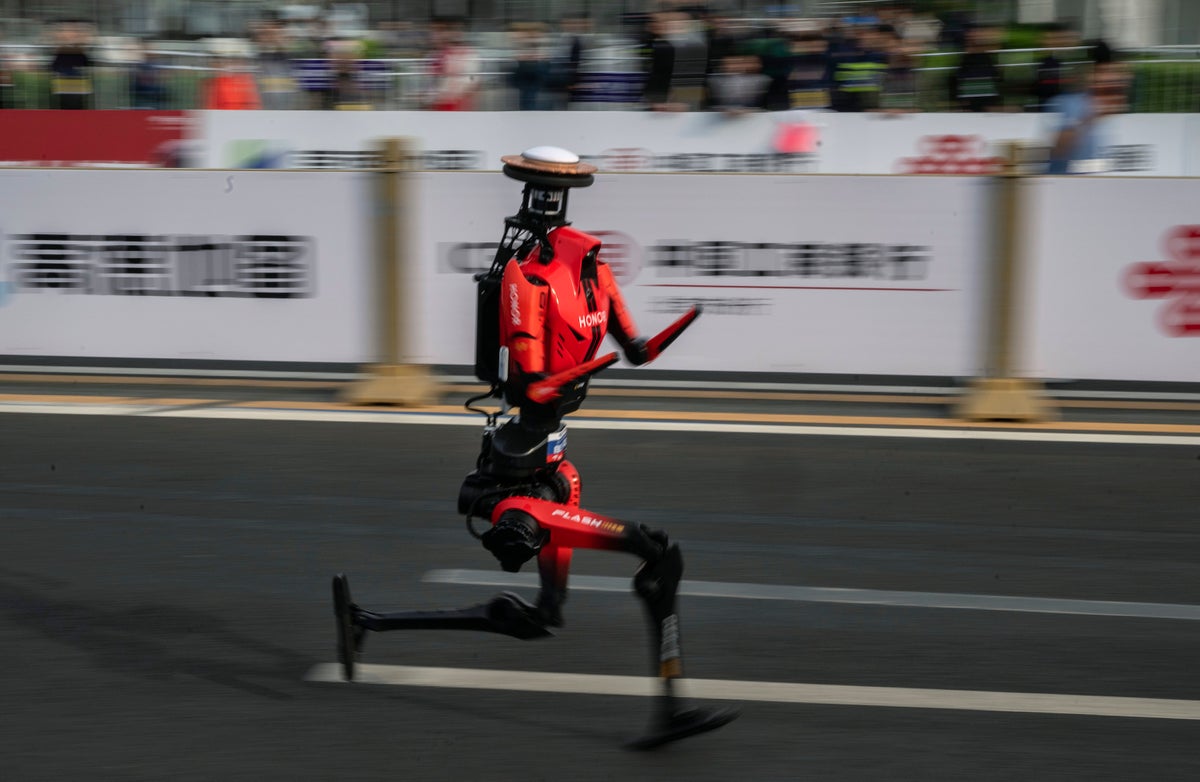
Last Sunday, at the Beijing E-Town Half Marathon, a red humanoid robot of a type named Lightning finished the course in 50 minutes and 26 seconds—faster than the human world record. Its long legs were modeled on elite runners, and its motors were cooled with a liquid-circulation system adapted from the smartphones of its maker, Honor, a Chinese phone company. A clip of the robot’s performance that ricocheted around the Internet looked to a lot of viewers like a milestone. It was, and it wasn’t. The Lightning robot also crashed into a barricade, fell and waited for its handlers to set it upright.
The Beijing race offered a vivid snapshot of where humanoid robotics stands. Engineers have gotten much better at building machines that can run long distances without overheating or breaking. Getting them to move through the real world with anything like human judgment is another matter.
In this year’s race, more than 100 teams entered, up from roughly 20 the previous year, when the winning robot finished in two hours and 40 minutes. But only 38 percent of the 2026 event’s entries ran autonomously, organizers say; the rest were piloted remotely. And all of the robots ran on a dedicated, rehearsed course, with support crews trailing behind.
On supporting science journalism
If you’re enjoying this article, consider supporting our award-winning journalism by subscribing. By purchasing a subscription you are helping to ensure the future of impactful stories about the discoveries and ideas shaping our world today.
“It’s just a stupid publicity stunt,” says Rodney Brooks, an emeritus professor at the Massachusetts Institute of Technology, who co-founded iRobot—the company behind Roomba—and now runs the artificial-intelligence-powered robotics company Robust.AI. He has spent decades watching robotics hype cycles come and go. “It’s like when they used to have horses racing cars,” Brooks says. “It doesn’t matter.”
His objection isn’t Lightning’s build or its time but the framing of its achievement. Lightning did not run a half marathon under anything like human conditions. “There is nothing useful that you could use in any application because it shows no safety at all,” Brooks says. “There’s no interaction with real people…, and there’s no ability to interact with the world because it’s all premapped,” he adds. “How many support people did [the robots] have? How many vehicles followed them? People just do a marathon. They don’t know where the track is.”
Brooks has been making a version of this argument for nearly a decade: humans conflate performance with competence. “When you see a performance of an AI system or a robot on one thing,” he says, “that fools us into thinking that it has the same general competence as a human. And that’s a mistake people make.” If a human ran a half marathon, we would infer something about that person’s balance, perception and resilience. The robot’s feat doesn’t generalize that way. “If it was running in the crowd and it was safe, that would be amazing,” Brooks says. “But they’re nowhere near that.”
So what did the race actually measure? Alan Fern, a computer science professor at Oregon State University, has spent most of his career training bipedal robots to walk. With his collaborator Jonathan Hurst, he helped build Cassie, a two-legged robot that ran an outdoor 5K in 2021 and later set a Guinness World Record in the 100-meter dash. The technique that made Cassie run—training it in physics simulations—likely underlies the capability of robots like Lightning as well. “The basic principles of robots walking have been around for a while,” Fern says. “There’s no scientific advance in that aspect of the problem.”
What changed this year, Fern says, was “good old-fashioned engineering and investment.” Last year’s robots were slower, and many broke; this year’s machines were fast and held together. That is not nothing, but it is not a breakthrough either.
On autonomy, Fern is gentler than Brooks, though not by much. The robots that ran without a human pilot still followed a route they already knew. “It does meet the definition of autonomy for that particular task,” he says. “It’s similar to how you would talk about autonomous cars. The first autonomous cars—it might be autonomous lane following. The human doesn’t have to do anything, and the robot will follow the lanes on the road.” Fern calls this specialized autonomy. What would have been scientifically interesting—and what was not done with any robot in the Beijing event—would be to drop one into “a brand-new location” and ask it to navigate a crowded market, squeeze through tight areas and avoid hitting people.
Jonathan Hurst, who co-created Cassie and later co-founded Agility Robotics, sees the Beijing race as an inflection point for global interest in robotics. He believes that when Cassie ran its 5K in 2021, it was the first time a bipedal robot controlled its own running gait outdoors using reinforcement learning—a trial-and-error method in which an AI system is rewarded for successfully controlling its robot body. Few people noticed. “Maybe there were only six people in the robotics community who were like, ‘Holy crap, I didn’t realize reinforcement learning could actually control a robot,’” he says. Five years later teams around the world are reproducing that approach at a fraction of the cost.
That Beijing race, in Hurst’s telling, isn’t a singular scientific leap. It’s a field reaching the scale at which the hard work can begin in earnest. His own company has spent much of the past two years on one narrow problem: getting Digit, Agility Robotics’ signature humanoid robot, to operate safely in a warehouse. That is the gap between a robot that can run a premapped course and one that can move safely among people. “It’s like looking at the first cars and being like, ‘It doesn’t fly,’” Hurst says. “It’s a pretty high bar.”
The hardware improvements are significant, though. Yanran Ding, an assistant professor of robotics at the University of Michigan, sees the race primarily as a hardware demonstration. “It’s really hard to make robots run robustly for such a long period of time,” he says. The bigger feat was heat management. “Motor technology has been there to run for short distances,” he says, “but if you stretch it out, the cooling is the bottleneck.” Honor’s design, Ding adds, addressed that limit the way a high-end desktop does. “Instead of using a fan, which uses air conduction to cool the chips,” he says, “you actually use a liquid circulation system—basically put an [air conditioner] in the computer.”
Ding also notes the design choices for the bodies of the fastest robots. “They have huge hip and knee motors. But they have a very lean upper torso—their arms are quite small but just big enough to provide inertial balancing. And their shins and feet are also very lightweight.” When running, he explains, one loses energy on every foot strike. “In order to minimize the energy loss that happens when you hit the ground, you want to make your distal links as lightweight as possible,” Ding says. Lightning, in other words, was built like a greyhound, not a house cleaner.
“Hardware-wise, the limit is no longer the hardware—now we can really double down on the algorithms,” Ding says. “People, as humans…, have a cognitive bias to think that running a half marathon faster than a human is more difficult than folding laundry—which is not true.”
That inversion is really what the race demonstrated. A robot running fast looks hard because running fast is hard for us. Folding a towel or moving safely through a crowded room looks trivial because we do those things without thinking. For robots, the hierarchy is often reversed. The muscles work. The brain, as Brooks pointed out, remains the problem.