

Light particles seem to exhibit quantum weirdness even when they aren’t entangled
WLADIMIR BULGAR/SCIENCE PHOTO LIBRARY
Particles that don’t seem to be entangled have earned a high score on a famous test of entanglement. The experiment could offer a fresh look at what makes the quantum world so strange.
Nearly 60 years ago, physicist John Stewart Bell devised a test for whether our world is best described by quantum mechanics or by a set of more traditional theories. The key difference is quantum theory includes “non-locality”, or effects that can span any distance – even very large ones. Strikingly, all of the experiments that have implemented Bell’s test to date have affirmed our physical reality is non-local, suggesting we live in a quantum world.
However, those experiments included particles inextricably linked through quantum entanglement. Now Xiao-Song Ma at Nanjing University in China and his colleagues say they aced the Bell test without using entanglement. “Our new work may provide a new perspective to people’s understanding of non-local correlations,” he says.
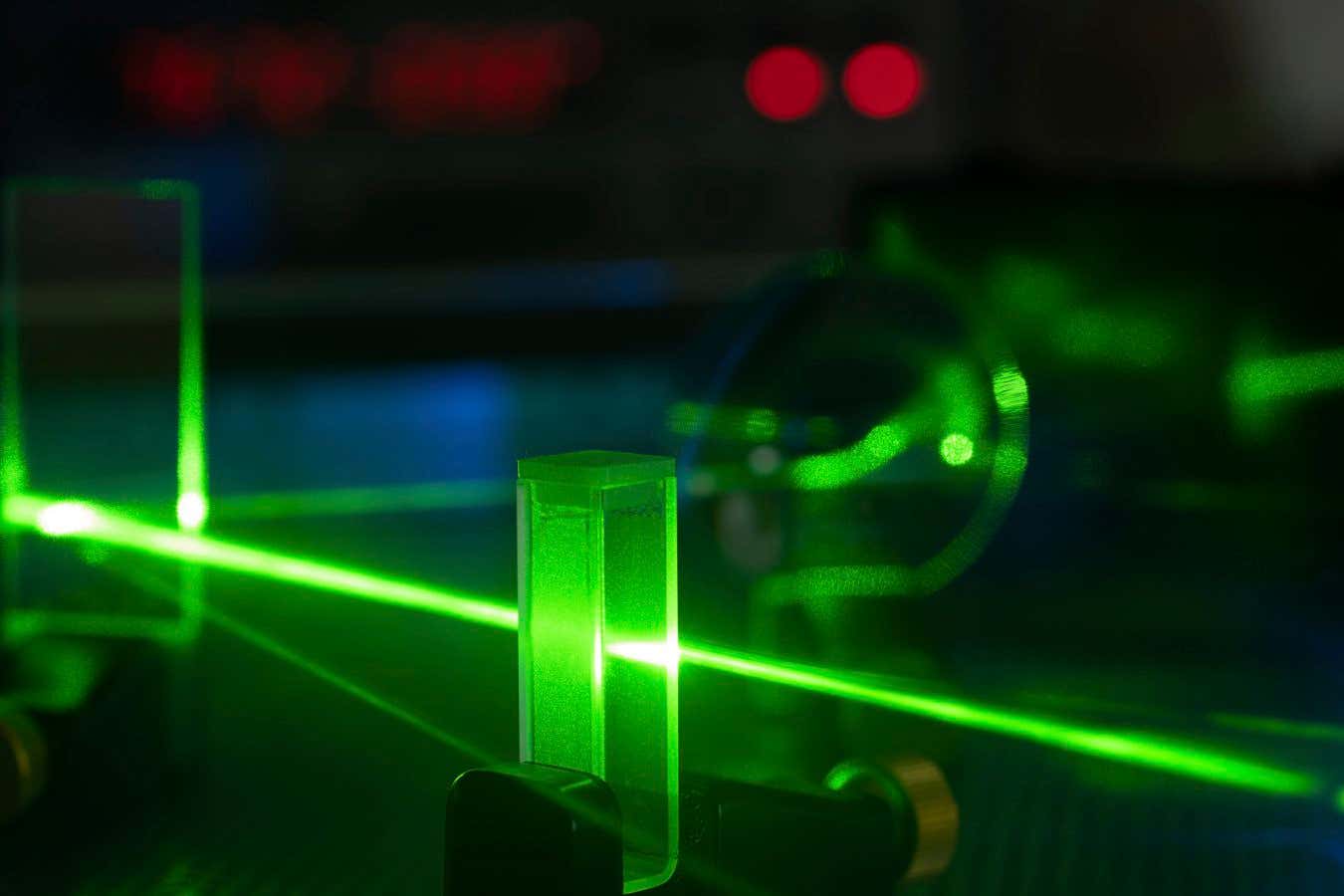
The experiment started with four special crystals, each of which emitted two particles of light, or photons, when illuminated with lasers. The photons had several properties the researchers could measure, including polarisation and phase, which describes the way light wiggles when seen as an electromagnetic wave. The researchers made these photons travel through a maze of optical devices, such as crystals and lenses, before hitting a detector.
In a typical Bell test experiment, two hypothetical experimenters, Alice and Bob, measure the properties of entangled particles. Then Alice and Bob can determine whether the particles are linked in a non-local way by plugging in their findings into an “inequality” equation.
The new experiment included Alice and Bob, each represented by a set of optical devices and detectors, but not entangled photons. In fact, the researchers added devices to their set-up that prevented the particles’ frequencies and velocities from becoming entangled. And yet, when the researchers put Alice’s and Bob’s measurements into the inequality equation, they found the photons were linked more strongly than could be explained by any local effect.
Mario Krenn at Max Planck Institute for the Science of Light in Germany says this may be because the photons had another odd quantum property: they were created in such a way it was impossible to tell which photon was “born” at which crystal, and their paths were indistinguishable, he says. In the past, Krenn, Ma and their colleagues used this property – called “indistinguishability by path identity” – to entangle photons. In this case, however, they made sure indistinguishability was the only type of quantum weirdness present.
The team does not yet have a definitive theory for why it could reproduce the results of entanglement in the Bell test without using entanglement, but Ma says several other fundamentally quantum phenomena have indistinguishability as a requirement. So, it could also be a basic ingredient needed to create non-local correlations, even in a recipe that doesn’t include entanglement.
Krenn and Ma expect other physicists may put forward new alternative theories and identify experimental loopholes in their Bell test. After all, this is what happened with the canonical Bell test – nearly 50 years passed between the first experiments vindicating quantum theory and ones where all alternative explanations were firmly ruled out.
One issue may lie with the “post-selection” technique the team used, where only some photon detections are considered, says Stefano Paesani at the University of Copenhagen in Denmark. In his view, this makes it unclear whether their non-entangled photons can be definitively scored as non-local on Bell’s test. Without post-selection, the experiment would match more standard scenarios where entanglement is present, he says.
Jeff Lundeen at the University of Ottawa in Canada says it is possible to construct experiments where the Bell test diagnoses light, even some light that is not quantum, with having unusually strong correlations. But this “has no grand implications for the nature of the universe or reality”.
In such situations, Alice and Bob are either effectively the same observer, or have a chance to communicate and produce correlations that researchers could mistake for non-local effects. Lundeen says the new experiment does not sufficiently rule out the possibility of Alice and Bob colluding. “So, the experiment does not seem to have the same implications as the famous Bell’s inequality violation,” he says.
“It really is a beautiful extension of one of the most striking landmark works on entangled photons from the ‘glory days’ of the 1990s,” says Aephraim Steinberg at the University of Toronto in Canada. In his view, however, there is still some entanglement in the new experiment. This exists not at the level of photons, but rather in the quantum fields photons arise from.
Going forward, the team wants to improve its devices to avoid some of these criticisms. For instance, getting each crystal to produce more photons would let the researchers stop using post-selection. “Our collaboration group already identified several key potential loopholes, and that’s something we are looking forward to addressing in the future,” says Ma.
Topics: