
Close Menu
    Trending
    • When is London Marathon 2026? Start time and how to watch race for FREE
    • Pentagon Requests $54 Billion For AI War
    • Clavicular Hit With New YouTube Crackdown
    • Beijing’s new supply chain rules deepen concerns for US firms in China
    • India denounces ‘hellhole’ remark shared by Trump | Donald Trump News
    • New photos of Mike Vrabel and Dianna Russini emerge
    • AI search demands a new audience playbook
    • How do earthquakes end? A seismic ‘stop sign’ could help predict earthquake risk
    Benjamin Franklin Institute
    Friday, April 24
    • Home
    • Politics
    • Business
    • Science
    • Technology
    • Arts & Entertainment
    • International
    Benjamin Franklin Institute
    Home»World Economy»Tariffs test Japanese carmakers’ shock absorbing powers
    World Economy

    Tariffs test Japanese carmakers’ shock absorbing powers

    Team_Benjamin Franklin InstituteBy Team_Benjamin Franklin InstituteJuly 2, 2025No Comments3 Mins Read
    Share Facebook Twitter Pinterest Copy Link LinkedIn Tumblr Email VKontakte Telegram
    Share
    Facebook Twitter Pinterest Email Copy Link


    Unlock the Editor’s Digest for free

    Roula Khalaf, Editor of the FT, selects her favourite stories in this weekly newsletter.

    When the US imposed a 25 per cent tariff on imported Japanese cars, the expectation had been higher sticker prices for US consumers and falling sales. The assumption was that the added costs to exporters would inevitably be passed down the line. Yet, months into the policy, the outcome has proven far less dramatic.

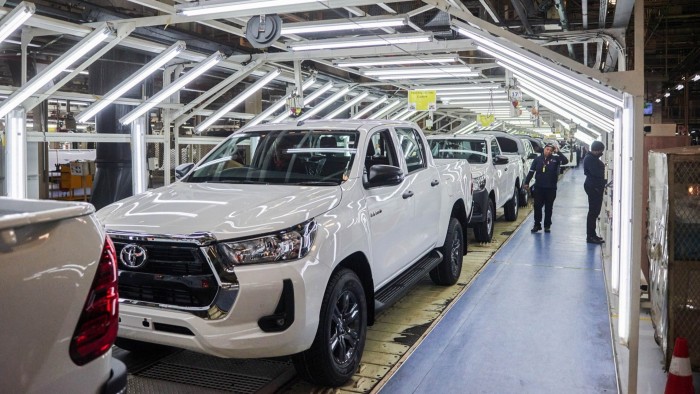
    Japanese automakers’ US sales have shown surprising resilience. Toyota, for example, hit a global sales record in May, with North America sales up more than a tenth. Part of that is thanks to their local US production.

    Behind the stable sales figures, export data tells a more troubling story. In May, the number of vehicles shipped to the US declined by just 3.9 per cent, according to official data. When export value is divided by the number of units sold, the average price per vehicle drops to about ¥3.5mn, or $24,000, roughly a fifth less than the previous year. By total value, Japan’s vehicle exports to the US fell by nearly a quarter. 

    If the cost of the tariffs had been passed on to consumers by raising prices, export volumes would probably have declined. But export value would have held steady, reflecting the higher per unit cost. Instead, both volume and value have fallen. That suggests carmakers are absorbing a large chunk of the tariff burden themselves.

    This may be an effective short-term strategy. The US remains the most lucrative market for Japanese automakers. Even modest price increases risk undermining market share, as the companies face aggressive competition from American and South Korean rivals. For companies such as Toyota, Honda and Nissan, keeping prices stable could protect their long-term positioning in the country.

    But trade negotiations have dragged on, with last week marking the seventh round of talks and little sign of resolution. If, as trade data suggests, companies are indeed absorbing the bulk of the tariff burden, their margins will be coming under growing pressure. That will squeeze even financially resilient groups such as Toyota, which has consistently reported operating margins above 10 per cent since 2023.

    In choosing not to raise prices to fully offset tariffs, carmakers have delayed disruption, while gambling that politicians will come to an agreement before profit runs dry. But as Japan’s chief trade negotiator Ryosei Akazawa has noted, some local automaker executives now estimate losses of up to $1mn per hour under the current tariff structure.

    Japan will need to act before losses reach the point where exports are no longer viable. That could mean buying more US energy or agricultural goods, or making market access concessions in areas such as food safety and pharmaceuticals. Discipline from its carmakers has bought time, but their resilience will soon be put to the test.

    june.yoon@ft.com


    Source link

    Share. Facebook Twitter Pinterest LinkedIn Tumblr Email Telegram Copy Link

    Related Posts

    World Economy

    Pentagon Requests $54 Billion For AI War

    April 24, 2026
    World Economy

    Google Is Tracking Your Life – Photo Cloud Feeding AI System

    April 24, 2026
    World Economy

    Market Talk – April 23, 2026

    April 23, 2026
    World Economy

    Understanding Iran | Armstrong Economics

    April 23, 2026
    World Economy

    The Dollar Lifeline In War – Currency Swaps

    April 23, 2026
    World Economy

    Data Harvesting In The Classroom

    April 23, 2026
    Editors Picks

    Heat star Jimmy Butler out at least two more games

    December 27, 2024

    Cardi B’s Post-Baby Glow Puts Body Confidence, And Her Bra, Front & Center

    December 13, 2025

    The best new popular science books of April 2026

    April 4, 2026

    US envoy suggests it would be ‘fine’ if Israel expands across Middle East | Israel-Palestine conflict News

    February 21, 2026

    How the US-Iran talks in Islamabad unfolded | US-Israel war on Iran News

    April 13, 2026
    About Us
    About Us

    Welcome to Benjamin Franklin Institute, your premier destination for insightful, engaging, and diverse Political News and Opinions.

    The Benjamin Franklin Institute supports free speech, the U.S. Constitution and political candidates and organizations that promote and protect both of these important features of the American Experiment.

    We are passionate about delivering high-quality, accurate, and engaging content that resonates with our readers. Sign up for our text alerts and email newsletter to stay informed.

    Latest Posts

    When is London Marathon 2026? Start time and how to watch race for FREE

    April 24, 2026

    Pentagon Requests $54 Billion For AI War

    April 24, 2026

    Clavicular Hit With New YouTube Crackdown

    April 24, 2026

    Subscribe for Updates

    Stay informed by signing up for our free news alerts.

    Paid for by the Benjamin Franklin Institute. Not authorized by any candidate or candidate’s committee.
    • Privacy Policy
    • About us
    • Contact us

    Type above and press Enter to search. Press Esc to cancel.