

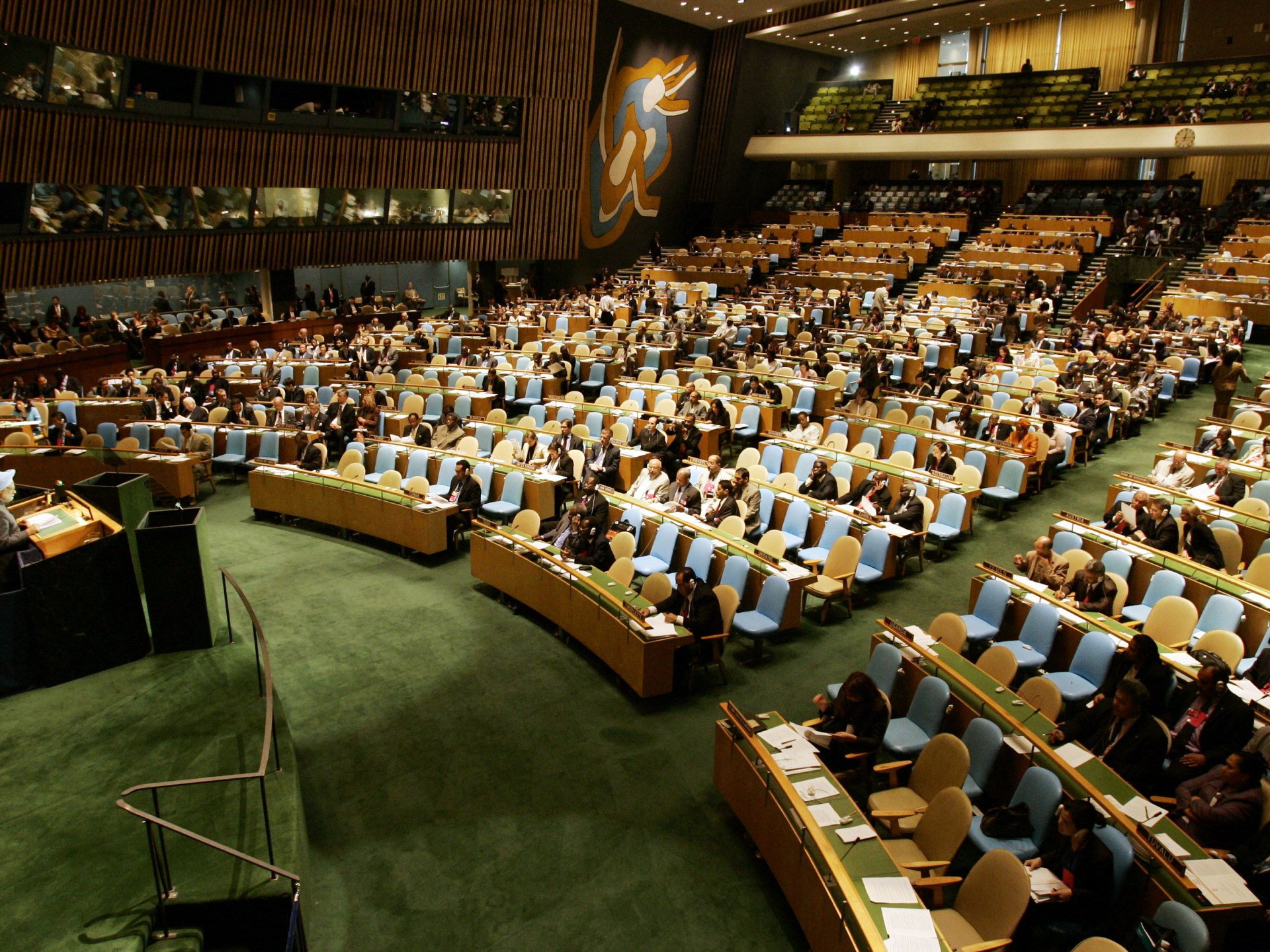
The United Nations General Assembly met yesterday at its headquarters in New York to discuss the responsibility to protect (R2P) doctrine and the continuing perpetration of atrocities across the world. These gatherings have been taking place annually since 2018, but they have done little to advance the proper enforcement of R2P. Yesterday’s meeting was no different.
The UN may have failed to effectively apply R2P, but that does not mean it is a bad principle. It also does not mean we should give up on it.
The idea of establishing a norm in international law to prevent crimes against humanity and genocide first emerged in the aftermath of the failure to stop the genocides in Rwanda and Bosnia.
In 2001, the International Committee on Intervention and State Sovereignty developed the framework for R2P. It was crafted first as an obligation of states to protect their own people, and then, when that fails, as an obligation of other states to take action.
In 2005, at the UN World Summit, the world’s heads of state met to discuss the new framework. The final document adopted at the summit – which, in effect, embedded R2P into international law – read:
“The international community, through the United Nations, also has the responsibility to use appropriate diplomatic, humanitarian and other peaceful means, in accordance with Chapters VI and VIII of the Charter, to help to protect populations from genocide, war crimes, ethnic cleansing and crimes against humanity.”
Similar efforts resulted, in July 2002, in the establishment of the International Criminal Court tasked with prosecuting individuals accused of committing war crimes, crimes against humanity and genocide.
All this represented a high point of the desire to ensure a rules-based order to protect people in need and to punish all those who flout that obligation.
It was an ambitious and imaginative effort to make the world a safer place.
But it did not work. There are various reasons for that failure.
Perhaps the main one was the absence of the slightest interest from several powerful member states in implementing R2P. Lack of action from governments has resulted in brutal indifference to suffering, famine, crimes against humanity and genocide. Ironically, several of them remain members of the so-called Group of Friends of R2P.
There was also the politicisation of R2P in pursuit of geopolitical agendas. In 2011, when protests erupted in Libya, the government of Muammar Gaddafi responded violently. Western governments led by the US invoked R2P when seeking permission from the UN Security Council to intervene.
What was supposed to be a humanitarian intervention to protect the civilian population turned into a regime-change operation. The manipulation of R2P was its death sentence. Russia, a permanent UNSC member, but also other powers, saw it as a conduit for Western interventionism rather than a humanitarian doctrine.
What followed was global inaction on horrific atrocities in Syria, Palestine, Sudan, DRC, Ethiopia, Myanmar, and elsewhere.
As a UN official involved in humanitarian efforts and conflict mediation, I have had a front seat to the suffering and devastation that the failure to protect has led to. I have spent the last six years in the worst places of the world – places of unimaginable suffering.
I have raged against those leaders who feel comfortable with their “expressions of concern” in the absence of any decisive action. I have mourned the dead and the suffering. And I have seen no justice for those who made these tragedies a new norm.
And yet, in every place, I was reminded of the power of human kindness and compassion. Everywhere I went, I met people who had given their all to help the displaced fleeing from war, who had opened their schools and clinics to host the homeless and injured and spent their own money to feed and clothe them.
This world of kindness and respect remains invisible to global politics. The lack of attention, however, has not diminished it. Indeed, it has grown even as leaders continue to betray the most basic humanitarian principles and hypocritically hide behind weak statements of condemnation.
The human values and ideals behind R2P still exist, and it is up to us to take it back to the high and inspiring grounds it once occupied. There are steps the UN can take that go far beyond the annual meetings in order to put this legal norm into action.
First, the international committee which put together the R2P framework needs to be reconvened and tasked with revising it in order to ensure proper implementation, outlining conditions and scope of action.
Second, their report must be recognised and endorsed by the UN, with the General Assembly, the Security Council, and the Human Rights Council putting their weight behind it.
Third, a mechanism needs to be set up for reporting back to the UN on situations where R2P may need to be applied. This would require an official mandate for a UN body to take up this responsibility.
All of this would require political will, which could only be generated when a threshold of popular revulsion at the continuing mass atrocities is reached.
In Sudan, right now, another genocidal moment is looming. El Obeid is under siege, and all indications are that the atrocities that happened in el-Fasher last year will repeat there.
We must act with urgency and determination. Stopping genocide is not a political act; it is a humanistic one.
The views expressed in this article are the author’s own and do not necessarily reflect Al Jazeera’s editorial policy.