

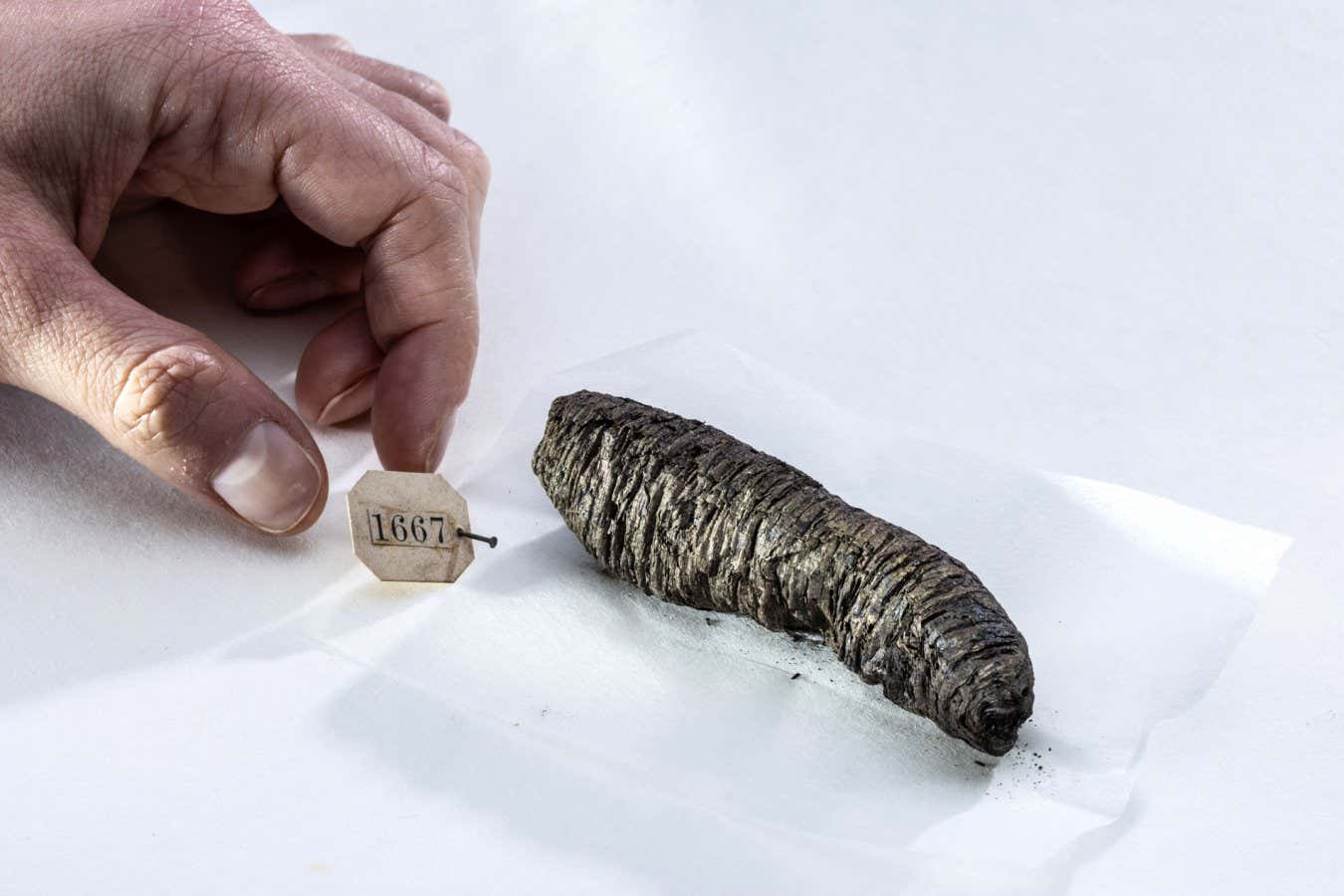
A carbonised scroll from Herculaneum that has now been read using advanced imaging techniques
Paolo Verzone/National Geographic
Long-lost works of ancient philosophy have been recovered from papyrus scrolls that were scorched by the AD 79 eruption of Mount Vesuvius and thought to be impossible to read. For the first time, researchers have used AI to extract the entire surviving text from super-high-resolution 3D scans of a scroll without unrolling it.
The scrolls come from the library of Herculaneum, which was buried along with Pompeii nearly 2000 years ago. Scholars have been trying to read the carbonised scrolls, which resemble lumps of charcoal, since the library was discovered in 1752. Physically unwrapping them risks their destruction and the ink they are written in is mostly indistinguishable from the charred papyri – at least to human eyes.
Since 2023, however, the Vesuvius Challenge project has used particle accelerators to scan dozens of scrolls and provided the scans to an online community, who have helped write AI software to digitally unwrap the scrolls and detect ink on them. The approach has made book titles, authors and short passages readable.
Now, though, the team has uncovered 1.5 metres of text, written across 22 columns, from a 2-centimetre-wide scroll core whose outer layers were stripped off by scholars through the centuries in an effort to read it.
“We find records of several attempts to open it… but they couldn’t read anything,” says Federica Nicolardi at the University of Naples Federico II in Italy. “There are some fragments surviving from the last attempt to physically open it, but you can really see just a couple of letters. So virtual unwrapping was able to change the history of this papyrus.”
The scroll is what Vesuvius Challenge co-founder Brent Seales at the University of Kentucky refers to as an “impossible scroll”, one of hundreds that survived the assaults of early papyrologists, who could only read the “easier ones”.
Longer sections of the impossible scrolls are now becoming readable due to a combination of higher-resolution imaging, down to 2 micrometres, and more scan data for training the team’s data-hungry AI algorithms, he says.
Currently, their AI models are adapted to individual scrolls due to differences in, for example, the inks used. But Seales hopes that when the AI has seen enough of the collection, it will be capable of finding ink on any of them. “That’s where we are with large language models,” he says. “But that’s because they’ve trained those models repeatedly on the entire internet, and we’re not there yet with scrolls.”
The unwrapped text speaks of ethics, art and human nature, making multiple references to the Stoic doctrine. It is typical of scripts from the 2nd century BC, says Nicolardi, and it mentions the nephew of the Greek Stoic philosopher Chrysippus – making Chrysippus himself “the most natural candidate for authorship”, she says.
Chrysippus is regarded as one of the architects of Stoicism, but almost all his work was lost to history. According to classicist Thomas Coward at the University of Bristol, UK, we mainly know of it through other, often critical authors.
“To have access to a source text rather than quotes and summaries, which can be modified or interpreted by other writers, is very important,” he says, likening such a discovery to uncovering lost works by Isaac Newton or Albert Einstein that were only referenced by other scientists.

A text by the philosopher Philodemus from a Herculaneum scroll
Vesuvius Challenge
One of Chrysippus’s critics was the lesser-known 1st-century Epicurean philosopher Philodemus, whose own works in the Herculaneum library were sponsored by its presumed owner: Julius Caesar’s father-in-law, Lucius Calpurnius Piso Caesoninus.
Another scroll made readable by the scans has been identified as On Gods, Book 8 by Philodemus, extending his previously known work On Gods, Book 1 to at least an eight-book series.
The findings represent extraordinary progress in imaging and the computational methods required for digital unwrapping, says Nicholas Freer at the University of Newcastle, UK, who believes the techniques could “radically transform” our understanding of ancient worlds.
“The reason why these developments matter so much is that hundreds of scrolls still remain unopened,” he says. “What we’re seeing now isn’t just a single, spectacular breakthrough. We’re witnessing the beginning of what could be a decades-long process of recovery.”
For Seales, who has pioneered digital unwrapping techniques for decades, the discoveries mark a transition from obsessing about whether the technology works to letting the scrolls do the talking.
“What people are going to care about now is: whose name actually appears, how old is the scroll and what does it say about philosophy?” he says. “So we’re working ourselves out of a job, but it’s all about restoring the lost voices.”
If he has any regrets, it is that so many scrolls were destroyed before he got a chance to read them. “The ones they pulled from the ground… the original 1752 scrolls, I believe we would be reading them instantly 1782470461 because they were the easiest ones to read,” he says.
Embark on a captivating journey where history and archaeology come to life through Mount Vesuvius and the ruins of Pompeii and Herculaneum. Topics:
Uncovering Vesuvius, Pompeii and ancient Naples: Italy