

When Russia launched its full-scale invasion of Ukraine in 2022, the two sides’ tank divisions looked much as they did during the Cold War.
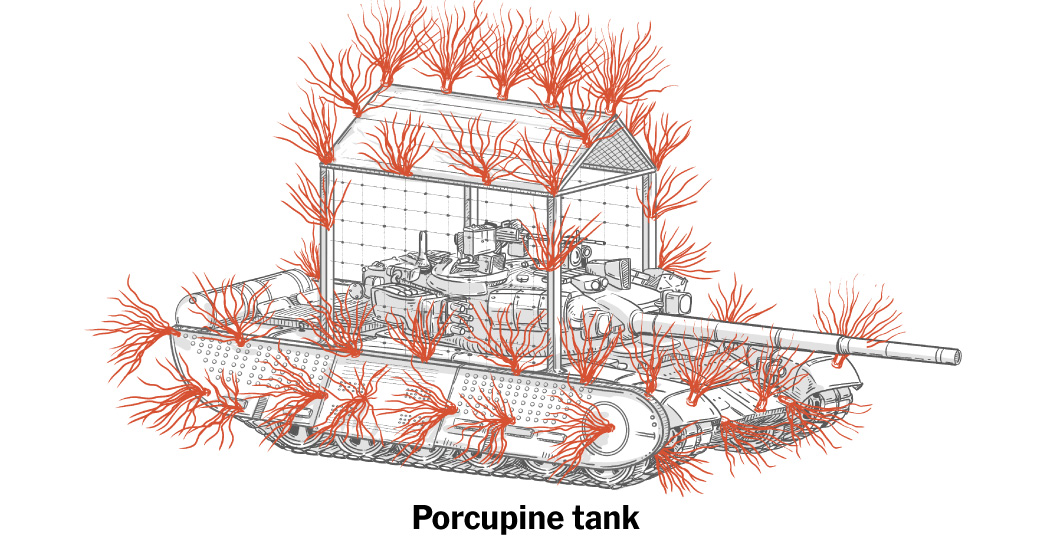
Now, Russia’s and Ukraine’s Soviet-era tanks rumble across the battlefield covered in anti-drone nets and spikes, dangling chains and unwieldy cages.
The exterior transformations of these hulking vehicles are a testament to how quickly drones have changed the war in Ukraine in just over three years. Lethal drones have pushed traditional missiles and artillery to the sidelines.
The armor changes began early in the war after Ukrainian forces used U.S.-supplied anti-tank missiles to strike Russian tanks directly from above, piercing weaker points in vehicles’ armor.
To counter the explosive projectiles, Russian tank crews began mounting homemade cages above their turrets to cushion the tanks from blasts. Other Russian units already had cages on their tanks, anticipating strikes from above.
Since then, the battlefield has completely changed. It is now driven by small, cheap first-person-view (F.P.V.) drones that can be used like homing missiles.
In response, both Ukrainian and Russian tanks have undergone transformations to address their vulnerabilities. Here’s how it happened:
1 Earlier in the war, anti-tank missiles and drones that dropped grenades primarily threatened tanks from above.
2 To protect the tanks from above, mechanics built structures on the tops. Then, soldiers began using F.P.V. drones to maneuver like homing projectiles into other vulnerable areas of the vehicles.
3 In response, tank crews learned to build their own defenses on the fly, like anti-drone netting, to protect themselves from other angles.
4 When signal jammers began disabling wireless drones, a new type of drone emerged, guided by fiber-optic cable. Soldiers then added spikes to tanks to catch the cables.
Since tanks were first widely introduced to cross the shell raked battlefield in World War I, their hulls and armor have stayed largely the same: Most protection was mounted on the front of the vehicle, where the crews believed the threat would materialize.
With the small, guided drones on the battlefield in Ukraine, the threat can come from any direction with a level of accuracy capable of hitting weak spots in the armor.
Configurations are rarely uniform, and it is difficult to pinpoint when these armor changes became widespread. But the outgrowth of these new types of protection has aligned with the proliferation of different types of drones, especially in 2023, when the F.P.V. drones became widespread on the battlefield.
Now, tanks are used in battle far less than in 2022. To maintain tanks’ relevance, Russian and Ukrainian soldiers have covered them in different configurations of armor as ad hoc solutions to rapidly shifting tactics.
Some of the first tank modifications came early in the war, when the main threats to military vehicles were Ukraine’s anti-tank missiles, supplied by the United States, and drones that dropped grenades.
Videos from early in the war show Russian troops modifying the T-72, one of Russia’s most widely used tanks in the Donbas in eastern Ukraine. This is what they added:
The Ukrainians also upgraded their tank armor as Russian drone numbers surged to match Ukraine’s homegrown fleet of lethal drones.
Much of the development, whether in bomb-dropping drones or F.P.V.s, came from Ukraine as Kyiv met Moscow’s much larger military by improvising with cheaper but equally deadly weapons.
The United States sent M1 Abrams battle tanks, long seen as the top of their class, to Ukraine in the fall of 2023. But the tanks were thrust into battle lacking the appropriate armor to defend against drones.
Once the Ukrainian troops realized that the American tank was susceptible to the same threats as their older Soviet models, they began to adapt the Abrams for the modern battlefield.
These are some of the modifications the Ukrainians have used:
The added protection can come with a cost: Cages, coverings and more armor mean it can be even harder for crews to see from their small hatches and windows.
So Ukrainian and Russian mechanics keep tinkering with their contraptions to keep the tanks in the fight.
As it stands, Ukraine’s 750-mile front line looks much different from three years ago. Fiber-optic cables line abandoned fields, and drones hunt individual soldiers at all hours of the day.
It is extremely dangerous to move large vehicles, especially tanks. A drone that cost several hundred dollars can quickly take out a multimillion-dollar tank.
At greater threat than three years ago, tanks are used far less in battle now, facing a combination of the proliferation of drones and legacy threats, such as landmines. But they remain important, especially for trying to take and hold territory. With their heavy firepower, they will continue to have a role in attacking, defending and supporting the foot soldiers of the infantry.